Story maps · Grades 8–12
The Importance of Being Earnest: A Story Map
The PDF is one tabloid page (11 × 17 in). On letter paper, choose “Fit to page.”
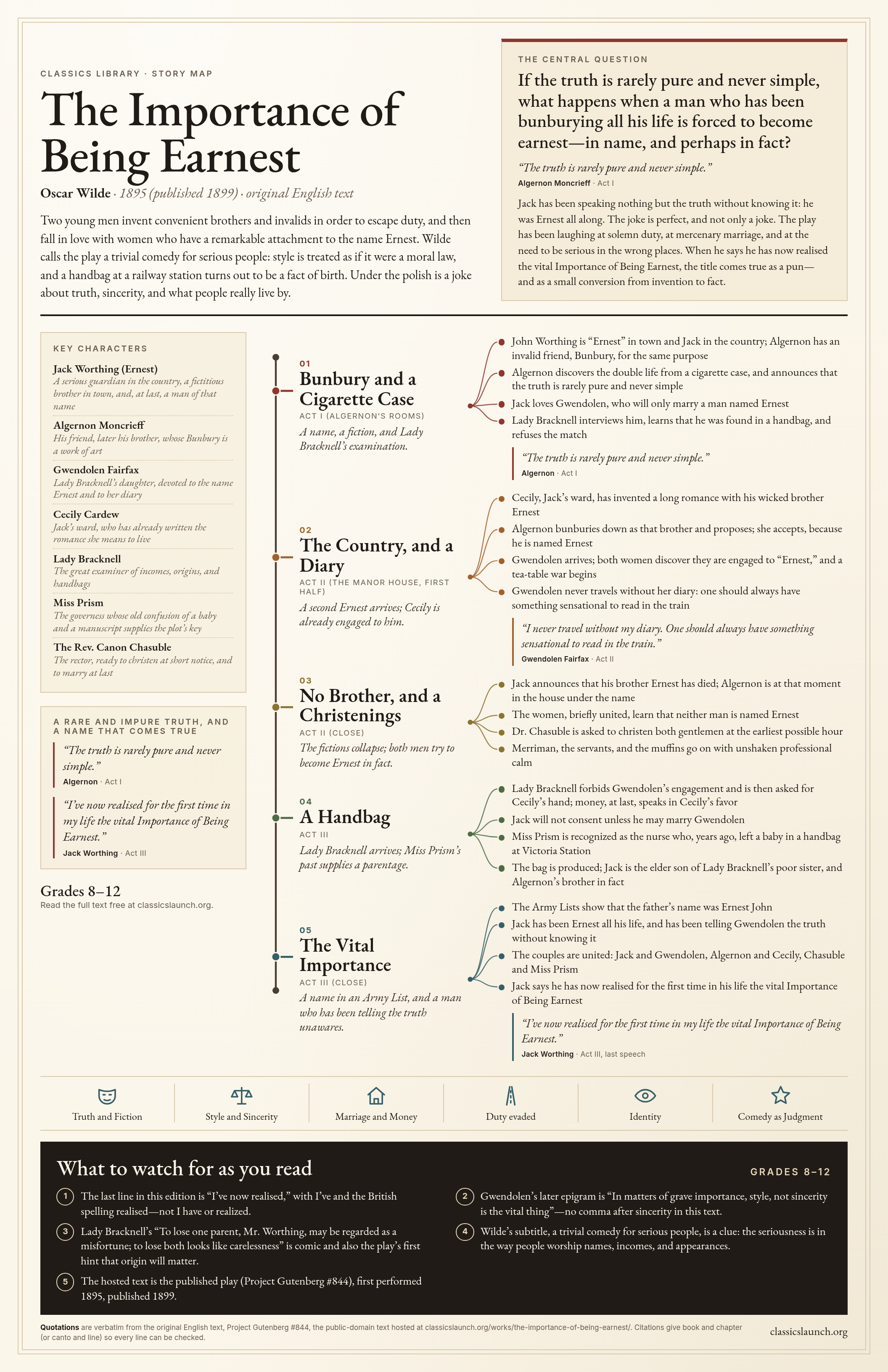
Two young men invent convenient brothers and invalids in order to escape duty, and then fall in love with women who have a remarkable attachment to the name Ernest. Wilde calls the play a trivial comedy for serious people: style is treated as if it were a moral law, and a handbag at a railway station turns out to be a fact of birth. Under the polish is a joke about truth, sincerity, and what people really live by.
The central question
If the truth is rarely pure and never simple, what happens when a man who has been bunburying all his life is forced to become earnest—in name, and perhaps in fact?
“The truth is rarely pure and never simple.”
Jack has been speaking nothing but the truth without knowing it: he was Ernest all along. The joke is perfect, and not only a joke. The play has been laughing at solemn duty, at mercenary marriage, and at the need to be serious in the wrong places. When he says he has now realised the vital Importance of Being Earnest, the title comes true as a pun—and as a small conversion from invention to fact.
- 01
Bunbury and a Cigarette Case
Act I (Algernon’s rooms)
A name, a fiction, and Lady Bracknell’s examination.
- John Worthing is “Ernest” in town and Jack in the country; Algernon has an invalid friend, Bunbury, for the same purpose
- Algernon discovers the double life from a cigarette case, and announces that the truth is rarely pure and never simple
- Jack loves Gwendolen, who will only marry a man named Ernest
- Lady Bracknell interviews him, learns that he was found in a handbag, and refuses the match
“The truth is rarely pure and never simple.”
- 02
The Country, and a Diary
Act II (the Manor House, first half)
A second Ernest arrives; Cecily is already engaged to him.
- Cecily, Jack’s ward, has invented a long romance with his wicked brother Ernest
- Algernon bunburies down as that brother and proposes; she accepts, because he is named Ernest
- Gwendolen arrives; both women discover they are engaged to “Ernest,” and a tea-table war begins
- Gwendolen never travels without her diary: one should always have something sensational to read in the train
“I never travel without my diary. One should always have something sensational to read in the train.”
- 03
No Brother, and a Christenings
Act II (close)
The fictions collapse; both men try to become Ernest in fact.
- Jack announces that his brother Ernest has died; Algernon is at that moment in the house under the name
- The women, briefly united, learn that neither man is named Ernest
- Dr. Chasuble is asked to christen both gentlemen at the earliest possible hour
- Merriman, the servants, and the muffins go on with unshaken professional calm
- 04
A Handbag
Act III
Lady Bracknell arrives; Miss Prism’s past supplies a parentage.
- Lady Bracknell forbids Gwendolen’s engagement and is then asked for Cecily’s hand; money, at last, speaks in Cecily’s favor
- Jack will not consent unless he may marry Gwendolen
- Miss Prism is recognized as the nurse who, years ago, left a baby in a handbag at Victoria Station
- The bag is produced; Jack is the elder son of Lady Bracknell’s poor sister, and Algernon’s brother in fact
- 05
The Vital Importance
Act III (close)
A name in an Army List, and a man who has been telling the truth unawares.
- The Army Lists show that the father’s name was Ernest John
- Jack has been Ernest all his life, and has been telling Gwendolen the truth without knowing it
- The couples are united: Jack and Gwendolen, Algernon and Cecily, Chasuble and Miss Prism
- Jack says he has now realised for the first time in his life the vital Importance of Being Earnest
“I’ve now realised for the first time in my life the vital Importance of Being Earnest.”
- Truth and Fiction
- Style and Sincerity
- Marriage and Money
- Duty evaded
- Identity
- Comedy as Judgment
What to watch for as you read
Grades 8–12- The last line in this edition is “I’ve now realised,” with I’ve and the British spelling realised—not I have or realized.
- Gwendolen’s later epigram is “In matters of grave importance, style, not sincerity is the vital thing”—no comma after sincerity in this text.
- Lady Bracknell’s “To lose one parent, Mr. Worthing, may be regarded as a misfortune; to lose both looks like carelessness” is comic and also the play’s first hint that origin will matter.
- Wilde’s subtitle, a trivial comedy for serious people, is a clue: the seriousness is in the way people worship names, incomes, and appearances.
- The hosted text is the published play (Project Gutenberg #844), first performed 1895, published 1899.
Every quotation is word for word from the original English text hosted in this library and is checked against that text each time the site is built. Citations give book and chapter (or canto and line).