Story maps · Grades 9–12
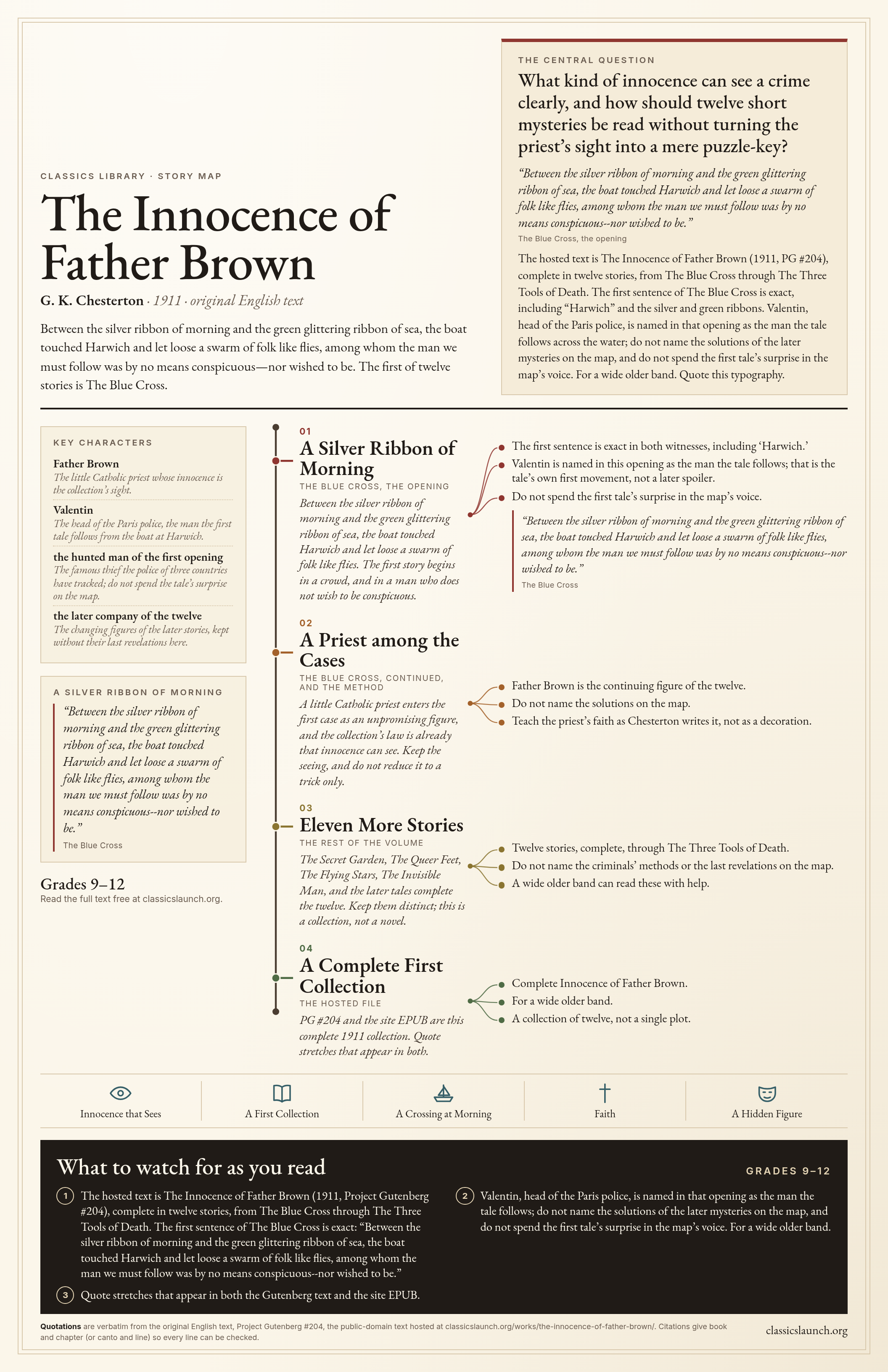
The Innocence of Father Brown: A Story Map
The PDF is one tabloid page (11 × 17 in). On letter paper, choose “Fit to page.”
Between the silver ribbon of morning and the green glittering ribbon of sea, the boat touched Harwich and let loose a swarm of folk like flies, among whom the man we must follow was by no means conspicuous—nor wished to be. The first of twelve stories is The Blue Cross.
The central question
What kind of innocence can see a crime clearly, and how should twelve short mysteries be read without turning the priest’s sight into a mere puzzle-key?
“Between the silver ribbon of morning and the green glittering ribbon of sea, the boat touched Harwich and let loose a swarm of folk like flies, among whom the man we must follow was by no means conspicuous--nor wished to be.”
The hosted text is The Innocence of Father Brown (1911, PG #204), complete in twelve stories, from The Blue Cross through The Three Tools of Death. The first sentence of The Blue Cross is exact, including “Harwich” and the silver and green ribbons. Valentin, head of the Paris police, is named in that opening as the man the tale follows across the water; do not name the solutions of the later mysteries on the map, and do not spend the first tale’s surprise in the map’s voice. For a wide older band. Quote this typography.
- 01
A Silver Ribbon of Morning
The Blue Cross, the opening
Between the silver ribbon of morning and the green glittering ribbon of sea, the boat touched Harwich and let loose a swarm of folk like flies. The first story begins in a crowd, and in a man who does not wish to be conspicuous.
- The first sentence is exact in both witnesses, including ‘Harwich.’
- Valentin is named in this opening as the man the tale follows; that is the tale’s own first movement, not a later spoiler.
- Do not spend the first tale’s surprise in the map’s voice.
“Between the silver ribbon of morning and the green glittering ribbon of sea, the boat touched Harwich and let loose a swarm of folk like flies, among whom the man we must follow was by no means conspicuous--nor wished to be.”
- 02
A Priest among the Cases
The Blue Cross, continued, and the method
A little Catholic priest enters the first case as an unpromising figure, and the collection’s law is already that innocence can see. Keep the seeing, and do not reduce it to a trick only.
- Father Brown is the continuing figure of the twelve.
- Do not name the solutions on the map.
- Teach the priest’s faith as Chesterton writes it, not as a decoration.
- 03
Eleven More Stories
The rest of the volume
The Secret Garden, The Queer Feet, The Flying Stars, The Invisible Man, and the later tales complete the twelve. Keep them distinct; this is a collection, not a novel.
- Twelve stories, complete, through The Three Tools of Death.
- Do not name the criminals’ methods or the last revelations on the map.
- A wide older band can read these with help.
- 04
A Complete First Collection
The hosted file
PG #204 and the site EPUB are this complete 1911 collection. Quote stretches that appear in both.
- Complete Innocence of Father Brown.
- For a wide older band.
- A collection of twelve, not a single plot.
- Innocence that Sees
- A First Collection
- A Crossing at Morning
- Faith
- A Hidden Figure
What to watch for as you read
Grades 9–12- The hosted text is The Innocence of Father Brown (1911, Project Gutenberg #204), complete in twelve stories, from The Blue Cross through The Three Tools of Death. The first sentence of The Blue Cross is exact: “Between the silver ribbon of morning and the green glittering ribbon of sea, the boat touched Harwich and let loose a swarm of folk like flies, among whom the man we must follow was by no means conspicuous--nor wished to be.”
- Valentin, head of the Paris police, is named in that opening as the man the tale follows; do not name the solutions of the later mysteries on the map, and do not spend the first tale’s surprise in the map’s voice. For a wide older band.
- Quote stretches that appear in both the Gutenberg text and the site EPUB.
Every quotation is word for word from the original English text hosted in this library and is checked against that text each time the site is built. Citations give book and chapter (or canto and line).