Story maps · Grades 9–12
The Island of Doctor Moreau: A Story Map
The PDF is one tabloid page (11 × 17 in). On letter paper, choose “Fit to page.”
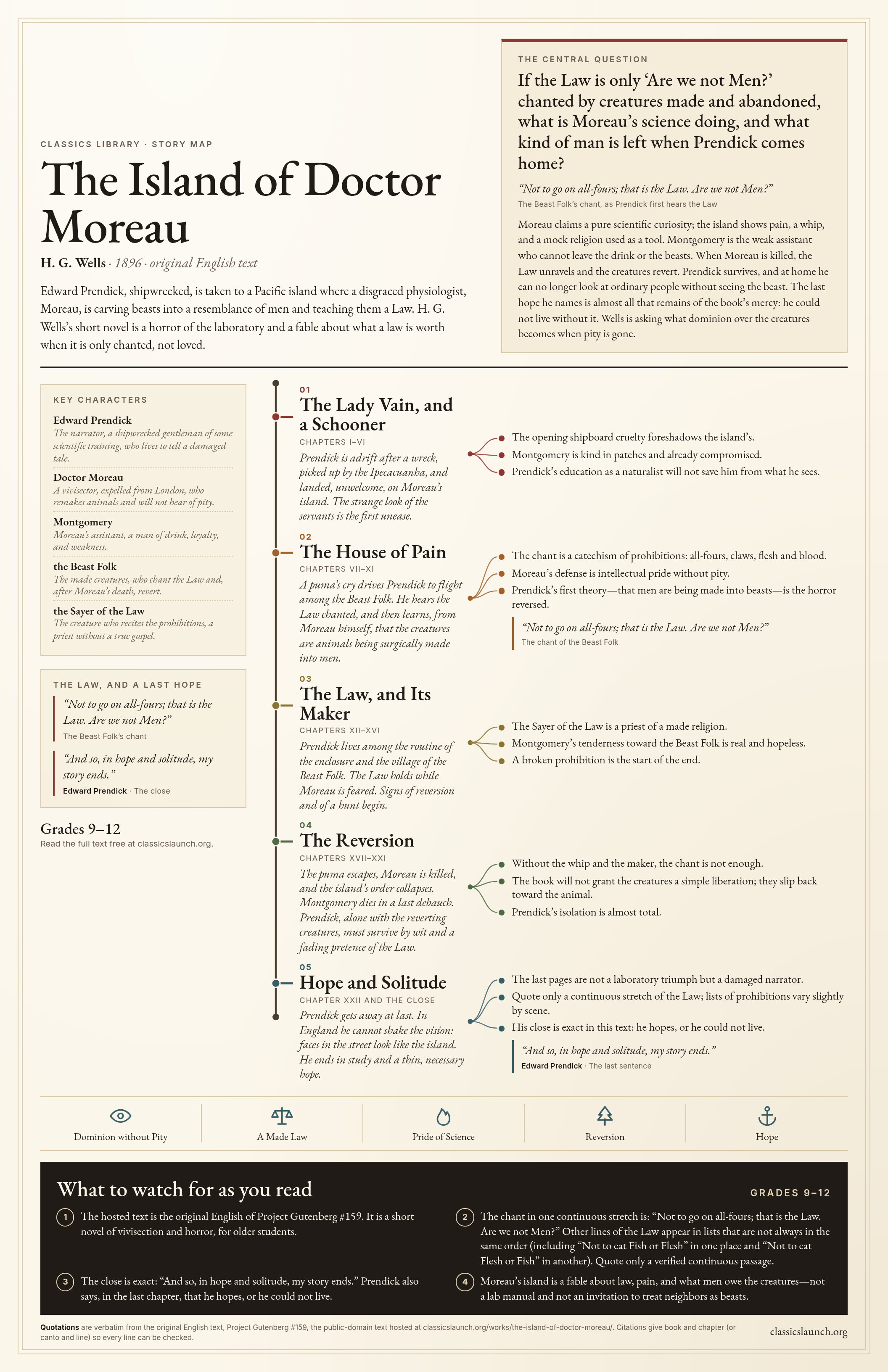
Edward Prendick, shipwrecked, is taken to a Pacific island where a disgraced physiologist, Moreau, is carving beasts into a resemblance of men and teaching them a Law. H. G. Wells’s short novel is a horror of the laboratory and a fable about what a law is worth when it is only chanted, not loved.
The central question
If the Law is only ‘Are we not Men?’ chanted by creatures made and abandoned, what is Moreau’s science doing, and what kind of man is left when Prendick comes home?
“Not to go on all-fours; that is the Law. Are we not Men?”
Moreau claims a pure scientific curiosity; the island shows pain, a whip, and a mock religion used as a tool. Montgomery is the weak assistant who cannot leave the drink or the beasts. When Moreau is killed, the Law unravels and the creatures revert. Prendick survives, and at home he can no longer look at ordinary people without seeing the beast. The last hope he names is almost all that remains of the book’s mercy: he could not live without it. Wells is asking what dominion over the creatures becomes when pity is gone.
- 01
The Lady Vain, and a Schooner
Chapters I–VI
Prendick is adrift after a wreck, picked up by the Ipecacuanha, and landed, unwelcome, on Moreau’s island. The strange look of the servants is the first unease.
- The opening shipboard cruelty foreshadows the island’s.
- Montgomery is kind in patches and already compromised.
- Prendick’s education as a naturalist will not save him from what he sees.
- 02
The House of Pain
Chapters VII–XI
A puma’s cry drives Prendick to flight among the Beast Folk. He hears the Law chanted, and then learns, from Moreau himself, that the creatures are animals being surgically made into men.
- The chant is a catechism of prohibitions: all-fours, claws, flesh and blood.
- Moreau’s defense is intellectual pride without pity.
- Prendick’s first theory—that men are being made into beasts—is the horror reversed.
“Not to go on all-fours; that is the Law. Are we not Men?”
- 03
The Law, and Its Maker
Chapters XII–XVI
Prendick lives among the routine of the enclosure and the village of the Beast Folk. The Law holds while Moreau is feared. Signs of reversion and of a hunt begin.
- The Sayer of the Law is a priest of a made religion.
- Montgomery’s tenderness toward the Beast Folk is real and hopeless.
- A broken prohibition is the start of the end.
- 04
The Reversion
Chapters XVII–XXI
The puma escapes, Moreau is killed, and the island’s order collapses. Montgomery dies in a last debauch. Prendick, alone with the reverting creatures, must survive by wit and a fading pretence of the Law.
- Without the whip and the maker, the chant is not enough.
- The book will not grant the creatures a simple liberation; they slip back toward the animal.
- Prendick’s isolation is almost total.
- 05
Hope and Solitude
Chapter XXII and the close
Prendick gets away at last. In England he cannot shake the vision: faces in the street look like the island. He ends in study and a thin, necessary hope.
- The last pages are not a laboratory triumph but a damaged narrator.
- Quote only a continuous stretch of the Law; lists of prohibitions vary slightly by scene.
- His close is exact in this text: he hopes, or he could not live.
“And so, in hope and solitude, my story ends.”
- Dominion without Pity
- A Made Law
- Pride of Science
- Reversion
- Hope
What to watch for as you read
Grades 9–12- The hosted text is the original English of Project Gutenberg #159. It is a short novel of vivisection and horror, for older students.
- The chant in one continuous stretch is: “Not to go on all-fours; that is the Law. Are we not Men?” Other lines of the Law appear in lists that are not always in the same order (including “Not to eat Fish or Flesh” in one place and “Not to eat Flesh or Fish” in another). Quote only a verified continuous passage.
- The close is exact: “And so, in hope and solitude, my story ends.” Prendick also says, in the last chapter, that he hopes, or he could not live.
- Moreau’s island is a fable about law, pain, and what men owe the creatures—not a lab manual and not an invitation to treat neighbors as beasts.
Every quotation is word for word from the original English text hosted in this library and is checked against that text each time the site is built. Citations give book and chapter (or canto and line).