Story maps · Grades 11–12
The Last Day of a Condemned Man: A Story Map
The PDF is one tabloid page (11 × 17 in). On letter paper, choose “Fit to page.”
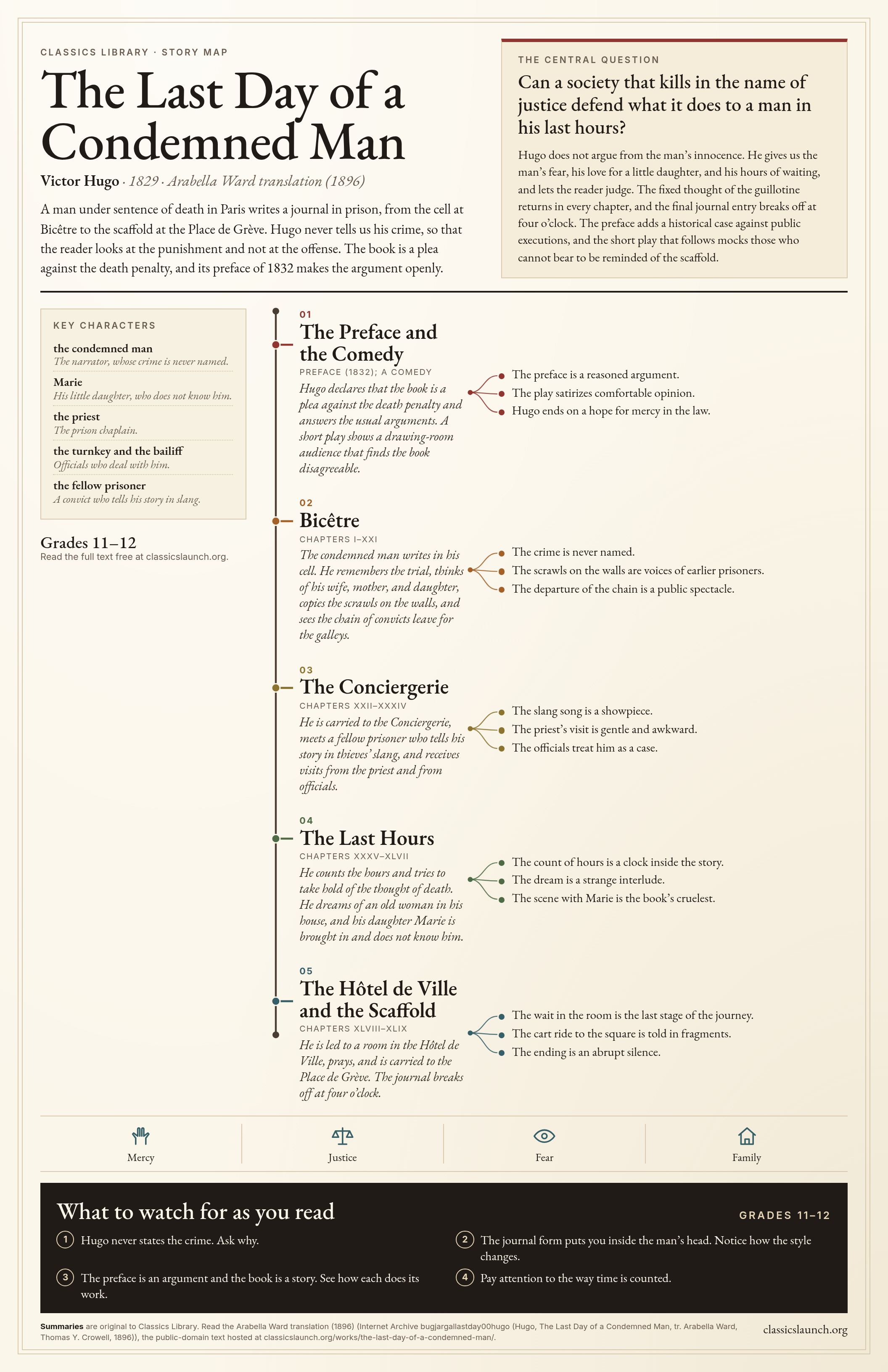
A man under sentence of death in Paris writes a journal in prison, from the cell at Bicêtre to the scaffold at the Place de Grève. Hugo never tells us his crime, so that the reader looks at the punishment and not at the offense. The book is a plea against the death penalty, and its preface of 1832 makes the argument openly.
The central question
Can a society that kills in the name of justice defend what it does to a man in his last hours?
Hugo does not argue from the man’s innocence. He gives us the man’s fear, his love for a little daughter, and his hours of waiting, and lets the reader judge. The fixed thought of the guillotine returns in every chapter, and the final journal entry breaks off at four o’clock. The preface adds a historical case against public executions, and the short play that follows mocks those who cannot bear to be reminded of the scaffold.
- 01
The Preface and the Comedy
Preface (1832); A Comedy
Hugo declares that the book is a plea against the death penalty and answers the usual arguments. A short play shows a drawing-room audience that finds the book disagreeable.
- The preface is a reasoned argument.
- The play satirizes comfortable opinion.
- Hugo ends on a hope for mercy in the law.
- 02
Bicêtre
Chapters I–XXI
The condemned man writes in his cell. He remembers the trial, thinks of his wife, mother, and daughter, copies the scrawls on the walls, and sees the chain of convicts leave for the galleys.
- The crime is never named.
- The scrawls on the walls are voices of earlier prisoners.
- The departure of the chain is a public spectacle.
- 03
The Conciergerie
Chapters XXII–XXXIV
He is carried to the Conciergerie, meets a fellow prisoner who tells his story in thieves’ slang, and receives visits from the priest and from officials.
- The slang song is a showpiece.
- The priest’s visit is gentle and awkward.
- The officials treat him as a case.
- 04
The Last Hours
Chapters XXXV–XLVII
He counts the hours and tries to take hold of the thought of death. He dreams of an old woman in his house, and his daughter Marie is brought in and does not know him.
- The count of hours is a clock inside the story.
- The dream is a strange interlude.
- The scene with Marie is the book’s cruelest.
- 05
The Hôtel de Ville and the Scaffold
Chapters XLVIII–XLIX
He is led to a room in the Hôtel de Ville, prays, and is carried to the Place de Grève. The journal breaks off at four o’clock.
- The wait in the room is the last stage of the journey.
- The cart ride to the square is told in fragments.
- The ending is an abrupt silence.
- Mercy
- Justice
- Fear
- Family
What to watch for as you read
Grades 11–12- Hugo never states the crime. Ask why.
- The journal form puts you inside the man’s head. Notice how the style changes.
- The preface is an argument and the book is a story. See how each does its work.
- Pay attention to the way time is counted.
Every quotation is word for word from the Arabella Ward translation (1896) hosted in this library and is checked against that text each time the site is built. Citations give book and chapter (or canto and line).