Work record
The Last Day of a Condemned Man (Le Dernier Jour d'un condamné)
Victor HugoLe Dernier Jour d'un condamné; The Last Day of a Condemned; Last Day of a Condemned Man; Hugo's Condemned Man; Dernier jour d'un condamnéThe Last Day of a Condemned Man (Le Dernier Jour d'un condamné) by Victor Hugo (1829)The Last Day of a Condemned Man is a short novel in the form of a journal, written by a man under sentence of death in the Paris of the 1820s.Also known as: Le Dernier Jour d'un condamné · The Last Day of a Condemned · Last Day of a Condemned Man · Hugo's Condemned Man · Dernier jour d'un condamné
1829 · 19th Century · Novella · French
Read this when the law's heaviest penalty needs a human face and a plain argument.
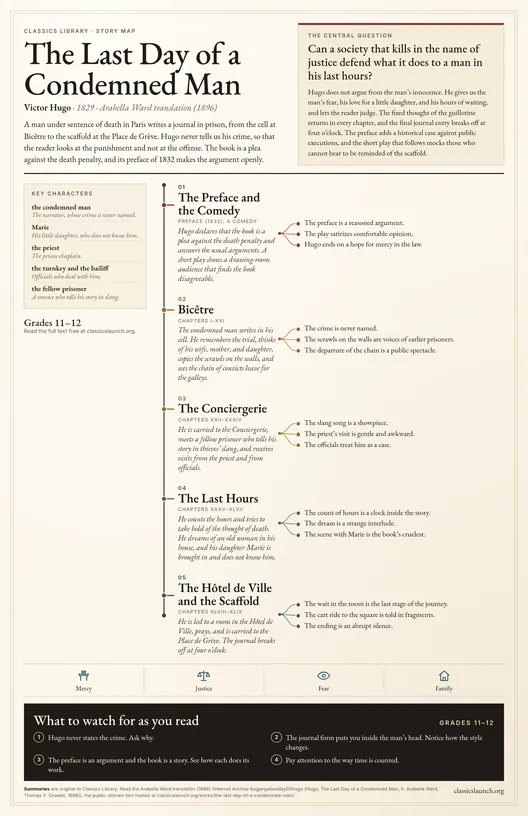 Story mapSee the story mapThe whole book on one page: the story in movements, the characters, and what to watch for. Free to print.
Abstract
Background. A young French poet wrote this book in 1828 and published it the next year, at a time when criminals were still put to death in public. He added a preface in 1832 to say what he meant.
Plot. A prisoner under sentence of death writes down his thoughts, from the courtroom to the cart that takes him to the scaffold. His crime is never told, but his love for his small daughter is, and the reader waits with him for the last hour.
Structure. The work is a diary of short chapters that grow shorter as the end comes, framed by an argumentative preface and by a mock drawing-room play that answers the critics.
Themes. The book dwells on mercy, the worth of one human life, the claims of a child, and the question of what a society may do in the name of order. It also records how a mind behaves when it is bound to one dreadful thought.
Significance. Hugo's plea became one of the best known statements of the case against the penalty, and France ended the practice only in 1981. The novel is still read as a study of fear, of conscience and of the limits of the state.
Main characters
- The condemned man: Nameless prisoner who keeps the journal
- Marie: His daughter, aged three
- The priest: The chaplain who attends him to the end
- The convict: A fellow prisoner who tells his tale in slang
Summary
The Last Day of a Condemned Man is a short novel in the form of a journal, written by a man under sentence of death in the Paris of the 1820s. It begins five weeks after his sentence. He never says what his crime was, and Hugo leaves that out on purpose, so that the reader looks at the punishment and not at the offence. The man writes in the prison at Bicêtre, in the Conciergerie and at last in the Hôtel de Ville, where the condemned wait for the cart. He remembers the trial, the chain of convicts who set out for the galleys, the slang of the prison, and the visits of the priest and the officials. Two fixed ideas hold him. One is the thought of the guillotine, which comes back in every chapter. The other is his three-year-old daughter Marie, who is brought to see him in the last hours and does not know him, for she has been told that her father is dead. In the closing chapters the clock runs down to four in the afternoon, the hour set for the execution on the Place de Grève. Hugo added a preface in 1832 in which he said plainly that the book was a plea against capital punishment, answering critics who had asked who the prisoner was and what the point of the tale might be. He also wrote a short comedy, printed in this edition, in which fashionable guests in a drawing-room discuss the book and show how little they have understood it. The preface goes through the arguments commonly made for the death penalty, such as deterrence and the removal of the dangerous, and replies to each of them from history and reason. It ends with a hope that the gentle law of Christ would enter the criminal law and that the cross would take the place of the gallows. For a classical Christian course the book is useful on the question of mercy and the magistrate's authority. Students can set Hugo's appeal beside Paul's teaching in Romans 13 that the ruler bears the sword, and beside the church's long reflection on mercy and on the sanctity of life, and they can ask whether his argument is sound. The text is Arabella Ward's 1896 English translation. It contains scenes of imprisonment, grief and a public execution, so it is best suited to the oldest students.
Virtues in this work
- Justice: Hugo asks what a just society may do to a man who has done wrong and presses the claim that punishment must not become vengeance.
- Charity: The prisoner's thoughts turn again and again to his child and mother, and the book asks for a mercy that looks on the condemned as a neighbour.
- Fortitude: The prisoner struggles to keep his courage as the hour comes, and the journal shows how hard it is to face death with a steady mind.
Plot or Argument
- The preface of 1832
Hugo declares that the book is a plea against the death penalty, rehearses the history of public executions in France, and answers the usual arguments for the penalty. He ends on a hope that Christian mercy will enter the law.
- A Comedy (Apropos of a Tragedy)
In a short play, guests at a fashionable drawing-room dispute the book. They want a book that is agreeable and cannot bear to be reminded of the scaffold, and Hugo shows their idle talk beside his subject.
- Bicêtre (Chapters I–XXI)
The condemned man writes in his cell. He remembers the trial, thinks of his wife, his mother and his daughter, copies the scrawls on the walls, and sees the chain of convicts leave for the galleys.
- The Conciergerie (Chapters XXII–XXXIV)
He is carried to the prison of the Conciergerie, meets a fellow prisoner who tells his story in the slang of thieves, and receives the visits of the priest and of the men who come to take his measure.
- The last hours (Chapters XXXV–XLVII)
The prisoner counts the hours and tries to take hold of the thought of death. He has a dream of an old woman found in his own house, and then his daughter Marie is brought in and does not know him.
- The Hôtel de Ville and the scaffold (Chapters XLVIII–XLIX)
He is led to a room in the Hôtel de Ville, prays, and is carried to the Place de Grève. The journal breaks off at four o'clock.
Characters
- The condemned man, narrator
An unnamed prisoner under sentence of death, whose crime is never told; he writes his journal from the day of the sentence to the hour of execution.
- Marie, his daughter
A child of three who is brought to see him in the last hours and does not know him.
- The priest, prison chaplain
A kind but ordinary clergyman who comes to prepare the prisoner and who rides with him on the cart.
- The turnkey and the bailiff, officials
The men who carry out the routine of the prison and are shown as neither cruel nor moved.
- The fellow prisoner, convict
A man in the Conciergerie who tells his own tale in thieves' slang.
Lessons
Mercy and the magistrate
Hugo asks whether a society may take a life as a lesson to others. Students should state his case fairly, then weigh it against the Christian teaching that the ruler bears the sword (Romans 13) and against the church's long habit of speaking for mercy, so that they see a grave question argued on both sides and do not take either side on feeling.
- What reasons for the penalty does the preface answer, and how does it answer each?
- What does Romans 13 add that Hugo does not discuss?
The sanctity of human life
The book keeps the reader with one man through his last hours, and the effect is to make the weight of a single life felt. A Christian student can see in this the teaching that every person is made in the image of God, while asking whether that teaching settles what the law should do.
- Why does Hugo leave out the prisoner's crime and name?
- How does the child Marie change the way we read the journal?
Use of the last hours
The prisoner counts the time that is left and cannot use it. The book can start a talk on how time should be used by one who knows that his days are numbered, which Psalm 90 puts as a prayer for wisdom of heart.
- What does the prisoner do with the hours he has?
- What would a Christian do differently with them, and why?
A reader's caution on how Hugo argues
Hugo wrote as a poet and a political writer, and the book works through feeling as much as through reasons. Teachers should ask students to separate the argument of the preface from the effect of the story, since each can be right or wrong apart from the other.
- Which part of the book is argument, and which part is picture?
- Is a moving story a proof?
Context
The story is set in the France of the Restoration, when executions were still carried out in public on the Place de Grève by the guillotine, and when convicts were chained together at Bicêtre and sent in a procession to the galleys at Toulon. Public opinion about the death penalty was divided, and in 1830 and the years after it the Chamber of Deputies heard proposals to abolish it for political crimes.
Composition
Hugo wrote the book in 1828 and published it in February 1829 without his name. He added a preface in 1832, dated March 15, and the comedy that answers the critics. The note of 1881 in this edition records the dates written on the original manuscript, October 14 to December 25–26, 1828. In later years he spoke against the penalty in the legislature.
Reception
The novel was praised by writers who shared Hugo's cause and attacked by critics who thought it a political tract. It has been read in schools in France for generations and has been translated many times. The Ward translation of 1896 was printed in New York with Hugo's early novel Bug-Jargal.
Comparisons
- Les Misérables
Hugo's great novel returns to the same subject in Javert and Jean Valjean, and Valjean's years in the galleys and the chain of convicts at Bicêtre recall the prison world of this earlier book.
- On Crimes and Punishments
Beccaria's 1764 treatise is the chief source of the argument against the death penalty that Hugo restates in his preface, though Beccaria writes as a lawyer and Hugo as a poet.
- Crime and Punishment
Dostoevsky shows a murderer's mind from within, as Hugo does for a nameless prisoner; the Russian author sets the whole weight on guilt and conversion, while Hugo leaves the crime unspoken.
- The Idiot
Prince Myshkin tells of watching a guillotine execution and of the thoughts of the condemned man, a scene that owes much to Hugo's book.
- The Hunchback of Notre-Dame (Notre-Dame de Paris)
Hugo's earlier novel of 1831 shows the justice of the late Middle Ages and ends at a gibbet, and the two works share an interest in the fate of the outcast.
- Oliver Twist
Dickens, who attended a public hanging and wrote against the custom, depicts Fagin's last night in the condemned cell with the same attention to a man's final hours.
Quotes
Frequently cited
“For five weeks this thought has dwelt within me, and this alone, congealing my blood, bearing me down beneath its weight!”
Frequently cited
“To avenge belongs to the individual; punishment, to God.”
“The gentle law of Christ will penetrate our laws after a while, and will shine through them.”
“The cross will take the place of the gallows.”
“Oh, if the jury had only seen my little Marie, they would have understood that they must not kill the father of a baby three years old!”
“Only three steps remain for me, — Bicêtre, the Conciergerie, La Grève.”
“Marie, I am your papa.”
“Pity me, O my God!”
For Students
A reading companion for classical Christian high school students. See the student guide.
Reading Guide
Watch for
- What the narrator tells us about himself and what Hugo keeps back.
- Each time the prisoner thinks of his daughter, and what he fears for her.
- How the other prisoners, the guards and the officials treat the man, and what they say.
- How the length of the chapters changes as the hours run out.
Key terms and names
- Bicêtre
- The old prison and hospital south of Paris where the condemned wait and where the chain of convicts was made up.
- The Conciergerie
- The prison on the Île de la Cité to which the prisoner is moved before his execution.
- Place de Grève
- The square before the Hôtel de Ville at Paris where executions were carried out in public.
- Argot
- The slang of thieves and prisoners, which Hugo uses in a song and in a convict's tale.
- Writ of error (pourvoi)
- The appeal to the court of cassation, which the prisoner awaits and which is rejected.
- The chain (la chaîne)
- The line of convicts shackled together and sent on foot to the galleys at Toulon.
Seminar Questions
- Comprehension What do we learn about the narrator's life and family, and what does Hugo leave out?
- Comprehension Describe the scene in the courtyard at Bicêtre when the convicts set out for the galleys.
- Comprehension What happens when the prisoner's daughter is brought to see him?
- Interpretation Why might Hugo have chosen not to name the crime or the man?
- Interpretation How does the comedy that follows the preface shape the way we read the novel?
- Interpretation What does the preface say about the hangman, the crowd and the judges, and how does it describe their part?
- Big Question May the state rightly put a murderer to death? State the strongest case for each side, using Romans 13 and the text.
- Big Question What does a man owe to the days that are left to him when he knows how many they are?
Faith Connections
- Romans 13:1-4 (Scripture)
Paul teaches that the ruler does not bear the sword in vain, which is the strongest text in the Christian tradition for the lawful power of the state to punish; Hugo's preface does not meet it directly.
- Ezekiel 33:11 (Scripture)
God says that he has no pleasure in the death of the wicked but that the wicked turn from his way and live; the verse is often cited by those who speak for mercy and a time for repentance.
- Luke 23:39-43 (Scripture)
The repentant thief on the cross is promised paradise, and Christian writers have drawn from this the duty to give the condemned time and a priest, which is the care the chaplain tries to show.
Logic and Rhetoric
Central argument: A society that kills a man in cold blood to set an example does not repair the harm of the crime or deter others, and it does a wrong of its own; therefore the penalty should be replaced by imprisonment and correction, in the hope that the mercy of Christ will govern the law.
Rhetorical device: narrative as argument. Hugo gives the prisoner no name and no crime, so that the reader is held to the experience of the sentence and cannot turn away to the question of guilt.
Debate: Resolved: That a Christian state should abolish the death penalty.
Memory Work
To avenge belongs to the individual; punishment, to God.
The gentle law of Christ will penetrate our laws after a while, and will shine through them.
Writing Prompts
Essay: Using at least three passages from the preface or the journal, explain Hugo's argument against the death penalty and say whether a Christian student should accept it.
Comparison with Les Misérables: Compare the way Hugo treats the criminal and the law in this short book with his treatment of Jean Valjean and Javert, and say what the later novel adds.
Medical Lens
The journal is a study of the mind of a man who expects to die on a fixed day. It shows a single idea that fills the thoughts, sleeplessness, nightmares, and sudden changes from calm to panic, and Hugo treats the fixed idea as a kind of illness. In the preface he says that crime ought to be regarded as a malady with physicians instead of judges and hospitals instead of prisons, which is a statement of a penal theory and not of modern medicine. The book is a useful literary source on the psychology of the condemned and on 19th-century views of crime as a disease.
- Chapter I
The prisoner describes a single thought that dominates his mind and his body since the sentence.
- Chapters XXXVIII and XLII
A violent pain in the head and a feverish dread at the quarter-hour, then a nightmare of an old woman in his own house.
- Preface
Hugo proposes that crime be treated as a disease and that hospitals take the place of prisons.
Creative Prompts
- Essay
Read the preface of 1832 and state in your own words three arguments for the death penalty that Hugo answers. Then say which of his answers is strongest and which is weakest, and why.
- Dialogue
Write a conversation between the prison chaplain and the condemned man in which the priest tries to prepare him and the prisoner asks what the church says about mercy and the state.
- Classroom
Hold a class debate on the resolution that the state may lawfully put a murderer to death. One side should argue from Romans 13 and the Christian tradition, and the other from the sanctity of life and Hugo's case, and both must use passages from the text.
- Fiction
Write a journal entry for the child Marie, years later, remembering the day she was brought to see a man she did not know.
Further Reading
- Les Misérables, Victor Hugo
Hugo's great novel of law, mercy and redemption, in this library.
- On Crimes and Punishments, Cesare Beccaria
The 1764 treatise that began the modern argument against capital punishment, in this library.
- Victor Hugo, Graham Robb
A modern life of Hugo, with an account of his campaign against the death penalty.
- Reflections on the Guillotine, Albert Camus
A 1957 essay against capital punishment that opens with a reference to this kind of public execution; a modern, still-copyrighted work, so a teacher should read it first.
Verification notes
The text is Arabella Ward's 1896 English translation as printed in Bug-Jargal, The Last Day of a Condemned Man and Other Stories (New York: Thomas Y. Crowell), cleaned from the Internet Archive OCR with the running page heads and stray marks removed and the translator's and author's notes kept in place. The book is a historical source and not a modern edition, and a few OCR slips may remain, including one doubtful word in Chapter XXIII, where a garbled word was read as 'or'. Every quotation in this file was matched to the hosted text. The publication date of 1829 and the dates of the prefaces follow standard reference works.
- The statement that France abolished capital punishment in 1981 follows standard accounts and was not checked here.
- The first publication in February 1829 and the dates of the preface of 1832 and the note of 1881 follow standard reference works and were not checked against a first edition.
- One garbled word in Chapter XXIII (printed 'cr') was supplied as 'or' by guess and should be checked against another printing.
- The Camus essay is cited from memory and should be checked before it is assigned.
- Whether Dickens saw the execution that led him to write against public hanging is a matter of biographical report and should be checked.