Story maps · Grades 10–12
The Mahabharata: A Story Map
The PDF is one tabloid page (11 × 17 in). On letter paper, choose “Fit to page.”
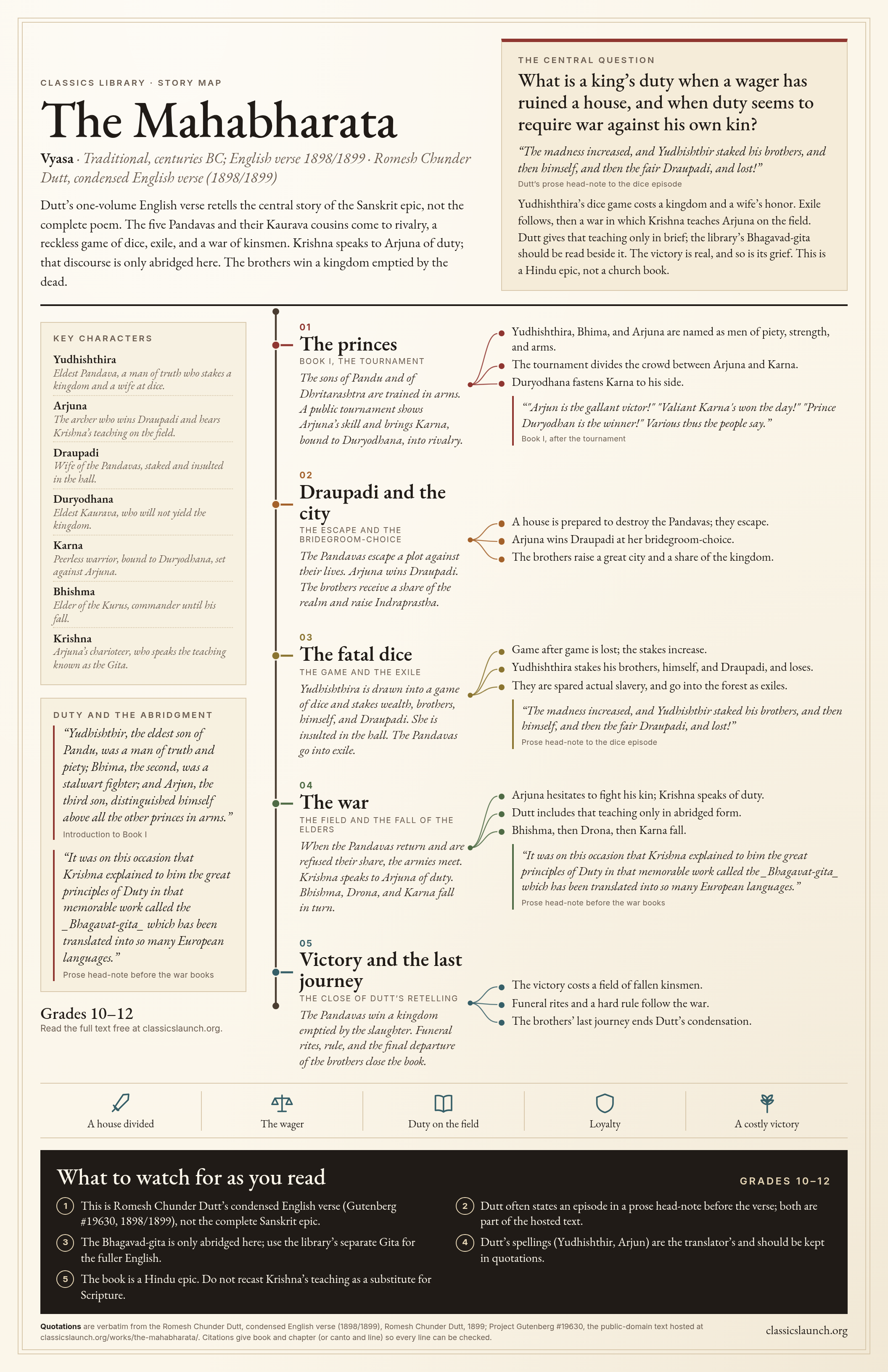
Dutt’s one-volume English verse retells the central story of the Sanskrit epic, not the complete poem. The five Pandavas and their Kaurava cousins come to rivalry, a reckless game of dice, exile, and a war of kinsmen. Krishna speaks to Arjuna of duty; that discourse is only abridged here. The brothers win a kingdom emptied by the dead.
The central question
What is a king’s duty when a wager has ruined a house, and when duty seems to require war against his own kin?
“The madness increased, and Yudhishthir staked his brothers, and then himself, and then the fair Draupadi, and lost!”
Yudhishthira’s dice game costs a kingdom and a wife’s honor. Exile follows, then a war in which Krishna teaches Arjuna on the field. Dutt gives that teaching only in brief; the library’s Bhagavad-gita should be read beside it. The victory is real, and so is its grief. This is a Hindu epic, not a church book.
- 01
The princes
Book I, the tournament
The sons of Pandu and of Dhritarashtra are trained in arms. A public tournament shows Arjuna’s skill and brings Karna, bound to Duryodhana, into rivalry.
- Yudhishthira, Bhima, and Arjuna are named as men of piety, strength, and arms.
- The tournament divides the crowd between Arjuna and Karna.
- Duryodhana fastens Karna to his side.
“"Arjun is the gallant victor!" "Valiant Karna's won the day!" "Prince Duryodhan is the winner!" Various thus the people say.”
- 02
Draupadi and the city
The escape and the bridegroom-choice
The Pandavas escape a plot against their lives. Arjuna wins Draupadi. The brothers receive a share of the realm and raise Indraprastha.
- A house is prepared to destroy the Pandavas; they escape.
- Arjuna wins Draupadi at her bridegroom-choice.
- The brothers raise a great city and a share of the kingdom.
- 03
The fatal dice
The game and the exile
Yudhishthira is drawn into a game of dice and stakes wealth, brothers, himself, and Draupadi. She is insulted in the hall. The Pandavas go into exile.
- Game after game is lost; the stakes increase.
- Yudhishthira stakes his brothers, himself, and Draupadi, and loses.
- They are spared actual slavery, and go into the forest as exiles.
“The madness increased, and Yudhishthir staked his brothers, and then himself, and then the fair Draupadi, and lost!”
- 04
The war
The field and the fall of the elders
When the Pandavas return and are refused their share, the armies meet. Krishna speaks to Arjuna of duty. Bhishma, Drona, and Karna fall in turn.
- Arjuna hesitates to fight his kin; Krishna speaks of duty.
- Dutt includes that teaching only in abridged form.
- Bhishma, then Drona, then Karna fall.
“It was on this occasion that Krishna explained to him the great principles of Duty in that memorable work called the _Bhagavat-gita_ which has been translated into so many European languages.”
- 05
Victory and the last journey
The close of Dutt’s retelling
The Pandavas win a kingdom emptied by the slaughter. Funeral rites, rule, and the final departure of the brothers close the book.
- The victory costs a field of fallen kinsmen.
- Funeral rites and a hard rule follow the war.
- The brothers’ last journey ends Dutt’s condensation.
- A house divided
- The wager
- Duty on the field
- Loyalty
- A costly victory
What to watch for as you read
Grades 10–12- This is Romesh Chunder Dutt’s condensed English verse (Gutenberg #19630, 1898/1899), not the complete Sanskrit epic.
- Dutt often states an episode in a prose head-note before the verse; both are part of the hosted text.
- The Bhagavad-gita is only abridged here; use the library’s separate Gita for the fuller English.
- Dutt’s spellings (Yudhishthir, Arjun) are the translator’s and should be kept in quotations.
- The book is a Hindu epic. Do not recast Krishna’s teaching as a substitute for Scripture.
Every quotation is word for word from the Romesh Chunder Dutt, condensed English verse (1898/1899) hosted in this library and is checked against that text each time the site is built. Citations give book and chapter (or canto and line).