Work record
The Mahabharata
VyasaMahabharata; The Maha-bharata; The Epic of the BharatasThe Mahabharata by Vyasa (Traditional, centuries BC)The Mahabharata is the great Sanskrit epic of the Bharata war, traditionally ascribed to Vyasa, and far longer in its full form than any one English book can hold.Also known as: Mahabharata · The Maha-bharata · The Epic of the Bharatas
Traditional, centuries BC; English verse 1898/1899 · Ancient · Epic · Sanskrit
Read this when a family quarrel becomes a war that none can leave.
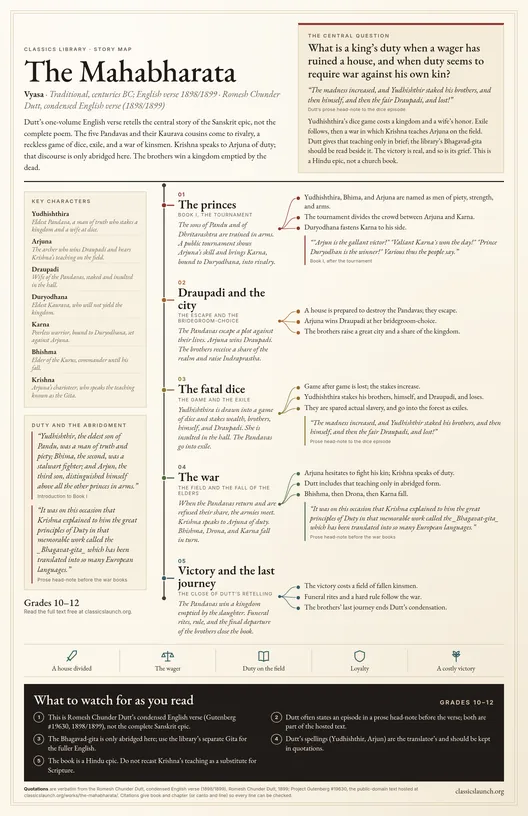 Story mapSee the story mapThe whole book on one page: the story in movements, the characters, and what to watch for. Free to print.
Abstract
Background. The Mahabharata is India’s vast war epic, traditionally ascribed to Vyasa. This page hosts Romesh Chunder Dutt’s public-domain condensation of 1898 and 1899 (Gutenberg #19630). It is a one-volume verse retelling, not the complete Sanskrit work. Dutt wrote so that English readers might know the central story in a single book.
Plot. The five Pandavas and their Kaurava cousins come to rivalry, a reckless game of dice, exile, and a war in which kinsmen fall. Krishna speaks to Arjuna of duty; that discourse is given only in brief here, and a fuller English of the Gita is hosted separately. Bhishma, Drona, and Karna fall before the brothers hold a kingdom emptied by the dead.
Ideas. The poem asks what a king owes to truth, to a wife’s honor, and to kin he must meet in battle. The cost of a wager, and the grief of a victory over cousins, stand at the center. A Christian class can follow those questions honestly and should not recast this Hindu epic as a church allegory or as a stand-in for Scripture.
Text. Dutt’s English is in the public domain in the United States. He abridges freely and often states an episode in prose before the verse. Students should know they are reading a skillful condensation, and should use the library’s Gita and Ramayana beside it.
Main characters
- Yudhishthira: eldest Pandava, whose dice game costs a kingdom
- Arjuna: the archer who hears Krishna’s teaching on the field
- Draupadi: wife of the Pandavas, staked and insulted in the hall
Summary
The Mahabharata is the great Sanskrit epic of the Bharata war, traditionally ascribed to Vyasa, and far longer in its full form than any one English book can hold. This page hosts Romesh Chunder Dutt’s condensed English verse, first published in December 1898 and reissued in June 1899, which retells the main story in a single volume and does not pretend to be the complete poem. The five Pandava brothers—Yudhishthira, Bhima, Arjuna, Nakula, and Sahadeva—are raised with their cousins, the hundred Kauravas, under the blind king Dhritarashtra. Rivalry hardens. A house of lac is prepared to burn the Pandavas; they escape, and Arjuna wins Draupadi at her bridegroom-choice. The brothers receive a share of the kingdom and raise Indraprastha. Then, in a fatal game of dice, Yudhishthira stakes and loses wealth, brothers, himself, and Draupadi. She is insulted in the hall. The Pandavas go into exile, and when they return to claim their share, war follows on the field remembered as Kurukshetra. Dutt’s book includes the occasion on which Krishna speaks to Arjuna of duty, the work known as the Bhagavad-gita, though only as part of this abridgment; a fuller English of the Gita is hosted separately in this library. Bhishma, Drona, and Karna fall. The Pandavas win at a terrible cost, and the close of the epic looks toward funeral rites, rule, and the last journey of the brothers. The book is a Hindu epic, not Scripture of the Church. A Christian class can follow its questions of duty, kingship, truthfulness, and the cost of a wager, and must not recast Krishna’s words as a substitute for the Gospel. Dutt writes in regular English verse, with short prose notes at the head of sections, and he says plainly that he has abridged the original. Students should know they are reading a skillful condensation, not every episode of the Sanskrit.
Virtues in this work
- Justice: The epic turns on a refused share, a public shame, and a war fought to right a claim, at a terrible cost.
- Fortitude: The Pandavas bear exile and a long war; Bhishma and others hold the field until they fall.
- Piety: Yudhishthira is drawn as a man of truth and piety, even when his wager betrays his house.
Plot or Argument
- The princes and the tournament
The sons of Pandu and of Dhritarashtra are trained in arms. A public tournament shows Arjuna’s skill and brings Karna, who is bound to Duryodhana, into open rivalry.
- Escape, Draupadi, and the kingdom
The Pandavas escape a plot against their lives. Arjuna wins Draupadi, and the brothers receive a share of the realm and raise a great city.
- The dice and the exile
Yudhishthira is drawn into a game of dice, stakes his wealth, his brothers, himself, and Draupadi, and loses. After her public humiliation, the Pandavas go into exile.
- The war
When they return and are refused their share, the armies meet. Krishna speaks to Arjuna of duty before the fighting. Bhishma, Drona, and Karna fall in turn.
- Victory and the last journey
The Pandavas win a kingdom emptied by the slaughter. Funeral rites, rule, and the final departure of the brothers close Dutt’s retelling.
Characters
- Yudhishthira, eldest Pandava
A man of truth and piety who nevertheless stakes his kingdom, his brothers, and Draupadi at dice and must bear the cost.
- Bhima, second Pandava
The stalwart fighter among the brothers, fierce in the war and in defense of Draupadi.
- Arjuna, third Pandava
The great archer, winner of Draupadi, who hesitates on the field and hears Krishna’s teaching on duty.
- Draupadi, wife of the Pandavas
Won at her bridegroom-choice, later staked and insulted in the hall, she remains central to the wrong that leads to war.
- Duryodhana, eldest Kaurava
Chief rival of the Pandavas, who holds Karna close and will not yield the kingdom.
- Karna, ally of Duryodhana
A peerless warrior, bound to Duryodhana, and a hidden son of Kunti, whom the poem sets against Arjuna.
- Bhishma, elder of the Kurus
The grand old fighter who commands the Kaurava army until his fall.
- Krishna, ally and teacher
Arjuna’s charioteer in the war, who speaks the teaching later known as the Bhagavad-gita.
Lessons
A wager can ruin more than a fortune
Yudhishthira’s dice game costs a kingdom, a wife’s honor, and at last a war. The epic lets students see how a king’s weakness at play becomes a public disaster, not a private slip.
- What, exactly, does Yudhishthira stake, and in what order?
- Why is Draupadi’s humiliation in the hall more than a lost bet?
Duty on the field is not a simple slogan
Arjuna’s hesitation before kinsmen, and Krishna’s reply, are the heart of the Gita. In this abridgment they appear only in brief. Students should read the library’s separate Gita for the full argument, and should not treat either English as a church tract.
- Why does Arjuna refuse, at first, to fight?
- What does Dutt’s short account include, and what must be read elsewhere?
Honor a Hindu epic without baptizing it
The Mahabharata is a sacred epic in its own tradition. A Christian class can take seriously its pictures of truthfulness, kingship, and grief, and must not pretend that Vyasa wrote an Old Testament type, or that Krishna is a figure of Christ.
- What in the story is a moral question any student can follow?
- What belongs to Hindu faith and should be named as such?
Context
The Mahabharata is one of the two great Sanskrit epics of India, far longer in its full form than the Iliad or the Ramayana as commonly read in English. Tradition ascribes it to Vyasa. Dutt, in his preface to the 1899 volume, treats the war as a memory of an ancient conflict in the land of the Kurus, and he offers the poem to English readers as a condensation, not as a complete translation.
Composition
The hosted text is Romesh Chunder Dutt’s English verse abridgment, Project Gutenberg #19630, from J. M. Dent’s volume (first edition December 1898, second edition June 1899). Dutt heads many sections with a short prose note and then retells the story in couplets. Large stretches of the Sanskrit are omitted by design.
Reception
Dutt’s book was meant for general readers in English and has long been a way into the epic for those who cannot yet face a complete translation. This library also hosts Griffith’s Ramayana and Arnold’s Bhagavad-gita, which should be used beside it rather than taken as the same book.
Comparisons
- The Bhagavad Gita
Sir Edwin Arnold’s Song Celestial is the fuller English of Krishna’s discourse hosted here; Dutt’s epic includes the occasion of that discourse only in abridged form.
- The Ramayana
The other great Sanskrit epic in this library, a poem of exile and return rather than of a cousin-war; both are Hindu classics and both are hosted in older public-domain English.
- Shakuntala
Kalidasa’s play treats the story of Shakuntala and Bharata, which also belongs to the epic tradition; the play is a drama of recognition, not a war poem.
- The Iliad
Another ancient war epic in which honor, wrath, and the fall of heroes govern the field; the faiths and the family quarrels are not the same, and the comparison should stay exact.
Quotes
“Yudhishthir, the eldest son of Pandu, was a man of truth and piety; Bhima, the second, was a stalwart fighter; and Arjun, the third son, distinguished himself above all the other princes in arms”
“The madness increased, and Yudhishthir staked his brothers, and then himself, and then the fair Draupadi, and lost”
“Arjun is the gallant victor!" "Valiant Karna's won the day!" "Prince Duryodhan is the winner!" Various thus the people say”
“It was on this occasion that Krishna explained to him the great principles of Duty in that memorable work called the _Bhagavat-gita_ which has been translated into so many European languages”
For Students
A reading companion for classical Christian high school students. See the student guide.
Reading Guide
Watch for
- Dutt’s prose notes, which often state the plot before the verse begins
- The difference between this abridgment and a complete Mahabharata
- How the dice game leads to exile and then to war
- The Gita’s place in the story, and the fuller English hosted separately
Key terms and names
- Pandavas
- The five sons of Pandu: Yudhishthira, Bhima, Arjuna, Nakula, and Sahadeva.
- Kauravas
- The sons of Dhritarashtra, led by Duryodhana, rivals of the Pandavas.
- Draupadi
- Wife of the Pandavas, won at her bridegroom-choice and later staked at dice.
- Kurukshetra
- The field of the great war in the epic tradition (Dutt’s notes treat the war as an ancient conflict in the land of the Kurus).
- Bhagavad-gita
- Krishna’s discourse to Arjuna on duty, included here only in abridged form; a fuller English is hosted separately.
- Dutt 1899
- Romesh Chunder Dutt’s condensed English verse, the public-domain text hosted on this page, not the complete Sanskrit epic.
Seminar Questions
- Comprehension Who are the five Pandavas, and how are they related to Duryodhana?
- Comprehension What does Yudhishthira lose at dice, and what follows for the family?
- Interpretation Is Yudhishthira’s truthfulness at odds with his conduct at the game, and how does the poem hold those together?
- Interpretation What does Karna’s loyalty to Duryodhana add to the war that a simple villain could not add?
- Interpretation How should a reader use Dutt’s abridgment without mistaking it for the complete epic?
- Big Question What is a king’s duty when duty seems to require war against his own kin?
- Big Question How can a Christian class honor a Hindu epic without turning Krishna’s teaching into a substitute for Scripture?
Faith Connections
- 2 Samuel 11–18 (Scripture)
Scripture also knows a royal house torn by sin, counsel, and war among kin; the comparison is of pattern, not of faith or of plot-for-plot identity.
- Matthew 5:9, 21–26 (Scripture)
The New Testament’s teaching on anger and peace should be set beside, not over, the epic’s own argument about duty in battle.
- The Bhagavad-gita in this library (Great Conversation)
Read Arnold’s Song Celestial beside Dutt’s short account so that Krishna’s discourse is not known only from an abridgment.
Logic and Rhetoric
Central argument: Dutt’s retelling shows how a quarrel among kinsmen, worsened by a reckless wager and a public shame, becomes a war in which duty, loyalty, and grief are all at stake.
Rhetorical device: abridgment with prose head-notes. Dutt often states the facts of an episode in prose, then recasts the scene in verse, so the reader is never left to guess the outline.
Debate: Resolved: That Dutt’s Mahabharata should be read as a faithful abridgment of a Hindu epic, and not as a complete text or as a Christian allegory.
Memory Work
The madness increased, and Yudhishthir staked his brothers, and then himself, and then the fair Draupadi, and lost
Writing Prompts
Essay: Trace the road from the tournament to the dice hall to the field of war. At which point could the quarrel still have been stopped, and by whom?
Comparison with The Bhagavad Gita: Compare Dutt’s brief account of Krishna’s teaching with a passage from Arnold’s Bhagavad-gita. What does the abridgment keep, and what does it leave out?
Medical Lens
The epic is full of battlefield slaughter and of grief for fallen kin. These are poetic and heroic, not clinical, descriptions.
- The dice hall and exile
Draupadi is insulted and the Pandavas go into the forest as exiles.
- The war books
Bhishma, Drona, Karna, and many kinsmen fall; the victory is bought with a field of the dead.
Creative Prompts
- Essay
Explain, in order, what Yudhishthira stakes at dice and why the loss of Draupadi changes the quarrel from a private game into a public wrong.
- Classroom
Have students mark, on a simple timeline, the tournament, the escape, the dice, the exile, the Gita, and the fall of Bhishma, Drona, and Karna.
- Essay
After reading Dutt’s brief account of Krishna’s teaching, turn to the library’s Bhagavad-gita and note what the abridgment leaves out.
Further Reading
- The Bhagavad-gita (The Song Celestial), Sir Edwin Arnold (in this library)
A fuller public-domain English of Krishna’s discourse than Dutt’s abridgment can give.
- The Ramayana, Valmiki, English by Ralph T. H. Griffith (in this library)
The other great Sanskrit epic hosted here.
Verification notes
The hosted English is Dutt’s 1898/1899 condensation (Gutenberg #19630), not the complete Sanskrit epic. Dutt’s spelling (Yudhishthir, Arjun, Draupadi) is kept in quotations. The sort year is for catalogue order only. Quotations will be verified against the hosted file.
- The date of the historical war, if any, and of the poem’s growth, remains debated; sortYear -400 is for ordering.
- Dutt’s spelling of names differs from some modern systems.