Story maps · Grades 9–12
The Mayor of Casterbridge: A Story Map
The PDF is one tabloid page (11 × 17 in). On letter paper, choose “Fit to page.”
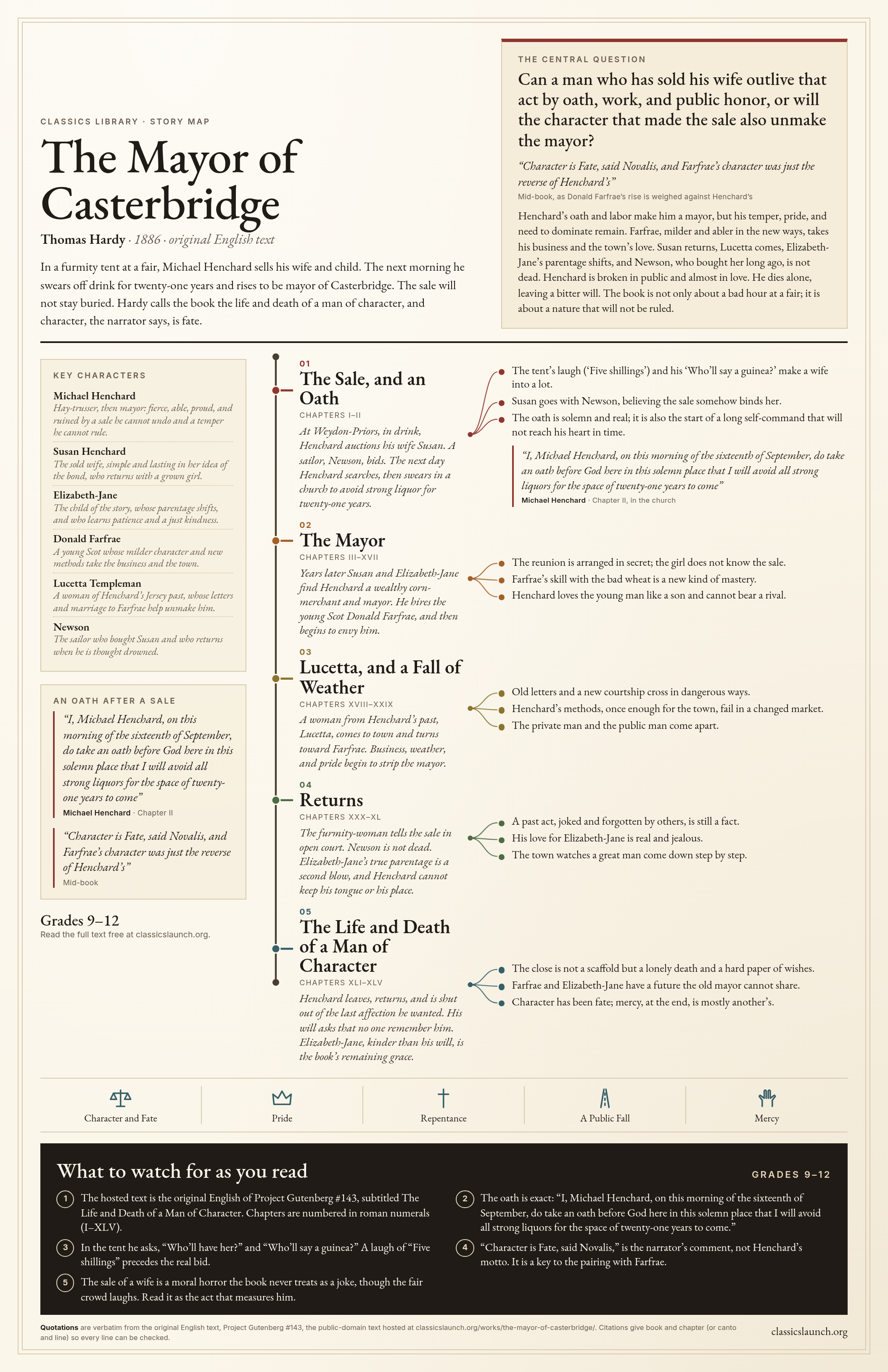
In a furmity tent at a fair, Michael Henchard sells his wife and child. The next morning he swears off drink for twenty-one years and rises to be mayor of Casterbridge. The sale will not stay buried. Hardy calls the book the life and death of a man of character, and character, the narrator says, is fate.
The central question
Can a man who has sold his wife outlive that act by oath, work, and public honor, or will the character that made the sale also unmake the mayor?
“Character is Fate, said Novalis, and Farfrae’s character was just the reverse of Henchard’s”
Henchard’s oath and labor make him a mayor, but his temper, pride, and need to dominate remain. Farfrae, milder and abler in the new ways, takes his business and the town’s love. Susan returns, Lucetta comes, Elizabeth-Jane’s parentage shifts, and Newson, who bought her long ago, is not dead. Henchard is broken in public and almost in love. He dies alone, leaving a bitter will. The book is not only about a bad hour at a fair; it is about a nature that will not be ruled.
- 01
The Sale, and an Oath
Chapters I–II
At Weydon-Priors, in drink, Henchard auctions his wife Susan. A sailor, Newson, bids. The next day Henchard searches, then swears in a church to avoid strong liquor for twenty-one years.
- The tent’s laugh (‘Five shillings’) and his ‘Who’ll say a guinea?’ make a wife into a lot.
- Susan goes with Newson, believing the sale somehow binds her.
- The oath is solemn and real; it is also the start of a long self-command that will not reach his heart in time.
“I, Michael Henchard, on this morning of the sixteenth of September, do take an oath before God here in this solemn place that I will avoid all strong liquors for the space of twenty-one years to come”
- 02
The Mayor
Chapters III–XVII
Years later Susan and Elizabeth-Jane find Henchard a wealthy corn-merchant and mayor. He hires the young Scot Donald Farfrae, and then begins to envy him.
- The reunion is arranged in secret; the girl does not know the sale.
- Farfrae’s skill with the bad wheat is a new kind of mastery.
- Henchard loves the young man like a son and cannot bear a rival.
- 03
Lucetta, and a Fall of Weather
Chapters XVIII–XXIX
A woman from Henchard’s past, Lucetta, comes to town and turns toward Farfrae. Business, weather, and pride begin to strip the mayor.
- Old letters and a new courtship cross in dangerous ways.
- Henchard’s methods, once enough for the town, fail in a changed market.
- The private man and the public man come apart.
- 04
Returns
Chapters XXX–XL
The furmity-woman tells the sale in open court. Newson is not dead. Elizabeth-Jane’s true parentage is a second blow, and Henchard cannot keep his tongue or his place.
- A past act, joked and forgotten by others, is still a fact.
- His love for Elizabeth-Jane is real and jealous.
- The town watches a great man come down step by step.
- 05
The Life and Death of a Man of Character
Chapters XLI–XLV
Henchard leaves, returns, and is shut out of the last affection he wanted. His will asks that no one remember him. Elizabeth-Jane, kinder than his will, is the book’s remaining grace.
- The close is not a scaffold but a lonely death and a hard paper of wishes.
- Farfrae and Elizabeth-Jane have a future the old mayor cannot share.
- Character has been fate; mercy, at the end, is mostly another’s.
- Character and Fate
- Pride
- Repentance
- A Public Fall
- Mercy
What to watch for as you read
Grades 9–12- The hosted text is the original English of Project Gutenberg #143, subtitled The Life and Death of a Man of Character. Chapters are numbered in roman numerals (I–XLV).
- The oath is exact: “I, Michael Henchard, on this morning of the sixteenth of September, do take an oath before God here in this solemn place that I will avoid all strong liquors for the space of twenty-one years to come.”
- In the tent he asks, “Who’ll have her?” and “Who’ll say a guinea?” A laugh of “Five shillings” precedes the real bid.
- “Character is Fate, said Novalis,” is the narrator’s comment, not Henchard’s motto. It is a key to the pairing with Farfrae.
- The sale of a wife is a moral horror the book never treats as a joke, though the fair crowd laughs. Read it as the act that measures him.
Every quotation is word for word from the original English text hosted in this library and is checked against that text each time the site is built. Citations give book and chapter (or canto and line).