Story maps · Grades 9–12
The Merchant of Venice: A Story Map
The PDF is one tabloid page (11 × 17 in). On letter paper, choose “Fit to page.”
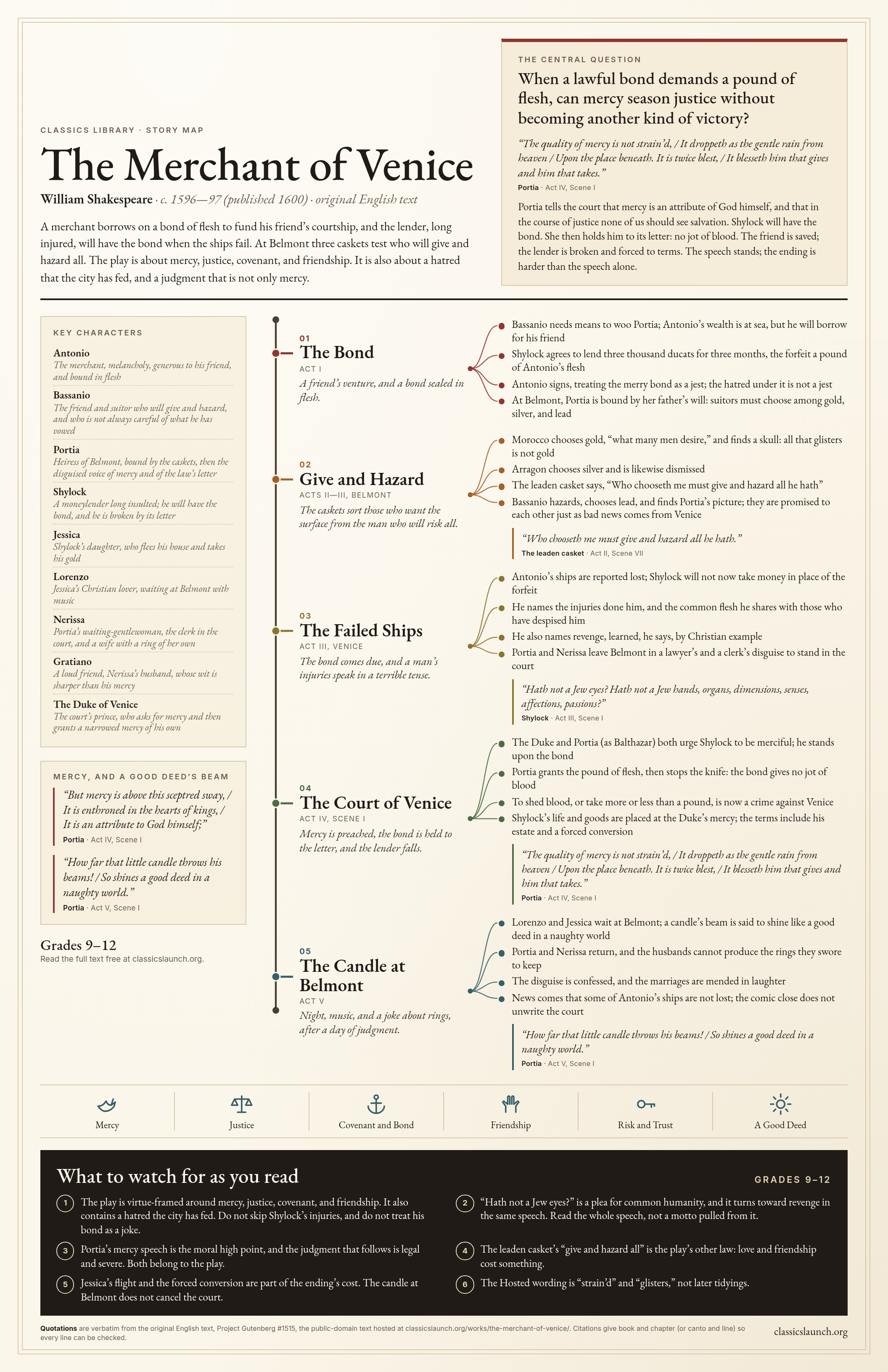
A merchant borrows on a bond of flesh to fund his friend’s courtship, and the lender, long injured, will have the bond when the ships fail. At Belmont three caskets test who will give and hazard all. The play is about mercy, justice, covenant, and friendship. It is also about a hatred that the city has fed, and a judgment that is not only mercy.
The central question
When a lawful bond demands a pound of flesh, can mercy season justice without becoming another kind of victory?
“The quality of mercy is not strain’d, / It droppeth as the gentle rain from heaven / Upon the place beneath. It is twice blest, / It blesseth him that gives and him that takes.”
Portia tells the court that mercy is an attribute of God himself, and that in the course of justice none of us should see salvation. Shylock will have the bond. She then holds him to its letter: no jot of blood. The friend is saved; the lender is broken and forced to terms. The speech stands; the ending is harder than the speech alone.
- 01
The Bond
Act I
A friend’s venture, and a bond sealed in flesh.
- Bassanio needs means to woo Portia; Antonio’s wealth is at sea, but he will borrow for his friend
- Shylock agrees to lend three thousand ducats for three months, the forfeit a pound of Antonio’s flesh
- Antonio signs, treating the merry bond as a jest; the hatred under it is not a jest
- At Belmont, Portia is bound by her father’s will: suitors must choose among gold, silver, and lead
- 02
Give and Hazard
Acts II—III, Belmont
The caskets sort those who want the surface from the man who will risk all.
- Morocco chooses gold, “what many men desire,” and finds a skull: all that glisters is not gold
- Arragon chooses silver and is likewise dismissed
- The leaden casket says, “Who chooseth me must give and hazard all he hath”
- Bassanio hazards, chooses lead, and finds Portia’s picture; they are promised to each other just as bad news comes from Venice
“Who chooseth me must give and hazard all he hath.”
- 03
The Failed Ships
Act III, Venice
The bond comes due, and a man’s injuries speak in a terrible tense.
- Antonio’s ships are reported lost; Shylock will not now take money in place of the forfeit
- He names the injuries done him, and the common flesh he shares with those who have despised him
- He also names revenge, learned, he says, by Christian example
- Portia and Nerissa leave Belmont in a lawyer’s and a clerk’s disguise to stand in the court
“Hath not a Jew eyes? Hath not a Jew hands, organs, dimensions, senses, affections, passions?”
- 04
The Court of Venice
Act IV, Scene I
Mercy is preached, the bond is held to the letter, and the lender falls.
- The Duke and Portia (as Balthazar) both urge Shylock to be merciful; he stands upon the bond
- Portia grants the pound of flesh, then stops the knife: the bond gives no jot of blood
- To shed blood, or take more or less than a pound, is now a crime against Venice
- Shylock’s life and goods are placed at the Duke’s mercy; the terms include his estate and a forced conversion
“The quality of mercy is not strain’d, / It droppeth as the gentle rain from heaven / Upon the place beneath. It is twice blest, / It blesseth him that gives and him that takes.”
- 05
The Candle at Belmont
Act V
Night, music, and a joke about rings, after a day of judgment.
- Lorenzo and Jessica wait at Belmont; a candle’s beam is said to shine like a good deed in a naughty world
- Portia and Nerissa return, and the husbands cannot produce the rings they swore to keep
- The disguise is confessed, and the marriages are mended in laughter
- News comes that some of Antonio’s ships are not lost; the comic close does not unwrite the court
“How far that little candle throws his beams! / So shines a good deed in a naughty world.”
- Mercy
- Justice
- Covenant and Bond
- Friendship
- Risk and Trust
- A Good Deed
What to watch for as you read
Grades 9–12- The play is virtue-framed around mercy, justice, covenant, and friendship. It also contains a hatred the city has fed. Do not skip Shylock’s injuries, and do not treat his bond as a joke.
- “Hath not a Jew eyes?” is a plea for common humanity, and it turns toward revenge in the same speech. Read the whole speech, not a motto pulled from it.
- Portia’s mercy speech is the moral high point, and the judgment that follows is legal and severe. Both belong to the play.
- The leaden casket’s “give and hazard all” is the play’s other law: love and friendship cost something.
- Jessica’s flight and the forced conversion are part of the ending’s cost. The candle at Belmont does not cancel the court.
- The Hosted wording is “strain’d” and “glisters,” not later tidyings.
Every quotation is word for word from the original English text hosted in this library and is checked against that text each time the site is built. Citations give book and chapter (or canto and line).