Work record
The Merchant of Venice
c. 1596-97 (published 1600) · Renaissance Early Modern · Drama · English
Abstract
Background. Shakespeare combined a flesh-bond tale from Ser Giovanni's Il Pecorone with the medieval casket test of the Gesta Romanorum, writing for the Lord Chamberlain's Men in a decade when Marlowe's Jew of Malta held the London stage.
Plot. To fund his friend's wooing, a merchant pledges his own flesh to the usurer he has scorned. Two princes misjudge the caskets before Bassanio wins the heiress, while Jessica flees her father's house with his money. When the ships miscarry, the creditor sues; the bride, posing as a Paduan-sponsored jurist, overturns the claim, and the court strips Shylock of his wealth and his faith.
Structure. Scenes alternate between mercantile Venice and the music and moonlight of Belmont. The courtroom climax of Act 4 is followed by a full act of comic resolution built on the rings given away to the disguised wives.
Themes. The letter of a contract against mercy; outward show against inner worth; the cost of friendship; wealth, usury and inheritance; the relations of Jew and Christian in a commercial republic.
Significance. Shylock has drawn great actors from Macklin to Irving, and the speeches on mercy and on shared humanity are among the most recited in English. The play is one of Shakespeare's most frequently performed and debated comedies.
Main characters
- Antonio: Venetian merchant whose ventures are all at sea
- Shylock: Jewish moneylender who demands the forfeit of his bond
- Portia: Belmont heiress who argues the case disguised as Balthazar
- Bassanio: Indebted gentleman who wins Portia by choosing lead
- Jessica: Shylock's daughter, who runs off with Lorenzo
- Lorenzo: Christian gentleman who marries Jessica
- Gratiano: Bassanio's loud companion, later Nerissa's husband
- Nerissa: Portia's gentlewoman, disguised in court as a clerk
- Launcelet Gobbo: Clown who changes masters from Shylock to Bassanio
- Tubal: Fellow Jew who reports from Genoa

Summary
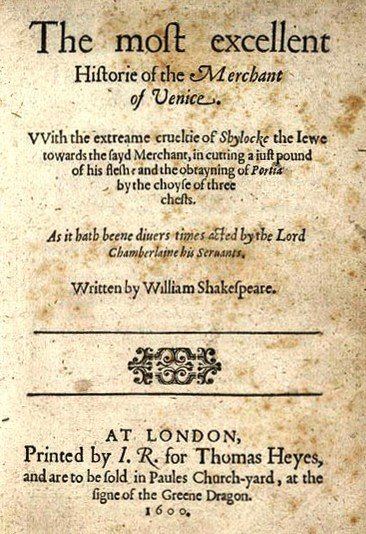
The Merchant of Venice joins two stories, a bond for a pound of flesh and a lottery of caskets, and moves between the commercial city of Venice and Belmont, the country estate of the heiress Portia. Antonio, a wealthy merchant, opens the play sad without knowing why. His young friend Bassanio, who has spent his fortune, needs three thousand ducats to court Portia, so Antonio, whose money is all at sea in his ships, borrows it from Shylock, a Jewish moneylender he has often insulted and spat upon on the Rialto. Shylock, nursing that grievance, offers the loan without interest on a merry bond: if it is not repaid in three months, he may cut a pound of Antonio's flesh. Antonio signs. At Belmont, Portia is bound by her dead father's will to marry whichever suitor chooses the right one of three caskets of gold, silver and lead. The Prince of Morocco picks gold and finds a skull with the scroll that all that glisters is not gold; the Prince of Arragon picks silver and finds a fool's portrait. Meanwhile Shylock's servant Launcelet Gobbo leaves him for Bassanio, and his daughter Jessica, disguised as a boy, elopes with the Christian Lorenzo, taking her father's ducats and jewels. Shylock's grief at the loss of his daughter and money, mocked in the streets, hardens into resolve when Antonio's ships are reported wrecked. Bassanio chooses lead, wins Portia, and receives a ring he swears never to part with; his friend Gratiano wins Portia's waiting-woman Nerissa. A letter brings news that Antonio's bond is forfeit. Portia sends Bassanio to Venice with money and follows secretly, disguised as Balthazar, a young doctor of laws sent by her cousin Bellario of Padua, with Nerissa as her clerk. In the trial scene (Act 4) Shylock refuses twice the sum and insists on his bond; Portia pleads for mercy, then grants the bond and stops the knife at the last moment: he may take flesh but no drop of Christian blood. Under a Venetian law against an alien who seeks a citizen's life, Shylock's goods are forfeit and his life lies at the Duke's mercy; he is spared on condition that he become a Christian and leave his estate to Jessica and Lorenzo, and he leaves the court saying he is not well. As a fee the disguised Portia and Nerissa demand the rings their husbands promised never to give away. Act 5 returns to moonlit Belmont for music, a comic quarrel over the rings, and the news that three of Antonio's argosies have safely come home. The play was entered in the Stationers' Register in 1598 and printed in quarto in 1600.
Virtues in this work
- Friendship: Antonio signs a bond for his own flesh so that Bassanio can go to Belmont to court Portia.
- Prudence: Bassanio rejects the gold and silver caskets as outward show and chooses the plain lead, winning Portia.
- Justice: Portia, as Balthazar, refuses to wrest the law of Venice even for Antonio's sake and decides the case by the bond's exact words.
- Charity: Portia's Act 4 speech teaches that mercy blesses both giver and receiver and is an attribute of God himself.
Plot or Argument
- Act 1: The bond and the caskets
Antonio's sadness and Bassanio's request; Portia and Nerissa mock her suitors and explain the caskets; Shylock lends three thousand ducats on the bond of a pound of flesh, defending interest with the story of Jacob and Laban's sheep.
- Act 2: Flight and the wrong choices
Morocco courts Portia; Launcelet leaves Shylock's service; Jessica elopes with Lorenzo during a masque, carrying her father's money; Morocco chooses gold and Arragon silver, and both depart.
- Act 3: Grief, choice and forfeit
Shylock defends his revenge with the speech on the shared humanity of Jew and Christian and hears from Tubal of Jessica's spending and Antonio's losses; Bassanio chooses lead and marries Portia; Antonio's letter arrives, Antonio is taken into custody, and Portia leaves Belmont in Lorenzo's charge.
- Act 4: The trial
Before the Duke, Shylock demands his bond; Portia, as the young doctor Balthazar, pleads for mercy, then turns the letter of the bond against him; Shylock loses his estate and is made to convert; the disguised wives take their husbands' rings.
- Act 5: Belmont by moonlight
Lorenzo and Jessica trade lovers' memories under the moon and speak of music; the wives return and tease their husbands over the rings; Portia reveals the disguise, gives Antonio news of his ships, and hands Lorenzo Shylock's deed of gift.
Characters
- Antonio, the merchant
A rich, melancholy Venetian trader who stakes his body for his friend Bassanio.
- Shylock, moneylender
A Jewish usurer, long abused by Antonio, who seeks the forfeit of the bond in court.
- Portia, heiress of Belmont
Witty and learned, bound by the caskets of her father's will, she wins the trial disguised as a doctor of laws.
- Bassanio, suitor to Portia
Antonio's spendthrift friend who chooses the lead casket.
- Jessica, Shylock's daughter
Escapes her father's house to marry Lorenzo and become a Christian.
- Lorenzo, Jessica's husband
Bassanio's friend, who speaks the play's lines on music and the harmony of the spheres.
- Gratiano, Bassanio's friend
A talkative jester who marries Nerissa and jeers loudest at Shylock in the trial.
- Nerissa, Portia's waiting-woman
Portia's confidante, who disguises herself as the lawyer's clerk.
- Launcelet Gobbo, clown
Shylock's servant who debates with his conscience and the fiend before leaving for Bassanio's service.
- Tubal, Shylock's friend
Brings mixed news from Genoa of Jessica's spending and Antonio's losses.
- The Prince of Morocco and the Prince of Arragon, suitors
Choose the gold and silver caskets and lose.
- The Duke of Venice, judge
Presides at the trial and spares Shylock's life.
Lessons
Mercy above the letter of the law
Portia's great speech in Act 4 argues that mercy is an attribute of God and that no one would be saved if justice alone were applied. Yet the same scene shows mercy pleaded for and then offered on hard terms. The play makes students weigh what mercy is, who shows it, and whether the verdict lives up to the speech.
- Why does Portia say that mercy is twice blessed?
- Does anyone in the trial scene actually show the mercy Portia describes?
- Is Shylock defeated by justice or by a trick of wording?
Appearances and the caskets
Morocco trusts gold and Arragon trusts his own deserving; Bassanio wins by choosing the plain lead that demands he give and hazard all. The casket test teaches that true love risks itself rather than seeking gain or reward.
- What does each suitor's reasoning reveal about him?
- Why is lead the right choice for a husband?
- How does the lead casket's motto apply to Antonio as well?
Injury and revenge
In Act 3 Shylock answers mockery by insisting that a Jew bleeds, laughs and dies like a Christian, then turns that shared nature into a claim to revenge learned from his enemies. Shakespeare gives the injured man eloquence while showing how grievance closes him off to mercy.
- What wrongs does Shylock list before asking his famous questions?
- How does the speech move from common humanity to revenge?
- Does Antonio's earlier treatment of Shylock change how we judge the bond?
Bonds of friendship and marriage
The bond of flesh, the marriage vow and the ring all test what a promise is worth. Antonio's love for Bassanio and Portia's claim on her husband meet in the ring plot, which Portia resolves by making Antonio surety a second time, now for Bassanio's faithfulness.
- Why does Bassanio give away the ring he swore to keep?
- What is the point of the comic quarrel in Act 5 after the near-tragedy of Act 4?
Context
Jews had been expelled from England by Edward I in 1290, and very few lived openly in Shakespeare's London, so most of his audience knew Jews chiefly from Scripture, sermons and the stage. Venice, by contrast, was a great trading republic whose Jewish community lived in the Ghetto established in 1516 and whose courts were famed for even-handed commercial law. Usury, lending at interest, was a live moral question in Elizabethan England, where the law permitted interest up to a limit while preachers condemned it. The trial and execution in 1594 of Roderigo Lopez, the queen's Portuguese physician of Jewish descent, and the popularity of Christopher Marlowe's The Jew of Malta (c. 1589) are often cited as part of the play's immediate background.
Composition
The bond plot and the Belmont lady come chiefly from a tale in Ser Giovanni Fiorentino's Italian collection Il Pecorone; the casket choice is found in the medieval Latin Gesta Romanorum. The play is usually dated 1596-97. Francis Meres listed it among Shakespeare's comedies in Palladis Tamia (1598); it was entered in the Stationers' Register in July 1598 and printed in a quarto of 1600 as performed by the Lord Chamberlain's Men, and it was included among the comedies in the First Folio of 1623.
Reception
Shylock became the play's dominant role. Charles Macklin in 1741 played him as a fierce and serious figure rather than a comic villain; Edmund Kean in 1814 and Henry Irving from 1879, with Ellen Terry as Portia, made him a figure of dignity and suffering. Portia's mercy speech and Shylock's Act 3 speech have long been among the most memorized passages in Shakespeare, and the play remains one of his most often staged and most discussed comedies.
Comparisons
- much-ado-about-nothing
Both comedies nearly turn tragic before a disguise or a revelation sets things right, and both pair a witty heroine, Portia or Beatrice, with a man whose loyalty to a friend is tested.
- the-taming-of-the-shrew
Two early comedies about a father's control over a daughter's marriage: Baptista auctions his daughters to suitors, while Portia's dead father binds her through the caskets, and Shylock loses Jessica entirely.
- romeo-and-juliet
Written in the same years, both plays set lovers against a feud between groups, but Jessica and Lorenzo escape by flight and conversion while Romeo and Juliet die.
- henry-v
Henry's Non nobis and his prayer before Agincourt give glory to God's mercy; Portia's speech makes mercy the likeness of God in earthly power, and both plays ask how a ruler or a court should temper justice.
- the-pilgrims-progress
Bunyan's Vanity Fair, where Faithful is tried by a court of hostile jurors, is a Puritan counterpart to the Venetian courtroom, and both test the gap between law and true judgment.
Quotes
Frequently cited
“In sooth I know not why I am so sad”
Frequently cited
“The devil can cite Scripture for his purpose.”
Frequently cited
“All that glisters is not gold”
Frequently cited
“Hath not a Jew eyes? Hath not a Jew hands, organs, dimensions, senses, affections, passions?”
Frequently cited
“If you prick us, do we not bleed? If you tickle us, do we not laugh? If you poison us, do we not die? And if you wrong us, shall we not revenge?”
Frequently cited
“The quality of mercy is not strain’d, It droppeth as the gentle rain from heaven Upon the place beneath.”
“It is an attribute to God himself; And earthly power doth then show likest God’s When mercy seasons justice.”
“How far that little candle throws his beams! So shines a good deed in a naughty world.”
For Students
A reading companion for classical Christian high school students. See the student guide.
Reading Guide
Watch for
- Antonio's opening sadness in Act 1, Scene 1 and his willingness to sign the bond in Act 1, Scene 3; ask what he is willing to give for Bassanio.
- The three casket scenes (Act 2, Scenes 7 and 9; Act 3, Scene 2) and the inscription on each casket.
- Shylock's speech in Act 3, Scene 1, from the list of Antonio's insults to the claim of revenge, and his grief over Leah's turquoise ring.
- The turn in the trial scene of Act 4 at Portia's words Tarry a little, and how the Duke's sentence and Antonio's conditions follow.
- The ring Bassanio swears to keep in Act 3, Scene 2 and gives away in Act 4, and how it is returned in Act 5.
Key terms and names
- Bond
- The legal agreement Antonio signs with Shylock, forfeiting a pound of his flesh if three thousand ducats are not repaid in three months. Its exact wording decides the trial.
- Usance
- Shylock's word for interest on a loan. Antonio lends without interest and condemns those who take it, which is the root of their quarrel.
- Rialto
- The merchants' exchange of Venice, where Antonio has publicly berated Shylock and where news of ships is traded.
- Belmont
- Portia's estate, a world of music, wit and moonlight set against the money and law of Venice.
- The caskets
- Gold, silver and lead chests left by Portia's father; the suitor who chooses the one holding her portrait may marry her.
- Balthazar
- The name Portia takes as a young doctor of laws from Rome, sent with a letter from the learned Bellario of Padua.
- A Daniel come to judgment
- Shylock's praise of the young judge, recalling the wise Daniel of the story of Susanna; Gratiano throws the phrase back at Shylock after the verdict turns.
Seminar Questions
- Comprehension What are the terms of the bond Antonio signs, and why does Shylock call it a merry sport?
- Comprehension How do Morocco, Arragon and Bassanio each reason about the caskets, and what does each find inside?
- Comprehension By what reading of the bond does Portia stop Shylock, and what penalties does the court then lay on him?
- Interpretation In Act 1, Scene 3 Shylock tells the story of Jacob and Laban's sheep and Antonio says the devil can cite Scripture. Who is using Scripture rightly in that exchange?
- Interpretation Shylock's speech in Act 3, Scene 1 begins with common humanity and ends with revenge. What has happened to him between Act 1 and this scene to bring him to that point?
- Interpretation Portia pleads for mercy and then holds Shylock to the strictest reading of the law. Is she inconsistent, or is she teaching him what strict justice means?
- Interpretation Why does Shakespeare follow the trial with the comic ring quarrel and the music of Act 5 instead of ending in the courtroom?
- Big Question Can a court be both just and merciful at once, and what would that have looked like for Shylock and Antonio?
Faith Connections
- James 2:13 (Scripture)
Judgment without mercy will be shown to anyone who has not been merciful, and mercy triumphs over judgment. Portia warns Shylock that in the course of justice none would see salvation, and the trial then gives him the strict judgment he asked for.
- Matthew 6:12-15 (Scripture)
The Lord's Prayer asks forgiveness as we forgive. Portia's reminder that we do pray for mercy and that the same prayer teaches us to render it rests on this petition.
- Genesis 30:25-43 (Scripture)
Shylock cites Jacob's bargain with Laban over the spotted lambs to justify thrift and profit. Reading the chapter itself lets students judge his use of it and Antonio's retort.
- Basil the Great, Homily II on Psalm 14 (Against Usurers); Ambrose, On Tobias (Church Fathers)
The church fathers condemned lending at interest to the poor as a hard use of a neighbour's need. Antonio's refusal to take interest stands in this tradition, though his contempt for Shylock does not reflect the charity they urged.
Logic and Rhetoric
Central argument: Every bond in the play, of money, of marriage, of friendship, is tested by whether it will be held to its letter or tempered by love. Shylock insists on the letter and is undone by the letter; Bassanio wins Portia by choosing the casket that demands giving rather than getting; and the ring plot shows even true lovers forgiving a broken promise. Therefore the play argues that law and contracts are necessary, but that a community lives only when mercy seasons justice, while leaving open whether Venice itself has learned that lesson.
Rhetorical device: rhetorical question in series (erotema with anaphora). Shylock's Act 3, Scene 1 speech builds a chain of parallel questions, Hath not a Jew eyes? and If you prick us, do we not bleed?, each forcing the listener to answer yes before the last one turns the logic toward revenge.
Debate: Resolved: that the sentence passed on Shylock in Act 4 is an act of mercy.
Memory Work
The quality of mercy is not strain’d, It droppeth as the gentle rain from heaven Upon the place beneath.
How far that little candle throws his beams! So shines a good deed in a naughty world.
Writing Prompts
Essay: Compare Antonio's sadness in Act 1, Scene 1 with his resignation as a tainted wether in Act 4. Argue what Antonio wants, and whether the play's ending gives it to him.
Comparison with Much Ado About Nothing: Portia and Beatrice are both witty women who act when the men around them fail. Compare Portia's disguise in Venice with Beatrice's command to Benedick after the broken wedding, and argue which heroine more fully shapes her play's outcome.
Medical Lens
The play opens with one of the best-known literary descriptions of causeless low mood: Antonio cannot say how he caught his sadness, and his friends propose period explanations (worry for his cargoes, love) which he denies. Gratiano's reply uses humoral physiology, setting a liver heated with wine against a heart cooled by groans and warning that peevishness breeds jaundice, while Portia's opening line about her little body being weary of the world gives a matching female melancholy that Nerissa answers with the proverbial medicine of the mean. In the trial Shylock defends his unreasoned hatred by comparing it to involuntary aversions, men who cannot abide a gaping pig or a cat or who lose control of their urine at the bagpipe, a passage often read as an early account of what would now be called phobic or idiosyncratic reactions, though Shakespeare frames it as affection ruling passion. The bond itself is a grim anatomy lesson: a pound of flesh cut nearest the heart, Portia's demand for a surgeon at Shylock's charge to stop the bleeding, and her ruling that the flesh cannot be taken without blood. Antonio's calling himself a tainted wether fittest for death extends the melancholy into resignation. Any modern diagnostic reading of Antonio is interpretive.
- Act 1, Scene 1
Antonio's unexplained sadness, his friends' guesses at its cause, and Gratiano's humoral advice to play the fool.
- Act 1, Scene 2
Portia says her little body is weary of the world; Nerissa answers that surfeit sickens as much as starving.
- Act 4, Scene 1
Shylock compares his hatred of Antonio to men's involuntary aversions to a gaping pig, a cat or the bagpipe.
- Act 4, Scene 1
Antonio bares his breast as a tainted wether; Portia asks for a surgeon to stop his wounds and rules on flesh without blood.
Listen to the book
Public-domain audiobook from LibriVox, read by Various volunteers. Recording: Merchant of Venice (version 2) on LibriVox (Internet Archive).
LibriVox recordings are volunteer readings released into the public domain. The reading may follow a different edition from the text in this library.
Creative Prompts
- Classroom
Stage the three casket scenes back to back and chart each suitor's reasoning, inscription and reward.
- Essay
Does the trial in Act 4 show mercy seasoning justice, as Portia's speech promises? Argue from the Duke's, Antonio's and Gratiano's conduct.
- Dialogue
Write a conversation between Jessica and Lorenzo, in Belmont after the trial, about her father.
- Fiction
Tell the night of Jessica's escape from the point of view of Launcelet Gobbo, who carried her letter.
Further Reading
- The Jew of Malta, Christopher Marlowe
The popular Elizabethan play usually set beside Shakespeare's.
- Shakespeare and the Jews, James Shapiro
- Shakespearean Comedy, H. B. Charlton
- Shakespeare's Festive Comedy, C. L. Barber
Verification notes
Plot, act and scene locators follow the attached Gutenberg text, and every quote was found in it. Sources (Il Pecorone, Gesta Romanorum), the 1598 Meres listing and Stationers' Register entry, the 1600 quarto and the stage history of Macklin, Kean and Irving are standard facts of the play's scholarship. Lopez and The Jew of Malta are mentioned as commonly cited background, not as proven influences.
- Exact month of the 1598 Stationers' Register entry (believed July 1598).
- Whether Barber's Shakespeare's Festive Comedy treats The Merchant of Venice at chapter length (believed so).