Story maps · Grades 3–5
The Merry Adventures of Robin Hood: A Story Map
The PDF is one tabloid page (11 × 17 in). On letter paper, choose “Fit to page.”
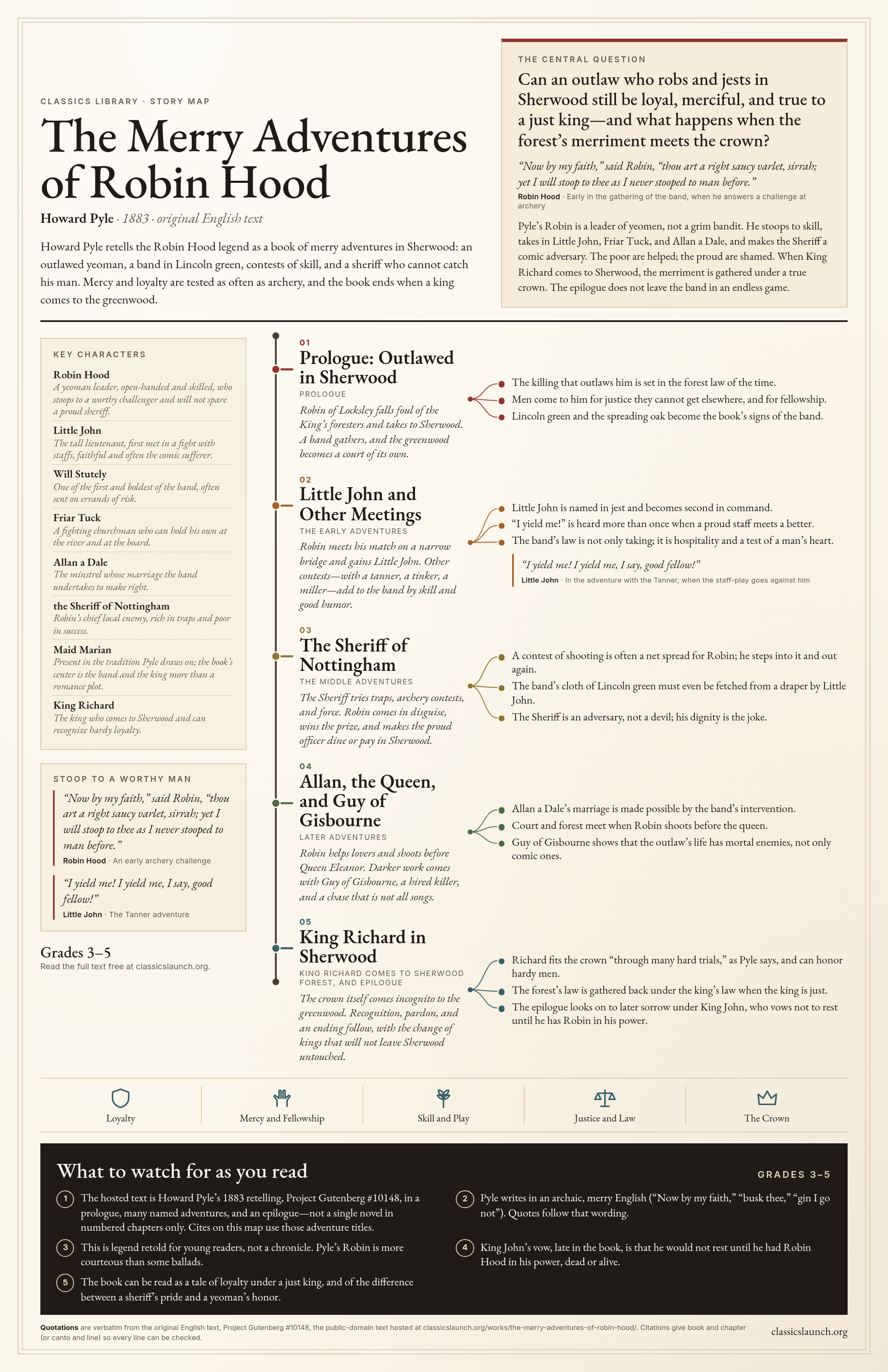
Howard Pyle retells the Robin Hood legend as a book of merry adventures in Sherwood: an outlawed yeoman, a band in Lincoln green, contests of skill, and a sheriff who cannot catch his man. Mercy and loyalty are tested as often as archery, and the book ends when a king comes to the greenwood.
The central question
Can an outlaw who robs and jests in Sherwood still be loyal, merciful, and true to a just king—and what happens when the forest’s merriment meets the crown?
“Now by my faith,” said Robin, “thou art a right saucy varlet, sirrah; yet I will stoop to thee as I never stooped to man before.”
Pyle’s Robin is a leader of yeomen, not a grim bandit. He stoops to skill, takes in Little John, Friar Tuck, and Allan a Dale, and makes the Sheriff a comic adversary. The poor are helped; the proud are shamed. When King Richard comes to Sherwood, the merriment is gathered under a true crown. The epilogue does not leave the band in an endless game.
- 01
Prologue: Outlawed in Sherwood
Prologue
Robin of Locksley falls foul of the King’s foresters and takes to Sherwood. A band gathers, and the greenwood becomes a court of its own.
- The killing that outlaws him is set in the forest law of the time.
- Men come to him for justice they cannot get elsewhere, and for fellowship.
- Lincoln green and the spreading oak become the book’s signs of the band.
- 02
Little John and Other Meetings
The early adventures
Robin meets his match on a narrow bridge and gains Little John. Other contests—with a tanner, a tinker, a miller—add to the band by skill and good humor.
- Little John is named in jest and becomes second in command.
- “I yield me!” is heard more than once when a proud staff meets a better.
- The band’s law is not only taking; it is hospitality and a test of a man’s heart.
“I yield me! I yield me, I say, good fellow!”
- 03
The Sheriff of Nottingham
The middle adventures
The Sheriff tries traps, archery contests, and force. Robin comes in disguise, wins the prize, and makes the proud officer dine or pay in Sherwood.
- A contest of shooting is often a net spread for Robin; he steps into it and out again.
- The band’s cloth of Lincoln green must even be fetched from a draper by Little John.
- The Sheriff is an adversary, not a devil; his dignity is the joke.
- 04
Allan, the Queen, and Guy of Gisbourne
Later adventures
Robin helps lovers and shoots before Queen Eleanor. Darker work comes with Guy of Gisbourne, a hired killer, and a chase that is not all songs.
- Allan a Dale’s marriage is made possible by the band’s intervention.
- Court and forest meet when Robin shoots before the queen.
- Guy of Gisbourne shows that the outlaw’s life has mortal enemies, not only comic ones.
- 05
King Richard in Sherwood
King Richard Comes to Sherwood Forest, and Epilogue
The crown itself comes incognito to the greenwood. Recognition, pardon, and an ending follow, with the change of kings that will not leave Sherwood untouched.
- Richard fits the crown “through many hard trials,” as Pyle says, and can honor hardy men.
- The forest’s law is gathered back under the king’s law when the king is just.
- The epilogue looks on to later sorrow under King John, who vows not to rest until he has Robin in his power.
- Loyalty
- Mercy and Fellowship
- Skill and Play
- Justice and Law
- The Crown
What to watch for as you read
Grades 3–5- The hosted text is Howard Pyle’s 1883 retelling, Project Gutenberg #10148, in a prologue, many named adventures, and an epilogue—not a single novel in numbered chapters only. Cites on this map use those adventure titles.
- Pyle writes in an archaic, merry English (“Now by my faith,” “busk thee,” “gin I go not”). Quotes follow that wording.
- This is legend retold for young readers, not a chronicle. Pyle’s Robin is more courteous than some ballads.
- King John’s vow, late in the book, is that he would not rest until he had Robin Hood in his power, dead or alive.
- The book can be read as a tale of loyalty under a just king, and of the difference between a sheriff’s pride and a yeoman’s honor.
Every quotation is word for word from the original English text hosted in this library and is checked against that text each time the site is built. Citations give book and chapter (or canto and line).