Story maps · Grades 6–8
The Prince and the Pauper: A Story Map
The PDF is one tabloid page (11 × 17 in). On letter paper, choose “Fit to page.”
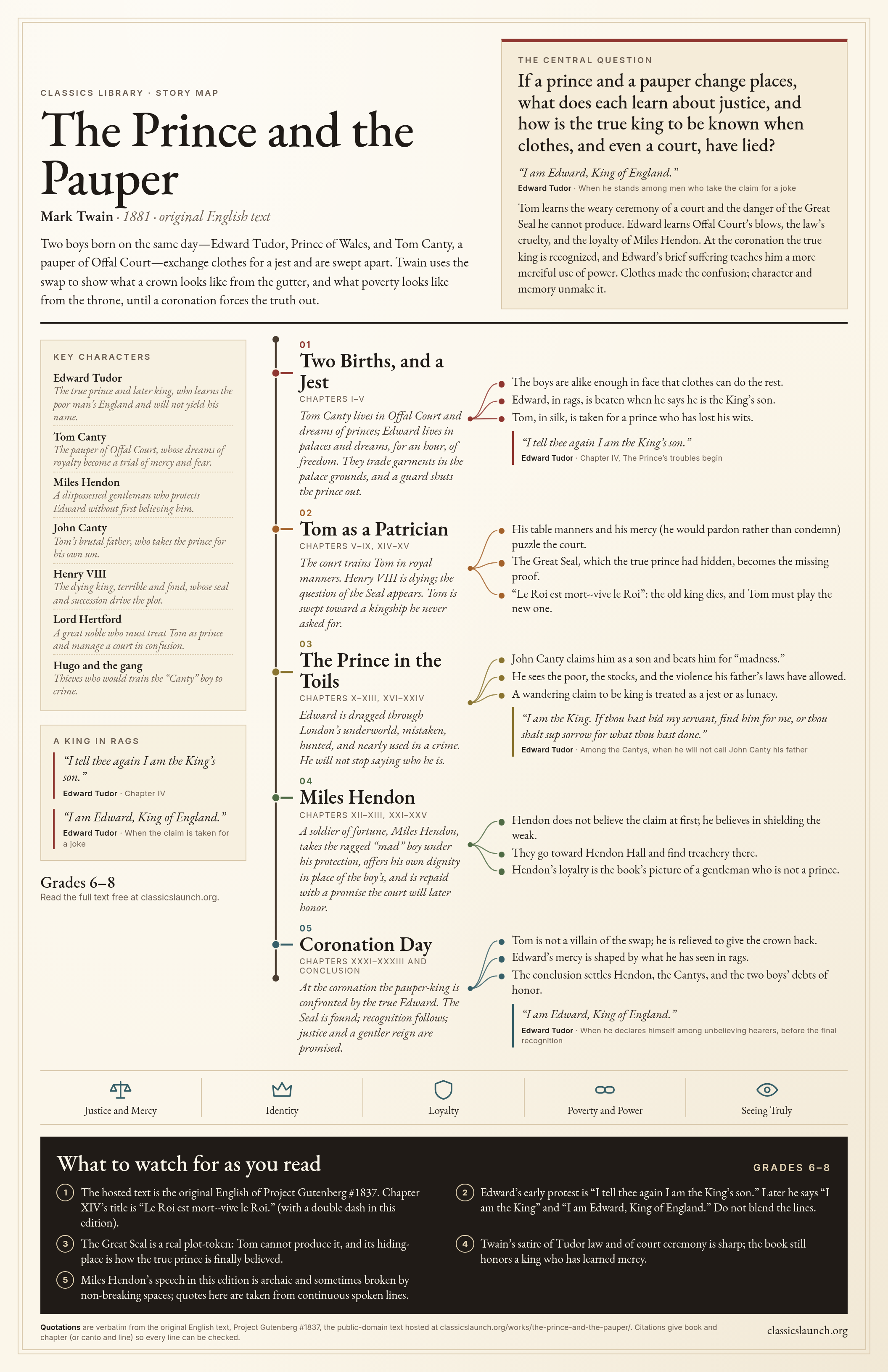
Two boys born on the same day—Edward Tudor, Prince of Wales, and Tom Canty, a pauper of Offal Court—exchange clothes for a jest and are swept apart. Twain uses the swap to show what a crown looks like from the gutter, and what poverty looks like from the throne, until a coronation forces the truth out.
The central question
If a prince and a pauper change places, what does each learn about justice, and how is the true king to be known when clothes, and even a court, have lied?
“I am Edward, King of England.”
Tom learns the weary ceremony of a court and the danger of the Great Seal he cannot produce. Edward learns Offal Court’s blows, the law’s cruelty, and the loyalty of Miles Hendon. At the coronation the true king is recognized, and Edward’s brief suffering teaches him a more merciful use of power. Clothes made the confusion; character and memory unmake it.
- 01
Two Births, and a Jest
Chapters I–V
Tom Canty lives in Offal Court and dreams of princes; Edward lives in palaces and dreams, for an hour, of freedom. They trade garments in the palace grounds, and a guard shuts the prince out.
- The boys are alike enough in face that clothes can do the rest.
- Edward, in rags, is beaten when he says he is the King’s son.
- Tom, in silk, is taken for a prince who has lost his wits.
“I tell thee again I am the King’s son.”
- 02
Tom as a Patrician
Chapters V–IX, XIV–XV
The court trains Tom in royal manners. Henry VIII is dying; the question of the Seal appears. Tom is swept toward a kingship he never asked for.
- His table manners and his mercy (he would pardon rather than condemn) puzzle the court.
- The Great Seal, which the true prince had hidden, becomes the missing proof.
- “Le Roi est mort--vive le Roi”: the old king dies, and Tom must play the new one.
- 03
The Prince in the Toils
Chapters X–XIII, XVI–XXIV
Edward is dragged through London’s underworld, mistaken, hunted, and nearly used in a crime. He will not stop saying who he is.
- John Canty claims him as a son and beats him for “madness.”
- He sees the poor, the stocks, and the violence his father’s laws have allowed.
- A wandering claim to be king is treated as a jest or as lunacy.
“I am the King. If thou hast hid my servant, find him for me, or thou shalt sup sorrow for what thou hast done.”
- 04
Miles Hendon
Chapters XII–XIII, XXI–XXV
A soldier of fortune, Miles Hendon, takes the ragged “mad” boy under his protection, offers his own dignity in place of the boy’s, and is repaid with a promise the court will later honor.
- Hendon does not believe the claim at first; he believes in shielding the weak.
- They go toward Hendon Hall and find treachery there.
- Hendon’s loyalty is the book’s picture of a gentleman who is not a prince.
- 05
Coronation Day
Chapters XXXI–XXXIII and Conclusion
At the coronation the pauper-king is confronted by the true Edward. The Seal is found; recognition follows; justice and a gentler reign are promised.
- Tom is not a villain of the swap; he is relieved to give the crown back.
- Edward’s mercy is shaped by what he has seen in rags.
- The conclusion settles Hendon, the Cantys, and the two boys’ debts of honor.
“I am Edward, King of England.”
- Justice and Mercy
- Identity
- Loyalty
- Poverty and Power
- Seeing Truly
What to watch for as you read
Grades 6–8- The hosted text is the original English of Project Gutenberg #1837. Chapter XIV’s title is “Le Roi est mort--vive le Roi.” (with a double dash in this edition).
- Edward’s early protest is “I tell thee again I am the King’s son.” Later he says “I am the King” and “I am Edward, King of England.” Do not blend the lines.
- The Great Seal is a real plot-token: Tom cannot produce it, and its hiding-place is how the true prince is finally believed.
- Twain’s satire of Tudor law and of court ceremony is sharp; the book still honors a king who has learned mercy.
- Miles Hendon’s speech in this edition is archaic and sometimes broken by non-breaking spaces; quotes here are taken from continuous spoken lines.
Every quotation is word for word from the original English text hosted in this library and is checked against that text each time the site is built. Citations give book and chapter (or canto and line).