Story maps · Grades 10–12
The Professor: A Story Map
The PDF is one tabloid page (11 × 17 in). On letter paper, choose “Fit to page.”
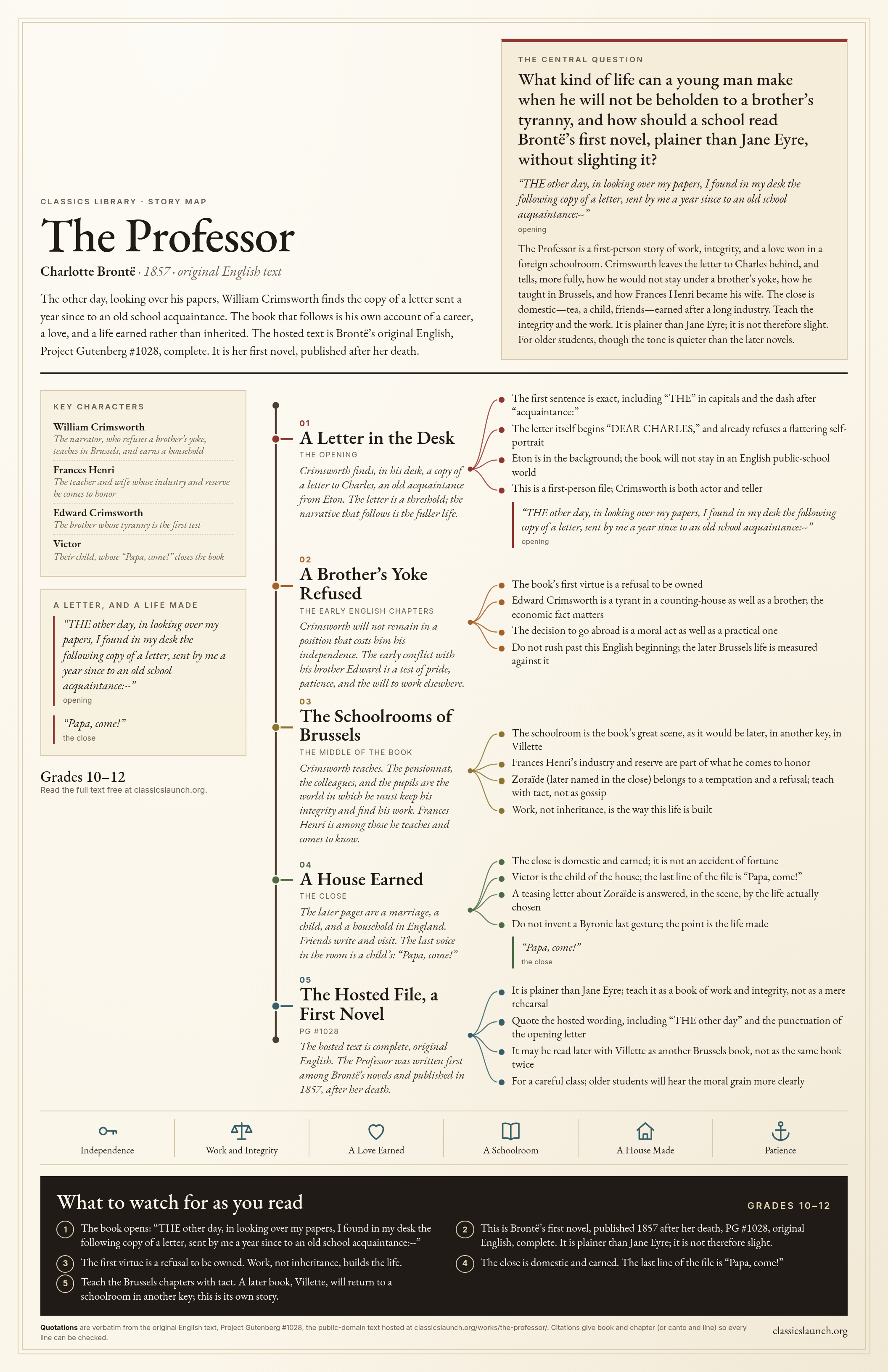
The other day, looking over his papers, William Crimsworth finds the copy of a letter sent a year since to an old school acquaintance. The book that follows is his own account of a career, a love, and a life earned rather than inherited. The hosted text is Brontë’s original English, Project Gutenberg #1028, complete. It is her first novel, published after her death.
The central question
What kind of life can a young man make when he will not be beholden to a brother’s tyranny, and how should a school read Brontë’s first novel, plainer than Jane Eyre, without slighting it?
“THE other day, in looking over my papers, I found in my desk the following copy of a letter, sent by me a year since to an old school acquaintance:--”
The Professor is a first-person story of work, integrity, and a love won in a foreign schoolroom. Crimsworth leaves the letter to Charles behind, and tells, more fully, how he would not stay under a brother’s yoke, how he taught in Brussels, and how Frances Henri became his wife. The close is domestic—tea, a child, friends—earned after a long industry. Teach the integrity and the work. It is plainer than Jane Eyre; it is not therefore slight. For older students, though the tone is quieter than the later novels.
- 01
A Letter in the Desk
The opening
Crimsworth finds, in his desk, a copy of a letter to Charles, an old acquaintance from Eton. The letter is a threshold; the narrative that follows is the fuller life.
- The first sentence is exact, including “THE” in capitals and the dash after “acquaintance:”
- The letter itself begins “DEAR CHARLES,” and already refuses a flattering self-portrait
- Eton is in the background; the book will not stay in an English public-school world
- This is a first-person file; Crimsworth is both actor and teller
“THE other day, in looking over my papers, I found in my desk the following copy of a letter, sent by me a year since to an old school acquaintance:--”
- 02
A Brother’s Yoke Refused
The early English chapters
Crimsworth will not remain in a position that costs him his independence. The early conflict with his brother Edward is a test of pride, patience, and the will to work elsewhere.
- The book’s first virtue is a refusal to be owned
- Edward Crimsworth is a tyrant in a counting-house as well as a brother; the economic fact matters
- The decision to go abroad is a moral act as well as a practical one
- Do not rush past this English beginning; the later Brussels life is measured against it
- 03
The Schoolrooms of Brussels
The middle of the book
Crimsworth teaches. The pensionnat, the colleagues, and the pupils are the world in which he must keep his integrity and find his work. Frances Henri is among those he teaches and comes to know.
- The schoolroom is the book’s great scene, as it would be later, in another key, in Villette
- Frances Henri’s industry and reserve are part of what he comes to honor
- Zoraïde (later named in the close) belongs to a temptation and a refusal; teach with tact, not as gossip
- Work, not inheritance, is the way this life is built
- 04
A House Earned
The close
The later pages are a marriage, a child, and a household in England. Friends write and visit. The last voice in the room is a child’s: “Papa, come!”
- The close is domestic and earned; it is not an accident of fortune
- Victor is the child of the house; the last line of the file is “Papa, come!”
- A teasing letter about Zoraïde is answered, in the scene, by the life actually chosen
- Do not invent a Byronic last gesture; the point is the life made
“Papa, come!”
- 05
The Hosted File, a First Novel
PG #1028
The hosted text is complete, original English. The Professor was written first among Brontë’s novels and published in 1857, after her death.
- It is plainer than Jane Eyre; teach it as a book of work and integrity, not as a mere rehearsal
- Quote the hosted wording, including “THE other day” and the punctuation of the opening letter
- It may be read later with Villette as another Brussels book, not as the same book twice
- For a careful class; older students will hear the moral grain more clearly
- Independence
- Work and Integrity
- A Love Earned
- A Schoolroom
- A House Made
- Patience
What to watch for as you read
Grades 10–12- The book opens: “THE other day, in looking over my papers, I found in my desk the following copy of a letter, sent by me a year since to an old school acquaintance:--”
- This is Brontë’s first novel, published 1857 after her death, PG #1028, original English, complete. It is plainer than Jane Eyre; it is not therefore slight.
- The first virtue is a refusal to be owned. Work, not inheritance, builds the life.
- The close is domestic and earned. The last line of the file is “Papa, come!”
- Teach the Brussels chapters with tact. A later book, Villette, will return to a schoolroom in another key; this is its own story.
Every quotation is word for word from the original English text hosted in this library and is checked against that text each time the site is built. Citations give book and chapter (or canto and line).