Story maps · Grades 3–5
The Railway Children: A Story Map
The PDF is one tabloid page (11 × 17 in). On letter paper, choose “Fit to page.”
When Father is taken away, Mother and the three children leave London for a house by a railway. Roberta, Peter, and Phyllis learn to wave, to help, and to wait. The line becomes their adventure and, at last, the road that brings a pale man home.
The central question
If a father can vanish into a silence the children do not understand, what can three of them still do that is brave, useful, and loyal—and how is he to be given back?
“Oh! my Daddy, my Daddy!”
The children do not at first know why Father has gone. They make a life by the railway: they wave to a train, befriend an old gentleman, stop a landslide with red petticoats, and help a Russian exile and a boy in a red jersey. Bobbie learns more of the truth than the others and keeps faith. The old gentleman’s help and the children’s own courage prepare the last scene: a station, a train, and Bobbie’s cry. The book’s joy is not that trouble never came, but that love held on until it could run to meet him.
- 01
The Beginning of Things
Chapters I–II
A comfortable London life ends in a night of knocked doors and whispering. They move to the Three Chimneys, near a railway, and Peter finds a “coal-mine” in a yard that is not theirs to take.
- Mother writes and is often tired; the children feel the new poverty without fully naming it.
- The railway cuts through the valley and becomes the first object of their interest.
- Peter’s coal-mine adventure teaches them that not every find is honest.
- 02
The Old Gentleman
Chapters III–V
They wave to a regular train; an old gentleman waves back. He becomes a hidden ally when Mother is ill and when they have no one else to ask.
- “London’s where Father is,” Bobbie says, and they go down to the station to learn the trains.
- A letter on a sheet, “LOOK OUT AT THE STATION,” begins a correspondence of help.
- They also meet Perks, the porter, who is proud and kind and must be treated with care.
- 03
Saviours of the Train
Chapter VI
A landslide covers the line. The children have nothing to signal with but their red flannel petticoats. They stand and wave until the train is stopped.
- Bobbie sees what an accident would mean: “people KILLED.”
- Peter says, “Stand firm, and wave like mad!” and warns Bobbie off the rails.
- The rescue is children’s courage used well, not a stunt for its own sake.
“Stand firm,” said Peter, “and wave like mad!”
- 04
Valour, Perks, and Secrets
Chapters VII–XIII
They are given gold watches “for valour,” help Perks on his birthday without shaming him, save a baby from a barge fire, and meet a boy in a red jersey whose grandfather is the old gentleman. Bobbie learns why Father is away.
- Honor that costs other people (Perks’s pride) must be handled gently.
- A Russian gentleman, escaped from a prison, is helped toward his family.
- The “terrible secret” is political injustice, not a crime of Father’s; Bobbie carries it quietly.
- 05
The End
Chapter XIV
On the station platform a train comes in, and a tall pale man gets down. Bobbie sees him first.
- The whole valley seems to have been waiting for this one arrival.
- Her cry goes “like a knife into the heart of everyone in the train.”
- The ending is reunion, not a lecture; the children’s faithfulness has been the book’s argument all along.
“Oh! my Daddy, my Daddy!”
- Loyalty
- Courage
- Home
- Help and Neighborliness
- Waiting and Faith
What to watch for as you read
Grades 3–5- The hosted text is the original English of Project Gutenberg #1874, in fourteen chapters with titles such as “Saviours of the train” and “For valour.”
- Bobbie’s last cry is “Oh! my Daddy, my Daddy!”—not the shorter “Daddy, my Daddy!” without the “Oh!”
- Peter’s order at the landslide is: “Stand firm,” said Peter, “and wave like mad!”
- The children’s signals are red flannel petticoats torn into flags. The book is practical about what they had, not magical.
- Father’s absence is an injustice to be righted, not a mystery for its own sake. The old gentleman’s help is providence through a neighbor, not a fairy ending only.
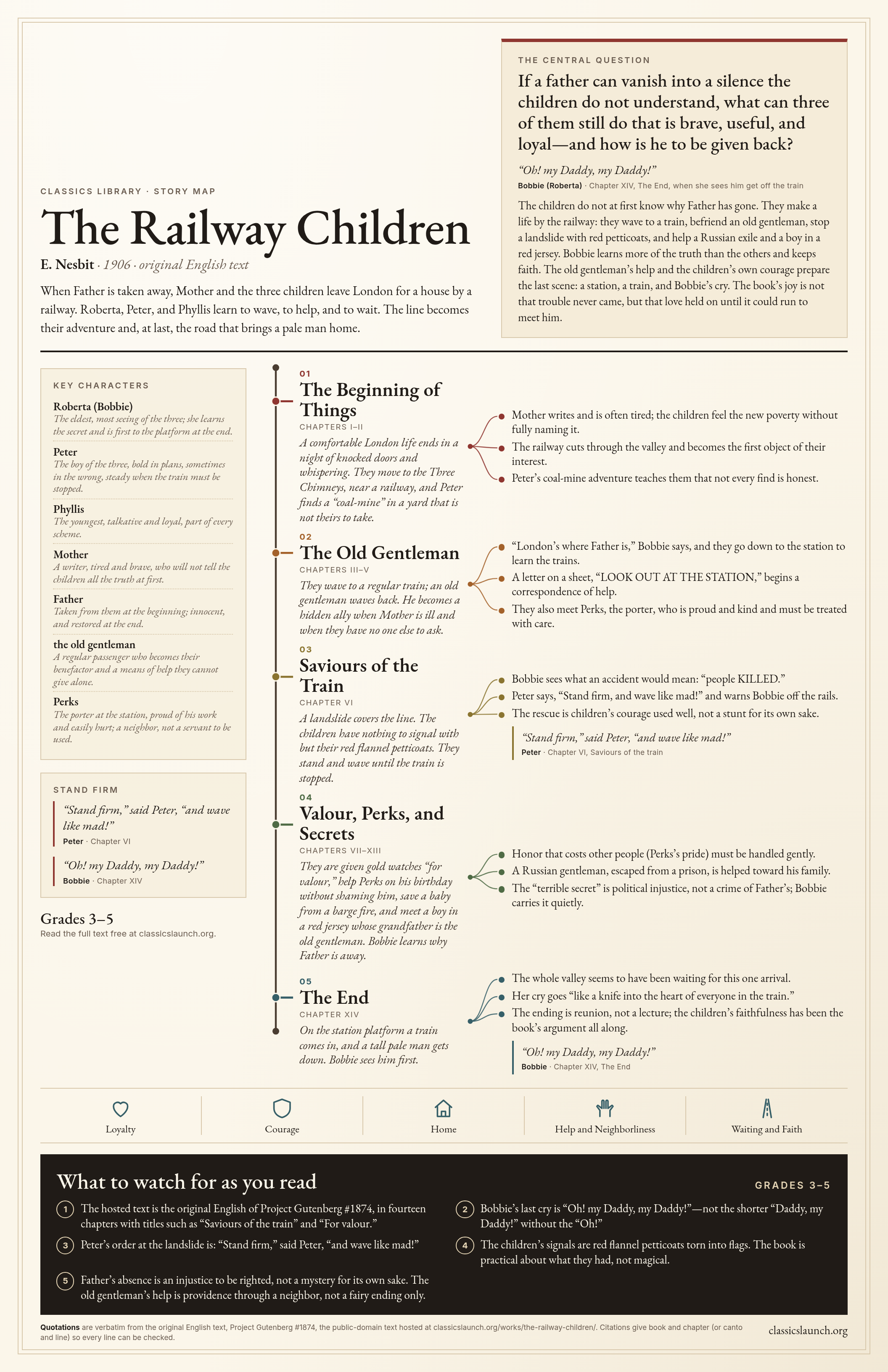
Every quotation is word for word from the original English text hosted in this library and is checked against that text each time the site is built. Citations give book and chapter (or canto and line).