Story maps · Grades 9–12
The Red Badge of Courage: A Story Map
The PDF is one tabloid page (11 × 17 in). On letter paper, choose “Fit to page.”
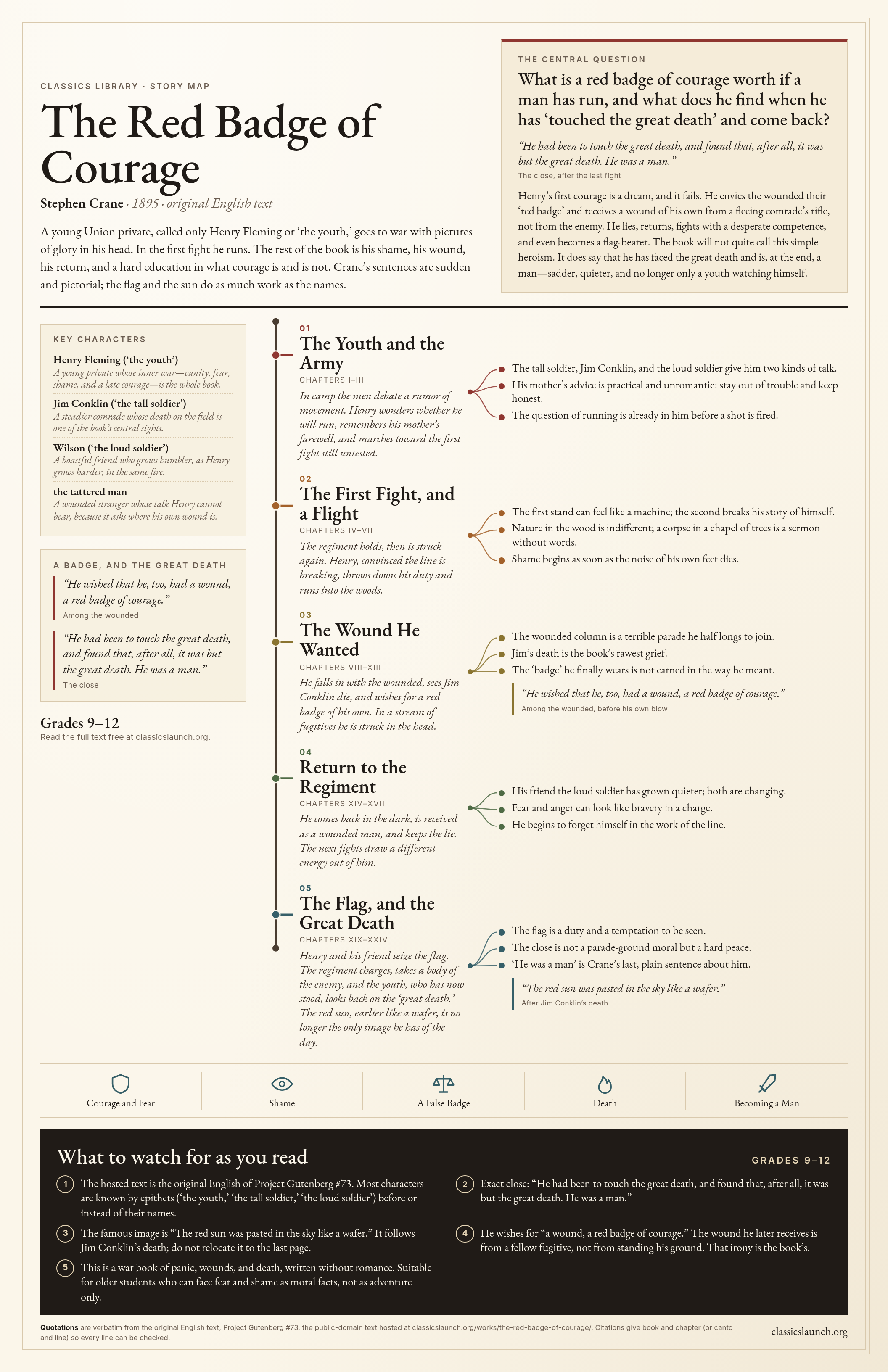
A young Union private, called only Henry Fleming or ‘the youth,’ goes to war with pictures of glory in his head. In the first fight he runs. The rest of the book is his shame, his wound, his return, and a hard education in what courage is and is not. Crane’s sentences are sudden and pictorial; the flag and the sun do as much work as the names.
The central question
What is a red badge of courage worth if a man has run, and what does he find when he has ‘touched the great death’ and come back?
“He had been to touch the great death, and found that, after all, it was but the great death. He was a man.”
Henry’s first courage is a dream, and it fails. He envies the wounded their ‘red badge’ and receives a wound of his own from a fleeing comrade’s rifle, not from the enemy. He lies, returns, fights with a desperate competence, and even becomes a flag-bearer. The book will not quite call this simple heroism. It does say that he has faced the great death and is, at the end, a man—sadder, quieter, and no longer only a youth watching himself.
- 01
The Youth and the Army
Chapters I–III
In camp the men debate a rumor of movement. Henry wonders whether he will run, remembers his mother’s farewell, and marches toward the first fight still untested.
- The tall soldier, Jim Conklin, and the loud soldier give him two kinds of talk.
- His mother’s advice is practical and unromantic: stay out of trouble and keep honest.
- The question of running is already in him before a shot is fired.
- 02
The First Fight, and a Flight
Chapters IV–VII
The regiment holds, then is struck again. Henry, convinced the line is breaking, throws down his duty and runs into the woods.
- The first stand can feel like a machine; the second breaks his story of himself.
- Nature in the wood is indifferent; a corpse in a chapel of trees is a sermon without words.
- Shame begins as soon as the noise of his own feet dies.
- 03
The Wound He Wanted
Chapters VIII–XIII
He falls in with the wounded, sees Jim Conklin die, and wishes for a red badge of his own. In a stream of fugitives he is struck in the head.
- The wounded column is a terrible parade he half longs to join.
- Jim’s death is the book’s rawest grief.
- The ‘badge’ he finally wears is not earned in the way he meant.
“He wished that he, too, had a wound, a red badge of courage.”
- 04
Return to the Regiment
Chapters XIV–XVIII
He comes back in the dark, is received as a wounded man, and keeps the lie. The next fights draw a different energy out of him.
- His friend the loud soldier has grown quieter; both are changing.
- Fear and anger can look like bravery in a charge.
- He begins to forget himself in the work of the line.
- 05
The Flag, and the Great Death
Chapters XIX–XXIV
Henry and his friend seize the flag. The regiment charges, takes a body of the enemy, and the youth, who has now stood, looks back on the ‘great death.’ The red sun, earlier like a wafer, is no longer the only image he has of the day.
- The flag is a duty and a temptation to be seen.
- The close is not a parade-ground moral but a hard peace.
- ‘He was a man’ is Crane’s last, plain sentence about him.
“The red sun was pasted in the sky like a wafer.”
- Courage and Fear
- Shame
- A False Badge
- Death
- Becoming a Man
What to watch for as you read
Grades 9–12- The hosted text is the original English of Project Gutenberg #73. Most characters are known by epithets (‘the youth,’ ‘the tall soldier,’ ‘the loud soldier’) before or instead of their names.
- Exact close: “He had been to touch the great death, and found that, after all, it was but the great death. He was a man.”
- The famous image is “The red sun was pasted in the sky like a wafer.” It follows Jim Conklin’s death; do not relocate it to the last page.
- He wishes for “a wound, a red badge of courage.” The wound he later receives is from a fellow fugitive, not from standing his ground. That irony is the book’s.
- This is a war book of panic, wounds, and death, written without romance. Suitable for older students who can face fear and shame as moral facts, not as adventure only.
Every quotation is word for word from the original English text hosted in this library and is checked against that text each time the site is built. Citations give book and chapter (or canto and line).