Story maps · Grades 2–6
The Red Fairy Book: A Story Map
The PDF is one tabloid page (11 × 17 in). On letter paper, choose “Fit to page.”
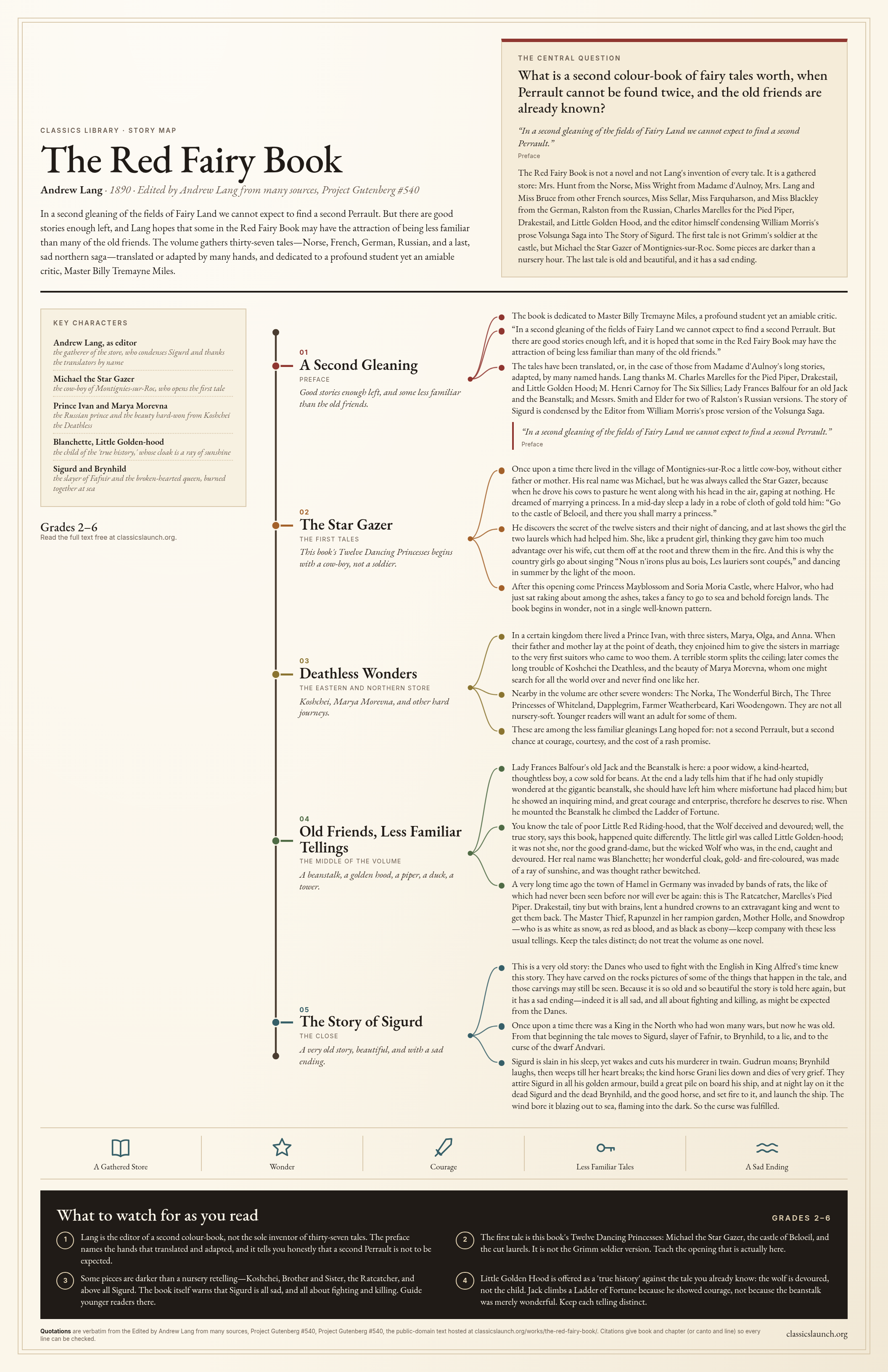
In a second gleaning of the fields of Fairy Land we cannot expect to find a second Perrault. But there are good stories enough left, and Lang hopes that some in the Red Fairy Book may have the attraction of being less familiar than many of the old friends. The volume gathers thirty-seven tales—Norse, French, German, Russian, and a last, sad northern saga—translated or adapted by many hands, and dedicated to a profound student yet an amiable critic, Master Billy Tremayne Miles.
The central question
What is a second colour-book of fairy tales worth, when Perrault cannot be found twice, and the old friends are already known?
“In a second gleaning of the fields of Fairy Land we cannot expect to find a second Perrault.”
The Red Fairy Book is not a novel and not Lang's invention of every tale. It is a gathered store: Mrs. Hunt from the Norse, Miss Wright from Madame d'Aulnoy, Mrs. Lang and Miss Bruce from other French sources, Miss Sellar, Miss Farquharson, and Miss Blackley from the German, Ralston from the Russian, Charles Marelles for the Pied Piper, Drakestail, and Little Golden Hood, and the editor himself condensing William Morris's prose Volsunga Saga into The Story of Sigurd. The first tale is not Grimm's soldier at the castle, but Michael the Star Gazer of Montignies-sur-Roc. Some pieces are darker than a nursery hour. The last tale is old and beautiful, and it has a sad ending.
- 01
A Second Gleaning
Preface
Good stories enough left, and some less familiar than the old friends.
- The book is dedicated to Master Billy Tremayne Miles, a profound student yet an amiable critic.
- “In a second gleaning of the fields of Fairy Land we cannot expect to find a second Perrault. But there are good stories enough left, and it is hoped that some in the Red Fairy Book may have the attraction of being less familiar than many of the old friends.”
- The tales have been translated, or, in the case of those from Madame d'Aulnoy's long stories, adapted, by many named hands. Lang thanks M. Charles Marelles for the Pied Piper, Drakestail, and Little Golden Hood; M. Henri Carnoy for The Six Sillies; Lady Frances Balfour for an old Jack and the Beanstalk; and Messrs. Smith and Elder for two of Ralston's Russian versions. The story of Sigurd is condensed by the Editor from William Morris's prose version of the Volsunga Saga.
“In a second gleaning of the fields of Fairy Land we cannot expect to find a second Perrault.”
- 02
The Star Gazer
The first tales
This book's Twelve Dancing Princesses begins with a cow-boy, not a soldier.
- Once upon a time there lived in the village of Montignies-sur-Roc a little cow-boy, without either father or mother. His real name was Michael, but he was always called the Star Gazer, because when he drove his cows to pasture he went along with his head in the air, gaping at nothing. He dreamed of marrying a princess. In a mid-day sleep a lady in a robe of cloth of gold told him: “Go to the castle of Beloeil, and there you shall marry a princess.”
- He discovers the secret of the twelve sisters and their night of dancing, and at last shows the girl the two laurels which had helped him. She, like a prudent girl, thinking they gave him too much advantage over his wife, cut them off at the root and threw them in the fire. And this is why the country girls go about singing “Nous n'irons plus au bois, Les lauriers sont coupés,” and dancing in summer by the light of the moon.
- After this opening come Princess Mayblossom and Soria Moria Castle, where Halvor, who had just sat raking about among the ashes, takes a fancy to go to sea and behold foreign lands. The book begins in wonder, not in a single well-known pattern.
- 03
Deathless Wonders
The eastern and northern store
Koshchei, Marya Morevna, and other hard journeys.
- In a certain kingdom there lived a Prince Ivan, with three sisters, Marya, Olga, and Anna. When their father and mother lay at the point of death, they enjoined him to give the sisters in marriage to the very first suitors who came to woo them. A terrible storm splits the ceiling; later comes the long trouble of Koshchei the Deathless, and the beauty of Marya Morevna, whom one might search for all the world over and never find one like her.
- Nearby in the volume are other severe wonders: The Norka, The Wonderful Birch, The Three Princesses of Whiteland, Dapplegrim, Farmer Weatherbeard, Kari Woodengown. They are not all nursery-soft. Younger readers will want an adult for some of them.
- These are among the less familiar gleanings Lang hoped for: not a second Perrault, but a second chance at courage, courtesy, and the cost of a rash promise.
- 04
Old Friends, Less Familiar Tellings
The middle of the volume
A beanstalk, a golden hood, a piper, a duck, a tower.
- Lady Frances Balfour's old Jack and the Beanstalk is here: a poor widow, a kind-hearted, thoughtless boy, a cow sold for beans. At the end a lady tells him that if he had only stupidly wondered at the gigantic beanstalk, she should have left him where misfortune had placed him; but he showed an inquiring mind, and great courage and enterprise, therefore he deserves to rise. When he mounted the Beanstalk he climbed the Ladder of Fortune.
- You know the tale of poor Little Red Riding-hood, that the Wolf deceived and devoured; well, the true story, says this book, happened quite differently. The little girl was called Little Golden-hood; it was not she, nor the good grand-dame, but the wicked Wolf who was, in the end, caught and devoured. Her real name was Blanchette; her wonderful cloak, gold- and fire-coloured, was made of a ray of sunshine, and was thought rather bewitched.
- A very long time ago the town of Hamel in Germany was invaded by bands of rats, the like of which had never been seen before nor will ever be again: this is The Ratcatcher, Marelles's Pied Piper. Drakestail, tiny but with brains, lent a hundred crowns to an extravagant king and went to get them back. The Master Thief, Rapunzel in her rampion garden, Mother Holle, and Snowdrop—who is as white as snow, as red as blood, and as black as ebony—keep company with these less usual tellings. Keep the tales distinct; do not treat the volume as one novel.
- 05
The Story of Sigurd
The close
A very old story, beautiful, and with a sad ending.
- This is a very old story: the Danes who used to fight with the English in King Alfred's time knew this story. They have carved on the rocks pictures of some of the things that happen in the tale, and those carvings may still be seen. Because it is so old and so beautiful the story is told here again, but it has a sad ending—indeed it is all sad, and all about fighting and killing, as might be expected from the Danes.
- Once upon a time there was a King in the North who had won many wars, but now he was old. From that beginning the tale moves to Sigurd, slayer of Fafnir, to Brynhild, to a lie, and to the curse of the dwarf Andvari.
- Sigurd is slain in his sleep, yet wakes and cuts his murderer in twain. Gudrun moans; Brynhild laughs, then weeps till her heart breaks; the kind horse Grani lies down and dies of very grief. They attire Sigurd in all his golden armour, build a great pile on board his ship, and at night lay on it the dead Sigurd and the dead Brynhild, and the good horse, and set fire to it, and launch the ship. The wind bore it blazing out to sea, flaming into the dark. So the curse was fulfilled.
- A Gathered Store
- Wonder
- Courage
- Less Familiar Tales
- A Sad Ending
What to watch for as you read
Grades 2–6- Lang is the editor of a second colour-book, not the sole inventor of thirty-seven tales. The preface names the hands that translated and adapted, and it tells you honestly that a second Perrault is not to be expected.
- The first tale is this book's Twelve Dancing Princesses: Michael the Star Gazer, the castle of Beloeil, and the cut laurels. It is not the Grimm soldier version. Teach the opening that is actually here.
- Some pieces are darker than a nursery retelling—Koshchei, Brother and Sister, the Ratcatcher, and above all Sigurd. The book itself warns that Sigurd is all sad, and all about fighting and killing. Guide younger readers there.
- Little Golden Hood is offered as a 'true history' against the tale you already know: the wolf is devoured, not the child. Jack climbs a Ladder of Fortune because he showed courage, not because the beanstalk was merely wonderful. Keep each telling distinct.
Every quotation is word for word from the Edited by Andrew Lang from many sources, Project Gutenberg #540 hosted in this library and is checked against that text each time the site is built. Citations give book and chapter (or canto and line).