Work record
The Red Fairy Book
Andrew LangThe Red Fairy Book by Andrew Lang (1890)The Red Fairy Book (1890) is the second of Andrew Lang's colored fairy-book collections, a cupboard of traditional tales gathered for English-speaking children from French, Norse, German, Romanian, Russian, and other sources.1890 · 19th Century · Collection · English
Read this when a family wants a second cupboard of older fairy tales.
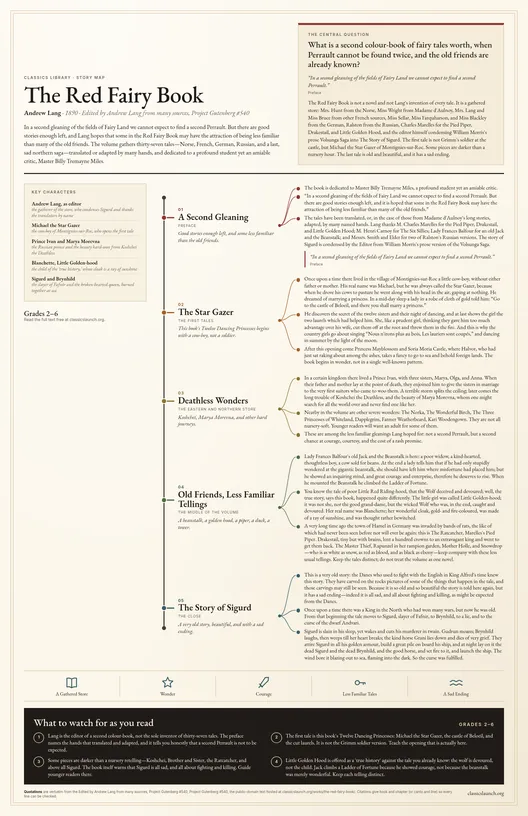 Story mapSee the story mapThe whole book on one page: the story in movements, the characters, and what to watch for. Free to print.
Abstract
A second gleaning. Lang's preface presents the book as a second gathering of fairy tales, not a second Perrault, and hopes some stories will feel less familiar than the old friends. Translators and adapters, including Mrs. Lang, supply the English.
The cupboard. The collection moves from the Twelve Dancing Princesses to northern quests, a Jack tale, Rapunzel, Mother Holle, Little Golden Hood, and, at the end, the story of Sigurd, among many others.
How to read it. Because it is a collection, families may choose a few tales at a time rather than march through every chapter. The tone stays that of the old stories, sometimes stern, and is not recast as a present-day lesson plan. Young listeners can retell the events in order and talk about the choices without needing a lecture from the narrator. A text-only reading is well paired with an illustrated copy whenever one is at hand. The complete English text of The Red Fairy Book is hosted here from a verified public-domain transcription of the 1890 book, so families can read the words freely. Families can linger over the pictures and retell the events in their own words. The sequence is short enough to narrate after a single sitting.
Main characters
- Andrew Lang: The editor who gathered and introduced the colored Fairy Books.
- The storytellers and translators: Mrs. Lang, Mrs. Hunt, Miss Wright, and others who made the English versions.
- Sigurd: The hero of the closing tale, condensed by Lang from Morris's Volsunga Saga.
Summary
The Red Fairy Book (1890) is the second of Andrew Lang's colored fairy-book collections, a cupboard of traditional tales gathered for English-speaking children from French, Norse, German, Romanian, Russian, and other sources. Lang's preface calls the volume a second gleaning of Fairy Land, not a second Perrault, and hopes that some of the stories will have the attraction of being less familiar than the old friends. Mrs. Lang and other translators and adapters — among them Mrs. Hunt, Miss Minnie Wright, and, for 'The Story of Sigurd,' Lang himself working from William Morris's prose of the Volsunga Saga — supply the English. The book opens with a version of the Twelve Dancing Princesses and goes on to Soria Moria Castle, the death of Koshchei the Deathless, The Master Thief, Jack and the Beanstalk, Rapunzel, Mother Holle, The Golden Goose, a 'true history' of Little Golden Hood, and many more, thirty-seven tales in all if one counts the list in the contents. Families can read a single story on a winter evening, or they can use the collection as a shelf beside The Blue Fairy Book, noticing how often courage, cunning, kindness to a strange helper, and a kept word decide the ending. The stories are old, sometimes stern, and not rewritten as modern lessons. This library hosts the complete public-domain English text from Project Gutenberg #540. Because the book is a collection, a first reading might choose four or five tales — a princess story, a northern quest, a household tale, and Sigurd — and leave the rest for later, rather than marching through every chapter in order. An illustrated older edition is a welcome companion, but the words themselves are here in full, to be read aloud and talked about in a classical Christian classroom or at home. It is a book to return to.
Virtues in this work
Plot or Argument
- The preface
Lang presents a second gleaning of fairy tales and names his translators and sources.
- Many tales
Princess stories, northern quests, household tales, and a Jack tale fill the middle of the book.
- Sigurd at the end
The collection closes with a condensed story of Sigurd from the Volsunga Saga.
Characters
- Andrew Lang, editor
The editor who gathered and introduced the colored Fairy Books.
- The storytellers and translators, contributors
Mrs. Lang, Mrs. Hunt, Miss Wright, and others who made the English versions.
Lessons
A collection, not one plot
The book is a cupboard of tales; it should be read a story at a time.
- What does Lang say he is offering in the preface?
- How would you choose a first handful of tales?
Old friends and less familiar ones
Some stories are widely known; others are not.
- Name one tale you already knew and one that was new.
- Why might Lang think unfamiliarity is an attraction?
Sternness and wonder
Traditional tales are not always gentle, and they are not rewritten here as modern lessons.
- Which story felt stern, and why?
- What virtues do you see deciding an ending — a kept word, courage, or kindness to a helper?
Context
Andrew Lang's second colored Fairy Book gathers traditional tales from several European languages for English-speaking children, with a preface that calls the volume a second gleaning rather than a second Perrault.
Composition
First published in 1890. The local text follows the public-domain English book at Project Gutenberg #540, including Lang's preface and the collected tales.
Reception
It has long stood on the shelf beside The Blue Fairy Book as a standard English cupboard of older stories for family reading.
Comparisons
- The Blue Fairy Book
The first of Lang's colored collections; the Red Book is a second gleaning, with some less familiar tales and a closing Sigurd.
- Aesop's Fables
Another gathered book of old stories for children; Aesop is brief and pointed, Lang's tales are longer quests and household wonders.
Quotes
“In a second gleaning of the fields of Fairy Land we cannot expect to find a second Perrault.”
“But there are good stories enough left, and it is hoped that some in the Red Fairy Book may have the attraction of being less familiar than many of the old friends.”
For Students
A reading companion for classical Christian high school students. See the student guide.
Reading Guide
Watch for
- What Lang says in the preface about a second gleaning.
- That the book is many tales, not one plot.
- How a family might choose a first handful of stories.
Key terms and names
- Collection
- A book made of many separate tales rather than one long novel.
- Preface
- The editor's opening remarks; here Lang explains the second gleaning and thanks his helpers.
- Traditional tale
- A story handed down and retold, not invented for this volume alone.
- Saga
- An old northern narrative; the Sigurd story is condensed from the Volsunga Saga.
Seminar Questions
- Comprehension What does Lang say he is doing in the preface?
- Comprehension Name three tales included in the book.
- Interpretation Why might a 'less familiar' story be attractive in a second collection?
- Interpretation How should a family read a stern fairy tale with children?
- Big Question What makes a traditional tale worth keeping, even when it is not gentle?
- Big Question How does Philippians 4:8 help a family choose which tales to linger on, without demanding that every old story be remade?
Faith Connections
- Philippians 4:8 (Scripture)
Whatever is true, honorable, and lovely: a way to choose tales to linger on, not a demand that every old story be remade.
- Psalm 78:2-4 (Scripture)
Telling the coming generation things heard and known: a frame for handing on traditional stories with care.
Logic and Rhetoric
Central argument: A second collection can be valuable precisely because some of its stories are less familiar, and old tales need not be rewritten as modern lessons.
Rhetorical device: Anthology. Many short tales, gathered and introduced, invite a family to choose and return rather than to read only once from cover to cover.
Debate: Resolved: Unfamiliar old stories are worth opening, not only the handful everyone already knows.
Writing Prompts
Essay: Explain what kind of book this is, using the preface and two tales you actually read.
Comparison with The Blue Fairy Book: Compare the two collections: how you would choose tales from each, and what the Red Book adds that the Blue Book does not.
Creative Prompts
- Classroom
Choose four tales from different parts of the book and make a simple map of heroes, helpers, dangers, and endings.
- Essay
Compare one familiar tale in the book with one you did not know. What do they share, and what is different?
- Fiction
Write a one-page retelling of a single episode — a climb, a dance, a bargain — in your own words, without copying the book's sentences.
Further Reading
Verification notes
Primary text checked against the edition identified in fullText. No unverified quotations or page numbers supplied. Recommended grades concern teaching suitability, not a mechanical reading score.
No verification flags recorded.