Story maps · Grades 6–8
The Sketch Book of Geoffrey Crayon, Gent.: A Story Map
The PDF is one tabloid page (11 × 17 in). On letter paper, choose “Fit to page.”
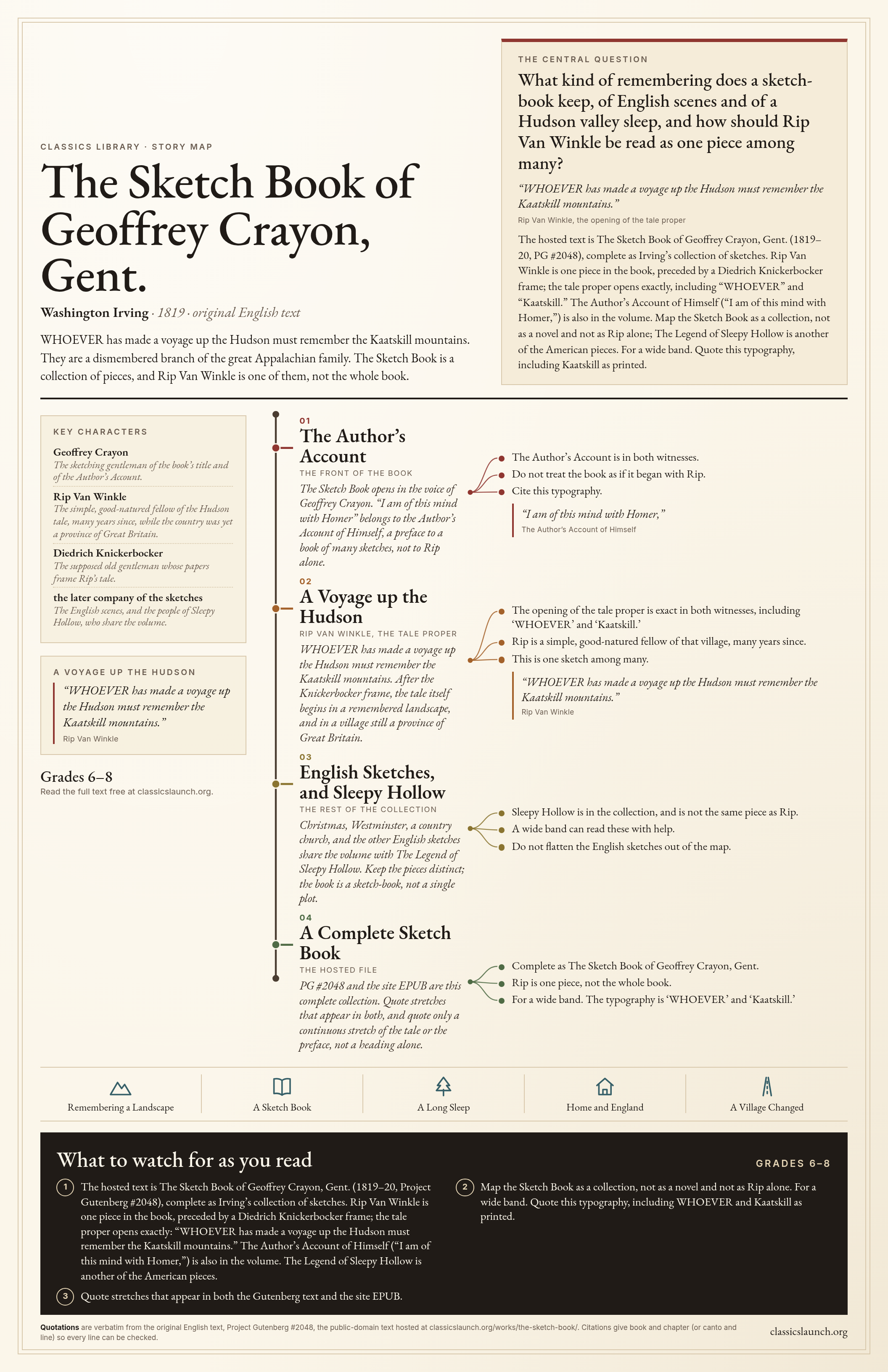
WHOEVER has made a voyage up the Hudson must remember the Kaatskill mountains. They are a dismembered branch of the great Appalachian family. The Sketch Book is a collection of pieces, and Rip Van Winkle is one of them, not the whole book.
The central question
What kind of remembering does a sketch-book keep, of English scenes and of a Hudson valley sleep, and how should Rip Van Winkle be read as one piece among many?
“WHOEVER has made a voyage up the Hudson must remember the Kaatskill mountains.”
The hosted text is The Sketch Book of Geoffrey Crayon, Gent. (1819–20, PG #2048), complete as Irving’s collection of sketches. Rip Van Winkle is one piece in the book, preceded by a Diedrich Knickerbocker frame; the tale proper opens exactly, including “WHOEVER” and “Kaatskill.” The Author’s Account of Himself (“I am of this mind with Homer,”) is also in the volume. Map the Sketch Book as a collection, not as a novel and not as Rip alone; The Legend of Sleepy Hollow is another of the American pieces. For a wide band. Quote this typography, including Kaatskill as printed.
- 01
The Author’s Account
The front of the book
The Sketch Book opens in the voice of Geoffrey Crayon. “I am of this mind with Homer” belongs to the Author’s Account of Himself, a preface to a book of many sketches, not to Rip alone.
- The Author’s Account is in both witnesses.
- Do not treat the book as if it began with Rip.
- Cite this typography.
“I am of this mind with Homer,”
- 02
A Voyage up the Hudson
Rip Van Winkle, the tale proper
WHOEVER has made a voyage up the Hudson must remember the Kaatskill mountains. After the Knickerbocker frame, the tale itself begins in a remembered landscape, and in a village still a province of Great Britain.
- The opening of the tale proper is exact in both witnesses, including ‘WHOEVER’ and ‘Kaatskill.’
- Rip is a simple, good-natured fellow of that village, many years since.
- This is one sketch among many.
“WHOEVER has made a voyage up the Hudson must remember the Kaatskill mountains.”
- 03
English Sketches, and Sleepy Hollow
The rest of the collection
Christmas, Westminster, a country church, and the other English sketches share the volume with The Legend of Sleepy Hollow. Keep the pieces distinct; the book is a sketch-book, not a single plot.
- Sleepy Hollow is in the collection, and is not the same piece as Rip.
- A wide band can read these with help.
- Do not flatten the English sketches out of the map.
- 04
A Complete Sketch Book
The hosted file
PG #2048 and the site EPUB are this complete collection. Quote stretches that appear in both, and quote only a continuous stretch of the tale or the preface, not a heading alone.
- Complete as The Sketch Book of Geoffrey Crayon, Gent.
- Rip is one piece, not the whole book.
- For a wide band. The typography is ‘WHOEVER’ and ‘Kaatskill.’
- Remembering a Landscape
- A Sketch Book
- A Long Sleep
- Home and England
- A Village Changed
What to watch for as you read
Grades 6–8- The hosted text is The Sketch Book of Geoffrey Crayon, Gent. (1819–20, Project Gutenberg #2048), complete as Irving’s collection of sketches. Rip Van Winkle is one piece in the book, preceded by a Diedrich Knickerbocker frame; the tale proper opens exactly: “WHOEVER has made a voyage up the Hudson must remember the Kaatskill mountains.” The Author’s Account of Himself (“I am of this mind with Homer,”) is also in the volume. The Legend of Sleepy Hollow is another of the American pieces.
- Map the Sketch Book as a collection, not as a novel and not as Rip alone. For a wide band. Quote this typography, including WHOEVER and Kaatskill as printed.
- Quote stretches that appear in both the Gutenberg text and the site EPUB.
Every quotation is word for word from the original English text hosted in this library and is checked against that text each time the site is built. Citations give book and chapter (or canto and line).