Work record
The Sketch Book of Geoffrey Crayon, Gent.
1819-1820 · 19th Century · Short Stories · English
Abstract
Background. Stranded in Britain when his family's business collapsed, Irving turned his notebooks into saleable prose and mailed the pieces home. Their mild, observant persona let an American sit comfortably among English hedgerows and abbeys without either flattering or sneering.
Content. Most pieces record a traveler's impressions: an ocean crossing, mourners at a village church, Eastcheap, the poet-king James I of Scotland, Shakespeare's birthplace, and a Yorkshire Christmas of carols, games and a boar's head. Interspersed are a German ghost comedy, essays on the native nations of New England, and two Hudson valley legends. In one, a ne'er-do-well naps through the Revolution; in the other, a credulous teacher flees a phantom rider and vanishes.
Form. Sentimental essays, antiquarian rambles and comic tales alternate, so that pathos and humor check each other. The two American stories wear an extra disguise, presented as papers left by a dead historian, with notes swearing to their truth.
Themes. Time's erosion of fame and custom, homesickness and transatlantic kinship, mourning and remembrance, the comedy of idleness and greed, and the making of local legend for a country that had few of its own.
Significance. Irving won the first broad British audience for an American writer, and his two Knickerbocker legends became the cornerstone of a native American storytelling tradition, retold endlessly in print, theater and film.
Main characters
- Geoffrey Crayon: Bachelor traveler and pseudonymous author of the sketches
- Diedrich Knickerbocker: Invented antiquarian to whom both New York legends are credited
- Rip Van Winkle: Easygoing Catskill villager who wakes two decades later
- Ichabod Crane: Superstitious Yankee schoolmaster with designs on a farm fortune
- Brom Bones: Swaggering horseman suspected of playing the spectre
- Katrina Van Tassel: Coquettish only child of a wealthy Dutch farmer
- Squire Bracebridge: Yorkshire gentleman who keeps the old Christmas rites

Summary
The Sketch Book is a miscellany of essays, travel sketches and tales presented as the notebook of Geoffrey Crayon, a genial American bachelor who crosses the Atlantic to look at the England he has known from books. Crayon opens by explaining that he wanders to see the shifting scenes of life, then describes the voyage itself, a visit to the Liverpool historian William Roscoe, and a portrait of a wife who sustains her ruined husband. Two tales set in the Dutch villages of the Hudson valley, both credited to the late historian Diedrich Knickerbocker, became the most famous pieces in the book. In Rip Van Winkle, a kindly, idle villager in the Catskills escapes his scolding wife by wandering into the mountains with his dog Wolf, meets a silent crew of old-fashioned Dutchmen playing at ninepins, drinks from their flagon, and falls asleep. He wakes with a long beard and a rusted gun, walks home to find the King George sign replaced by one of General Washington, his wife dead, his friends gone, and the village arguing about elections; after a moment of terror in which he cannot say who he is, his grown daughter Judith takes him in, and he lives out his days telling his story at the inn door. In The Legend of Sleepy Hollow, the lanky Connecticut schoolmaster Ichabod Crane, a lover of good food and ghost stories, courts Katrina Van Tassel, the plump heiress of a rich farm, against the rough prankster Brom Bones. After a harvest party where the guests trade tales of the Headless Horseman, a Hessian trooper said to ride in search of his head, Ichabod rides home on a borrowed plough-horse, is chased to the church bridge by a headless rider, and is struck down by a flung head. Next morning only his hat and a smashed pumpkin are found; Brom marries Katrina and laughs knowingly whenever the pumpkin is mentioned. Between the American tales Crayon visits English places and customs: a village church and a grieving widow, rural funerals, Westminster Abbey, the Boar's Head Tavern in Eastcheap, Shakespeare's Stratford, a German ghost story called The Spectre Bridegroom, and five linked sketches of an old-fashioned Christmas at Bracebridge Hall, with its squire, Master Simon, carols, wassail and yule log. Two essays on the Indians of New England, including a sympathetic portrait of King Philip, and a humorous sketch of John Bull complete the range. Irving issued the book in seven paperbound numbers in New York between 1819 and 1820, and it appeared in two volumes in London in 1820; the library text is the revised edition with Irving's later preface.
Virtues in this work
- Industry: Rip will help any neighbor but neglects his own farm, and his twenty-year sleep turns that idleness into a fable.
- Charity: Squire Bracebridge opens his hall to tenants and villagers at Christmas, and Crayon praises the season for kindling charity in the heart.
- Piety: In The Widow and Her Son, the old mother keeps coming to the village church to worship even in the depth of her grief.
- Prudence: Ichabod's greed for the Van Tassel farm and his belief in every ghost story leave him easy prey for Brom Bones's trick.
Plot or Argument
- Crayon sets out: the voyage and first portraits
The Author's Account of Himself, The Voyage, Roscoe and The Wife introduce the narrator, the Atlantic crossing, a Liverpool scholar ruined in business, and a devoted wife.
- Rip Van Winkle
A henpecked Catskill villager sleeps twenty years after drinking with Hendrick Hudson's ghostly crew and wakes into the new republic; a note and postscript from Knickerbocker vouch for the tale.
- England observed
English Writers on America, Rural Life in England, The Broken Heart, The Art of Book-making, A Royal Poet, The Country Church and The Widow and Her Son mix argument, description and pathos.
- Old London and the Spectre Bridegroom
The Boar's Head Tavern, The Mutability of Literature, Rural Funerals, The Inn Kitchen, The Spectre Bridegroom and Westminster Abbey turn to Falstaff's tavern, forgotten books, mourning customs, a comic German ghost tale and the tombs of kings.
- Christmas at Bracebridge Hall
Christmas, The Stage-Coach, Christmas Eve, Christmas Day and The Christmas Dinner follow Crayon to a Yorkshire squire's house where ancient holiday customs are kept.
- Antiquities, Stratford and the Indians of New England
London Antiques, Little Britain, Stratford-on-Avon, Traits of Indian Character, Philip of Pokanoket, John Bull, The Pride of the Village and The Angler range from city curiosities to American history and a dying village girl.
- The Legend of Sleepy Hollow
Ichabod Crane courts Katrina Van Tassel, rivals Brom Bones, hears ghost stories at the Van Tassel party, and disappears after the Headless Horseman's chase; Knickerbocker's postscript records a listener's doubts.
Characters
- Geoffrey Crayon, narrator
Irving's genial, sentimental persona, an American gentleman sketching England and its customs.
- Diedrich Knickerbocker, fictional historian
The late Dutch-New York antiquarian among whose papers the two Hudson valley tales were supposedly found.
- Rip Van Winkle, hero of the first American tale
A good-natured, idle villager, loved by children and dogs, who sleeps away twenty years.
- Dame Van Winkle, Rip's wife
A sharp-tongued housewife exasperated by her husband's neglect of his farm.
- Wolf, Rip's dog
Rip's fellow sufferer in domestic persecution and companion on the mountain.
- Ichabod Crane, schoolmaster of Sleepy Hollow
A lanky, credulous, hungry Connecticut pedagogue and singing master who hopes to marry wealth.
- Katrina Van Tassel, heiress
The rosy daughter of a prosperous Dutch farmer, courted by Ichabod and Brom.
- Brom Bones, Ichabod's rival
Abraham Van Brunt, a burly horseman and practical joker who wins Katrina.
- The Headless Horseman, local spectre
The ghost of a Hessian trooper said to ride nightly in search of his head.
- Squire Bracebridge, host of the Christmas sketches
An old English country gentleman devoted to reviving ancient holiday customs.
- Master Simon, the squire's companion
A brisk old bachelor kinsman who leads the Christmas games and songs.
Lessons
Waking into a changed world
Rip sleeps through the American Revolution and wakes to find that the tavern sign has changed from King George to General Washington, though the faces under it are much the same. Irving uses a folk tale to ask what really changes when a nation changes and what a person keeps when everything familiar is gone.
- What signs tell Rip that time has passed, and which does he notice first?
- Why can Rip not say who he is when the villagers question him?
- Is Rip's life better or worse after his long sleep?
Credulity and the prank
Ichabod Crane believes every ghost story he reads in Cotton Mather and hears from the Dutch wives, and his fear makes him easy prey for a rival. The legend never tells us plainly what happened at the bridge, but the pumpkin and Brom's laughter let the reader judge. Irving teaches by comedy that fear and greed cloud the eyes.
- What does Ichabod want from Katrina, and how do we know?
- What clues suggest who the Headless Horseman really was?
Keeping old customs
The Christmas sketches show Squire Bracebridge reviving carols, the yule log, wassail and plain hospitality for his tenants. Crayon admires these customs because they bind rich and poor and the present to the past. The book treats tradition as something that must be loved to be kept.
- What customs does the squire keep, and why does he think they matter?
- How does Crayon describe the spirit of Christmas in the opening sketch?
Grief honored, not hurried
Several of the English sketches, among them The Widow and Her Son, Rural Funerals and The Broken Heart, dwell on mourning. Irving argues that sorrow for the dead is a sorrow people rightly refuse to forget, and that tender remembrance can make the living gentler.
- What does the widow's grief at the village church show Crayon?
- Why does Irving say we keep the wound of grief open?
Context
Irving wrote the sketches in England in the years after the War of 1812, when British reviewers often mocked American letters and American readers felt both kinship with and rivalry toward the old country. His Hudson valley tales look back to the Dutch settlements of New York and to the Revolutionary era, while his English pieces record customs and places that were already passing.
Composition
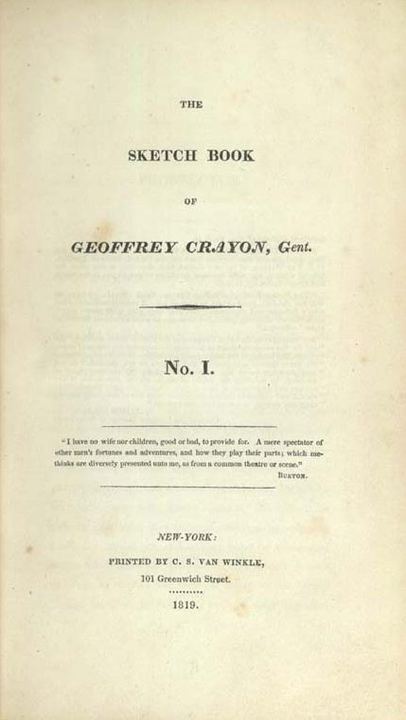
After the bankruptcy of his family's firm in 1818, Irving began sending manuscript sketches to New York, where they were issued by C. S. Van Winkle in seven paperbound numbers from June 1819 to 1820, under the pseudonym Geoffrey Crayon; Rip Van Winkle appeared in the first number and The Legend of Sleepy Hollow in the sixth. A London edition followed in 1820, published in the end by John Murray. Irving revised the text for the collected edition of his works in 1848, adding a new preface; the library text includes that preface.
Reception
The Sketch Book was a success on both sides of the Atlantic and made Irving the first American man of letters with an international reputation. Rip Van Winkle and The Legend of Sleepy Hollow became founding stories of American literature, often adapted for stage and screen, and the Bracebridge Christmas sketches helped renew affection for old English holiday customs before Dickens wrote A Christmas Carol.
Comparisons
- a-christmas-carol
Irving's Christmas Day and Christmas Dinner sketches celebrate holiday hospitality from the outside as a traveler's observation; Dickens turns the same warmth into a conversion story about a miser.
- henry-iv-part-1
Crayon's pilgrimage to the Boar's Head Tavern in Eastcheap goes looking for the scene of Falstaff's revels with Prince Hal and finds only relics and a sexton's gossip.
- the-scarlet-letter
Hawthorne's Custom-House preface, like Knickerbocker's papers, frames a tale of the American past with a found document; both writers gave their regions a usable legendary history.
- the-last-of-the-mohicans
Cooper's frontier romance and Irving's Traits of Indian Character and Philip of Pokanoket both portray the Indian nations of the Northeast with sympathy and with a sense of loss.
- the-adventures-of-tom-sawyer
Brom Bones's prank on Ichabod and Tom's tricks in St. Petersburg belong to the same tradition of American village comedy built on boasting, superstition and practical jokes.
Quotes
Frequently cited
“a tart temper never mellows with age, and a sharp tongue is the only edged tool that grows keener with constant use.”
Frequently cited
“The sorrow for the dead is the only sorrow from which we refuse to be divorced.”
Frequently cited
“History fades into fable; fact becomes clouded with doubt and controversy”
Frequently cited
“A drowsy, dreamy influence seems to hang over the land and to pervade the very atmosphere.”
Frequently cited
“He was tall, but exceedingly lank, with narrow shoulders, long arms and legs, hands that dangled a mile out of his sleeves, feet that might have served for shovels, and his whole frame most loosely hung together.”
“I was myself last night, but I fell asleep on the mountain, and they’ve changed my gun, and everything’s changed, and I’m changed, and I can’t tell what’s my name, or who I am!”
“I believe in broken hearts, and the possibility of dying of disappointed love!”
“It is, indeed, the season of regenerated feeling--the season for kindling not merely the fire of hospitality in the hall, but the genial flame of charity in the heart.”
For Students
A reading companion for classical Christian high school students. See the student guide.
Reading Guide
Watch for
- The tavern sign in Rip Van Winkle, and how it changes while Rip sleeps.
- The clues at the end of The Legend of Sleepy Hollow: the hat, the pumpkin, and Brom Bones's laughter.
- How Geoffrey Crayon introduces himself in The Author's Account of Himself and why he says he travels.
- The customs Squire Bracebridge keeps in the Christmas sketches, from the yule log to the boar's head.
- The notes and postscripts signed by Knickerbocker that claim the tales are true.
Key terms and names
- Geoffrey Crayon
- Irving's pen name and narrator; a crayon was a drawing pencil, so the book is a set of quick pencil sketches in words.
- Diedrich Knickerbocker
- The invented Dutch-New York historian credited with the two American tales; Irving had used him earlier for a comic history of New York.
- Ninepins
- A bowling game; the thunder in the Catskills is said to be Hendrick Hudson's crew playing it.
- Hessian
- A German soldier hired by Britain during the American Revolution; the Headless Horseman is said to be one who lost his head to a cannon-ball.
- Sketch
- A short, informal prose piece describing a scene, person or custom, as many of Crayon's English pieces do.
- Wassail
- Spiced ale or wine passed round in a bowl at old English Christmas feasts, served at Bracebridge Hall.
Seminar Questions
- Comprehension What happens to Rip in the mountains, and what does he find when he comes home?
- Comprehension Why does Ichabod Crane want to marry Katrina Van Tassel, and who is his rival?
- Comprehension What old customs does Crayon see at Bracebridge Hall at Christmas?
- Interpretation Irving never tells us directly who the Headless Horseman was. Why might he leave the ending open?
- Interpretation Rip sleeps through the Revolution. What does the story suggest changed in the village, and what stayed the same?
- Interpretation Why might an American writer fill half his book with English churches, tombs and holidays?
- Big Question Is it wise to hold on to old customs and old stories when the world around us changes?
Faith Connections
- Proverbs 6:9-11 (Scripture)
The sluggard is asked how long he will sleep, and poverty comes upon him. Rip, who would rather do anything than his own work, sleeps away twenty years of his life.
- Romans 12:15 (Scripture)
Paul tells believers to weep with those who weep. Crayon's sketch of the widow at the country church shows a stranger moved to share a poor mother's grief.
- Luke 2:10-14 (Scripture)
The angels' good tidings of great joy stand behind the carols sung at Bracebridge Hall, and Crayon calls Christmas the season for kindling charity in the heart.
Logic and Rhetoric
Central argument: The customs, legends and memories of a place give its people a shared life. England keeps these in its churches, inns and holidays, while the young American republic has fewer of them. Therefore Irving gathers old English customs with affection and invents Dutch legends for the Hudson, so that his country, too, can have stories that bind it to its past.
Rhetorical device: mock-authentication. The note after Rip Van Winkle quotes Knickerbocker swearing he has talked with Rip himself and seen a certificate signed before a country justice, a solemn claim that makes the tall tale funnier.
Debate: Resolved: that Brom Bones, not a ghost, drove Ichabod Crane out of Sleepy Hollow.
Memory Work
a tart temper never mellows with age, and a sharp tongue is the only edged tool that grows keener with constant use.
It is, indeed, the season of regenerated feeling--the season for kindling not merely the fire of hospitality in the hall, but the genial flame of charity in the heart.
Writing Prompts
Essay: Compare Rip Van Winkle and Ichabod Crane as outsiders in their villages. Using both tales, argue which man the village treats more justly.
Comparison with A Christmas Carol: Compare the Christmas at Bracebridge Hall with the Cratchits' and Fezziwig's Christmases in Dickens. What does each writer think keeps Christmas alive?
Medical Lens
The Sketch Book is a useful source for the sentimental medicine of grief around 1820. In The Broken Heart and The Pride of the Village Irving takes seriously the period belief that disappointed love could bring on a fatal decline, describing young women who waste away in silent melancholy; these are literary portraits in the tradition of lovesickness, not case histories, and any modern reading of them as depression or consumption is speculative. The Widow and Her Son and Rural Funerals treat mourning customs and the duty of remembrance with real psychological attention. Rip Van Winkle offers the comic counterpart: a long sleep after a flagon of spirits, a wakened man who cannot fix his identity, and Dame Van Winkle's death from a broken blood-vessel in a fit of passion, a common period explanation for sudden death in anger. Sleepy Hollow's atmosphere of trances, visions and the nightmare shows how a whole community could be described as prone to waking dreams.
- Rip Van Winkle
Rip drinks repeatedly from the ninepin players' flagon, sleeps twenty years, and on waking at first blames the flagon; later he cannot say who he is before the village crowd.
- Rip Van Winkle
Judith reports that her mother died after breaking a blood-vessel in a fit of passion at a New England peddler.
- The Broken Heart
Crayon argues that women can die of disappointed love and tells of a betrothed girl who wastes away in melancholy after her lover's execution.
- The Widow and Her Son; Rural Funerals
A poor widow mourns her only son, a sailor who comes home to die; Crayon describes English burial flowers and reflects on the sorrow for the dead.
- The Pride of the Village
A village girl deserted by an officer declines through the spring and dies, the parish mourning at her funeral.
- The Legend of Sleepy Hollow, opening
The inhabitants are said to live in a continual reverie, subject to trances and visions, and haunted by the nightmare.
Listen to the book
Public-domain audiobook from LibriVox, read by Various volunteers. Recording: Sketch Book of Geoffrey Crayon, Gent. on LibriVox (Internet Archive).
LibriVox recordings are volunteer readings released into the public domain. The reading may follow a different edition from the text in this library.
Creative Prompts
- Fiction
Write Rip's first evening at his daughter Judith's house, when he tries to understand what happened in the twenty years he slept.
- Classroom
Hold a village inquest into Ichabod Crane's disappearance: assign students to be Brom Bones, Katrina, Hans Van Ripper and the old Dutch wives, and decide what the evidence of the hat and pumpkin proves.
- Essay
Geoffrey Crayon is a gentle observer who rarely judges. Choose two English sketches and show how his manner of seeing shapes what the reader feels.
- Adaptation
Turn the Christmas Dinner at Bracebridge Hall into a short play for the class, with the squire, Master Simon, the boar's head carol and the wassail bowl.
Further Reading
- A History of New York (Knickerbocker's History), Washington Irving
The comic history that created Diedrich Knickerbocker.
- Bracebridge Hall, Washington Irving
Irving's 1822 sequel returning to the squire's household.
- Washington Irving: An American Original, Brian Jay Jones
- The Life of Washington Irving, Stanley T. Williams
Verification notes
Publication facts checked against standard reference accounts (https://en.wikipedia.org/wiki/The_Sketch_Book_of_Geoffrey_Crayon,_Gent.): seven numbers issued by C. S. Van Winkle from June 1819, with Rip Van Winkle in No. 1 and The Legend of Sleepy Hollow in No. 6. Sources give the date of the last number variously as July or September 1820, so the record says only 1820. The library text is Project Gutenberg #2048, the revised edition with Irving's later preface, and contains thirty-two sketches and tales by its headings; counts of the original contents differ by edition. All quotations were checked by exact search against that text. The Broken Heart does not name its heroine; she is usually identified with Sarah Curran, but the record does not rely on that.
No verification flags recorded.