Story maps · Grades 6–8
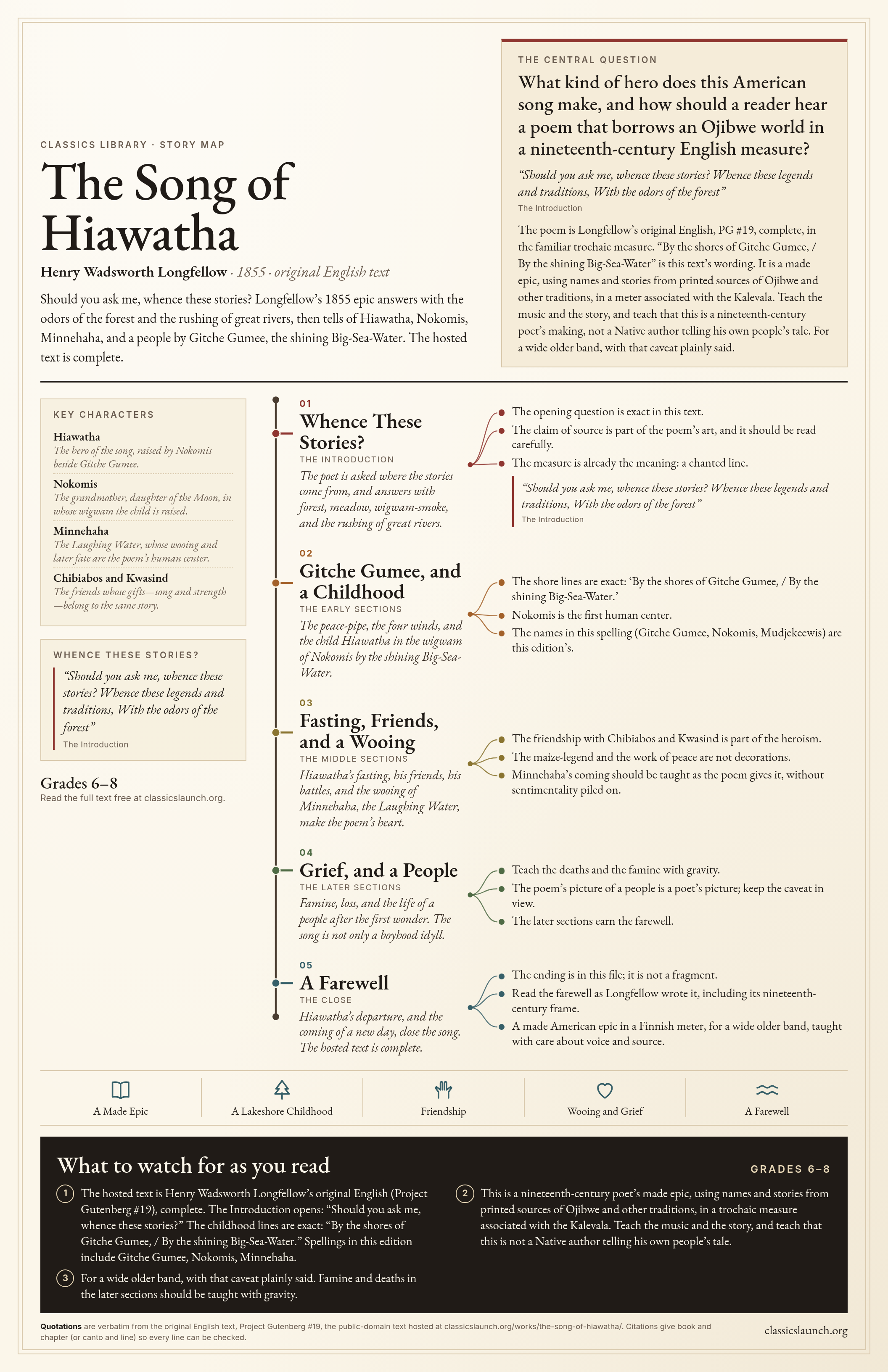
The Song of Hiawatha: A Story Map
The PDF is one tabloid page (11 × 17 in). On letter paper, choose “Fit to page.”
Should you ask me, whence these stories? Longfellow’s 1855 epic answers with the odors of the forest and the rushing of great rivers, then tells of Hiawatha, Nokomis, Minnehaha, and a people by Gitche Gumee, the shining Big-Sea-Water. The hosted text is complete.
The central question
What kind of hero does this American song make, and how should a reader hear a poem that borrows an Ojibwe world in a nineteenth-century English measure?
“Should you ask me, whence these stories? Whence these legends and traditions, With the odors of the forest”
The poem is Longfellow’s original English, PG #19, complete, in the familiar trochaic measure. “By the shores of Gitche Gumee, / By the shining Big-Sea-Water” is this text’s wording. It is a made epic, using names and stories from printed sources of Ojibwe and other traditions, in a meter associated with the Kalevala. Teach the music and the story, and teach that this is a nineteenth-century poet’s making, not a Native author telling his own people’s tale. For a wide older band, with that caveat plainly said.
- 01
Whence These Stories?
The Introduction
The poet is asked where the stories come from, and answers with forest, meadow, wigwam-smoke, and the rushing of great rivers.
- The opening question is exact in this text.
- The claim of source is part of the poem’s art, and it should be read carefully.
- The measure is already the meaning: a chanted line.
“Should you ask me, whence these stories? Whence these legends and traditions, With the odors of the forest”
- 02
Gitche Gumee, and a Childhood
The early sections
The peace-pipe, the four winds, and the child Hiawatha in the wigwam of Nokomis by the shining Big-Sea-Water.
- The shore lines are exact: ‘By the shores of Gitche Gumee, / By the shining Big-Sea-Water.’
- Nokomis is the first human center.
- The names in this spelling (Gitche Gumee, Nokomis, Mudjekeewis) are this edition’s.
- 03
Fasting, Friends, and a Wooing
The middle sections
Hiawatha’s fasting, his friends, his battles, and the wooing of Minnehaha, the Laughing Water, make the poem’s heart.
- The friendship with Chibiabos and Kwasind is part of the heroism.
- The maize-legend and the work of peace are not decorations.
- Minnehaha’s coming should be taught as the poem gives it, without sentimentality piled on.
- 04
Grief, and a People
The later sections
Famine, loss, and the life of a people after the first wonder. The song is not only a boyhood idyll.
- Teach the deaths and the famine with gravity.
- The poem’s picture of a people is a poet’s picture; keep the caveat in view.
- The later sections earn the farewell.
- 05
A Farewell
The close
Hiawatha’s departure, and the coming of a new day, close the song. The hosted text is complete.
- The ending is in this file; it is not a fragment.
- Read the farewell as Longfellow wrote it, including its nineteenth-century frame.
- A made American epic in a Finnish meter, for a wide older band, taught with care about voice and source.
- A Made Epic
- A Lakeshore Childhood
- Friendship
- Wooing and Grief
- A Farewell
What to watch for as you read
Grades 6–8- The hosted text is Henry Wadsworth Longfellow’s original English (Project Gutenberg #19), complete. The Introduction opens: “Should you ask me, whence these stories?” The childhood lines are exact: “By the shores of Gitche Gumee, / By the shining Big-Sea-Water.” Spellings in this edition include Gitche Gumee, Nokomis, Minnehaha.
- This is a nineteenth-century poet’s made epic, using names and stories from printed sources of Ojibwe and other traditions, in a trochaic measure associated with the Kalevala. Teach the music and the story, and teach that this is not a Native author telling his own people’s tale.
- For a wide older band, with that caveat plainly said. Famine and deaths in the later sections should be taught with gravity.
Every quotation is word for word from the original English text hosted in this library and is checked against that text each time the site is built. Citations give book and chapter (or canto and line).