Story maps · Grades 4–8
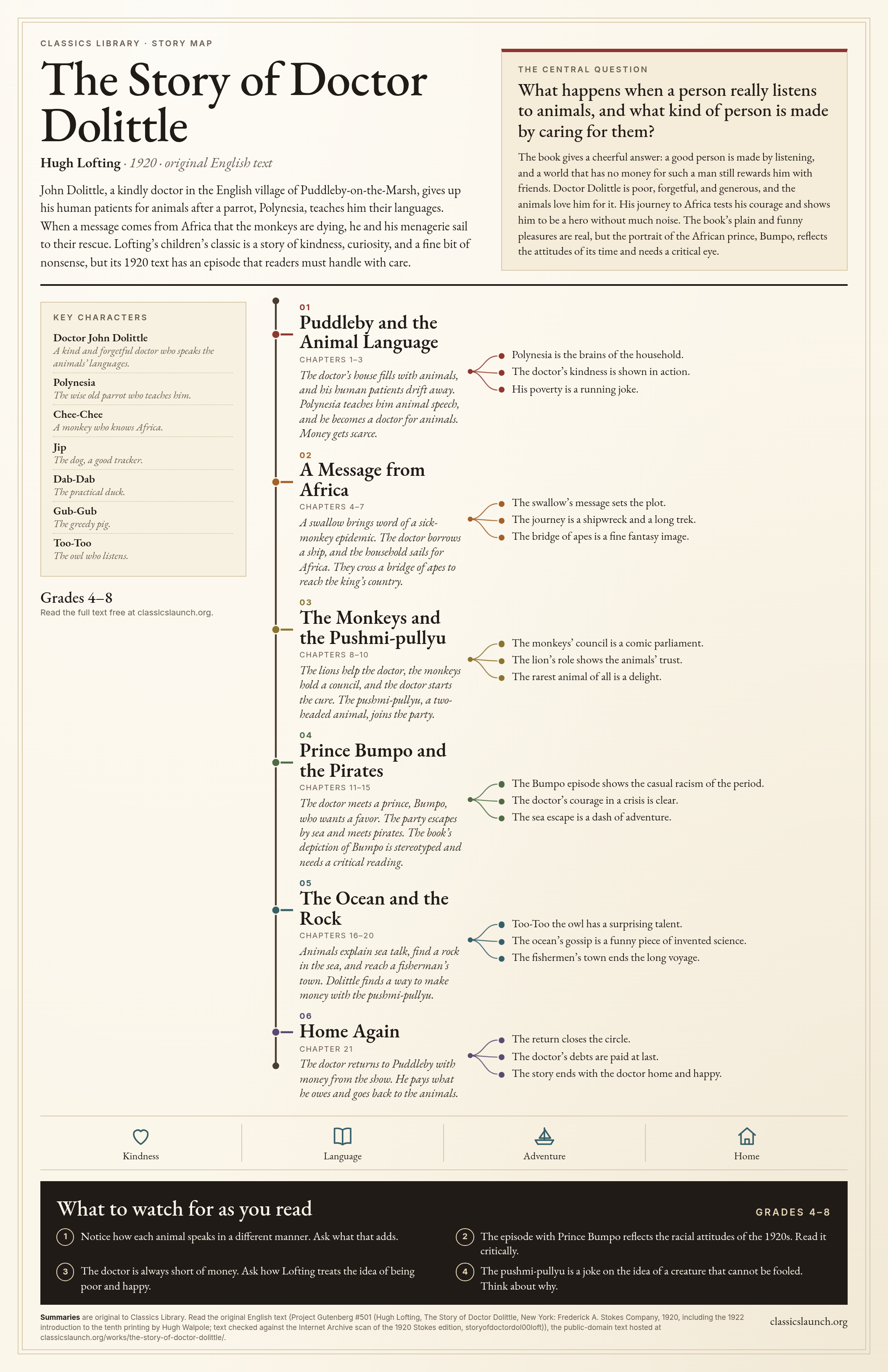
The Story of Doctor Dolittle: A Story Map
The PDF is one tabloid page (11 × 17 in). On letter paper, choose “Fit to page.”
John Dolittle, a kindly doctor in the English village of Puddleby-on-the-Marsh, gives up his human patients for animals after a parrot, Polynesia, teaches him their languages. When a message comes from Africa that the monkeys are dying, he and his menagerie sail to their rescue. Lofting’s children’s classic is a story of kindness, curiosity, and a fine bit of nonsense, but its 1920 text has an episode that readers must handle with care.
The central question
What happens when a person really listens to animals, and what kind of person is made by caring for them?
The book gives a cheerful answer: a good person is made by listening, and a world that has no money for such a man still rewards him with friends. Doctor Dolittle is poor, forgetful, and generous, and the animals love him for it. His journey to Africa tests his courage and shows him to be a hero without much noise. The book’s plain and funny pleasures are real, but the portrait of the African prince, Bumpo, reflects the attitudes of its time and needs a critical eye.
- 01
Puddleby and the Animal Language
Chapters 1–3
The doctor’s house fills with animals, and his human patients drift away. Polynesia teaches him animal speech, and he becomes a doctor for animals. Money gets scarce.
- Polynesia is the brains of the household.
- The doctor’s kindness is shown in action.
- His poverty is a running joke.
- 02
A Message from Africa
Chapters 4–7
A swallow brings word of a sick-monkey epidemic. The doctor borrows a ship, and the household sails for Africa. They cross a bridge of apes to reach the king’s country.
- The swallow’s message sets the plot.
- The journey is a shipwreck and a long trek.
- The bridge of apes is a fine fantasy image.
- 03
The Monkeys and the Pushmi-pullyu
Chapters 8–10
The lions help the doctor, the monkeys hold a council, and the doctor starts the cure. The pushmi-pullyu, a two-headed animal, joins the party.
- The monkeys’ council is a comic parliament.
- The lion’s role shows the animals’ trust.
- The rarest animal of all is a delight.
- 04
Prince Bumpo and the Pirates
Chapters 11–15
The doctor meets a prince, Bumpo, who wants a favor. The party escapes by sea and meets pirates. The book’s depiction of Bumpo is stereotyped and needs a critical reading.
- The Bumpo episode shows the casual racism of the period.
- The doctor’s courage in a crisis is clear.
- The sea escape is a dash of adventure.
- 05
The Ocean and the Rock
Chapters 16–20
Animals explain sea talk, find a rock in the sea, and reach a fisherman’s town. Dolittle finds a way to make money with the pushmi-pullyu.
- Too-Too the owl has a surprising talent.
- The ocean’s gossip is a funny piece of invented science.
- The fishermen’s town ends the long voyage.
- 06
Home Again
Chapter 21
The doctor returns to Puddleby with money from the show. He pays what he owes and goes back to the animals.
- The return closes the circle.
- The doctor’s debts are paid at last.
- The story ends with the doctor home and happy.
- Kindness
- Language
- Adventure
- Home
What to watch for as you read
Grades 4–8- Notice how each animal speaks in a different manner. Ask what that adds.
- The episode with Prince Bumpo reflects the racial attitudes of the 1920s. Read it critically.
- The doctor is always short of money. Ask how Lofting treats the idea of being poor and happy.
- The pushmi-pullyu is a joke on the idea of a creature that cannot be fooled. Think about why.
Every quotation is word for word from the original English text hosted in this library and is checked against that text each time the site is built. Citations give book and chapter (or canto and line).