Work record
The Story of Doctor Dolittle
Hugh LoftingDoctor Dolittle; The Story of Doctor Dolittle, Being the History of His Peculiar LifeThe Story of Doctor Dolittle by Hugh Lofting (1920)The Story of Doctor Dolittle is the first of Hugh Lofting’s tales of John Dolittle, M.D., of Puddleby-on-the-Marsh, a kind physician who comes to care more for animals than for his human patients.Also known as: Doctor Dolittle · The Story of Doctor Dolittle, Being the History of His Peculiar Life
1920 · Early 20th Century · Novel · English
Read this when a child wants a kind doctor who talks with animals and goes to their aid.
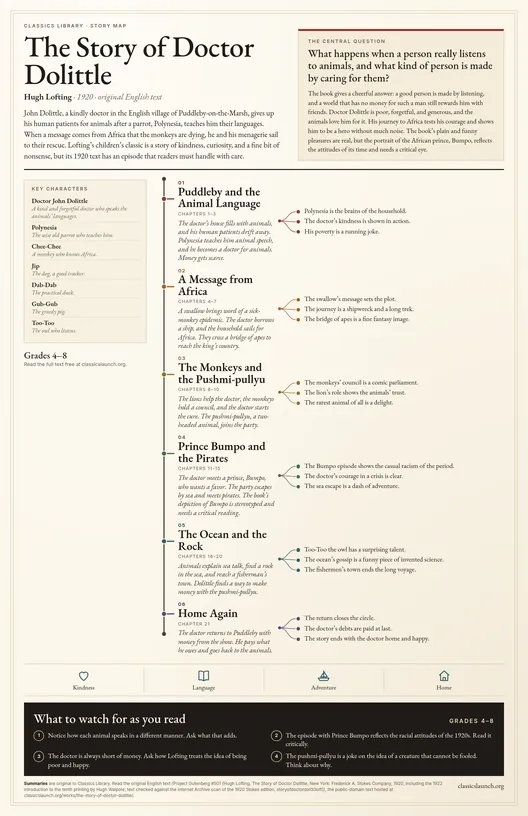 Story mapSee the story mapThe whole book on one page: the story in movements, the characters, and what to watch for. Free to print.
Abstract
Puddleby. John Dolittle, a kind physician in a little English town, learns from the parrot Polynesia to speak with animals. His house fills with creatures, his human practice fails, and a call comes from Africa to heal a sickness among the monkeys. The opening chapters show his character: he is gentle, a little unworldly, and already more loyal to beasts than to paying patients.
The voyage. He sails with his animal companions, suffers wreck and hunger, is taken by a king, and is helped by the monkeys, who even make a bridge of apes so that he can go on. The doctor does the work he came to do, treating the sickness that called him, and he is given the rare pushmi-pullyu as a living reward rather than as treasure.
The hard chapters and the homecoming. In the original 1920 text, Prince Bumpo asks to be made a white prince, a passage to be read with a parent or teacher, because the joke is false to the dignity of a person made in the image of God. The doctor later meets pirates and at last returns to Puddleby, still the same man of mercy, to take up his life among the animals again.
Main characters
- John Dolittle: kind animal doctor
- Polynesia: parrot and teacher
- Prince Bumpo: the king’s son in the 1920 chapters
Summary
The Story of Doctor Dolittle is the first of Hugh Lofting’s tales of John Dolittle, M.D., of Puddleby-on-the-Marsh, a kind physician who comes to care more for animals than for his human patients. When his parrot Polynesia teaches him the speech of beasts, the doctor’s house fills with creatures, his money runs low, and a message comes from Africa: the monkeys are sick and need his help. With Dab-Dab the duck, Jip the dog, Gub-Gub the pig, Too-Too the owl, and the crocodile, he sets out, is wrecked, is taken by a king, and is aided by the monkeys, who build a bridge of apes and later honor him. He is paid with the rare pushmi-pullyu, meets pirates, and at last finds his way home. The book is funny, swift and tender, and it honors kindness, courage and perseverance in a way young readers can see. This library hosts the 1920 original, including the Prince Bumpo chapters, not a later rewritten edition. In those chapters a Black African prince is made a comic figure who wants the Doctor to change the color of his face, and a parent or teacher should read that part with the child and say plainly that every person is made in the image of God. The reason for keeping the original is that students should see what Lofting wrote and learn to judge it, rather than be given a silent rewrite. Taken as a whole, and read with that care, the book remains a classic of a doctor who will go a long way to help those who cannot help themselves, and of animals who have character, loyalty and wit. A younger child can enjoy the voyage, the shipwreck, the bridge of apes and the pushmi-pullyu, while an older student can learn, with a teacher, how to keep a book’s real goods and to refuse its false joke.
Virtues in this work
- Charity: The doctor’s calling is to help those who need him, even when it costs him money, ease and safety.
- Friendship: The animals are true companions, and the book honors loyalty between a man and the creatures who trust him.
- Prudence: A teacher must help a child name what is false in the Bumpo chapters and still see what is good in the doctor’s mercy.
Plot or Argument
- Puddleby and the animal language
John Dolittle of Puddleby loses his human patients as his house fills with animals. Polynesia the parrot teaches him their speech, and his money troubles grow until a message comes that the monkeys of Africa are sick and need him.
- The voyage and the king
The doctor and his animals sail for Africa, suffer wreck and hunger, and fall into the hands of a king. The monkeys help them, a bridge of apes is made, and the doctor does his work among the sick.
- The Black Prince, the return, and home
In the chapters around The Black Prince, Prince Bumpo asks the doctor to make him a white prince, a passage that must be read with a parent or teacher. The doctor later gains the pushmi-pullyu, meets pirates, and comes home again to Puddleby.
Characters
- John Dolittle, kind Puddleby physician
A kind Puddleby physician who learns to speak with animals and sails to Africa to help the monkeys.
- Polynesia, parrot
The parrot who first teaches the doctor animal language and advises him in tight places.
- Dab-Dab, duck
The duck who keeps house and worries about the doctor’s practical needs.
- Jip, dog
The dog, loyal and useful, especially when a scent or a hunt is required.
- Prince Bumpo, african king’s son who
The African king’s son who, in the original 1920 text, asks the doctor to turn him white; a passage to be read with a teacher.
- The pushmi-pullyu, rare two-headed creature given to the doctor
A rare two-headed creature given to the doctor, a comic wonder of the book.
Lessons
Kindness as a calling
Dolittle’s greatness is not cleverness alone but a habit of helping those who need him, even when it costs money, ease and safety. A Christian reader can set this beside the call to be merciful.
- Why does the doctor leave Puddleby, and what does it cost him?
- How do the animals show him loyalty in return?
- Is kindness enough when a book also contains a false and comic picture of a people?
Read the hard pages honestly
The Prince Bumpo chapters are kept here so that students see the 1920 wording. The joke that a Black prince should wish to be white is false to human dignity. A good reader names that, and then goes on to judge the rest of the book fairly.
- What does Bumpo ask for, and how does the doctor answer?
- Why might a library keep an original wording rather than a silent rewrite?
- How should a Christian speak of the dignity of every person when a story fails to?
Creaturely wonder
The talking animals are not mere toys; each has a character, and the doctor respects them as creatures with their own ways. That respect is one of the book’s lasting goods.
- How does Polynesia differ from Dab-Dab or Jip?
- What does the doctor learn by listening, not only by talking?
- How does this book’s love of animals compare with a story like The Jungle Book?
Context
The book appeared in 1920, just after the First World War, in which Lofting served. He began the stories as letters to his children from the front, offering them a kind doctor and a talking-animal world instead of the ruin he had seen. The first edition was published in New York by Frederick A. Stokes.
Composition
The hosted text is the 1920 original, from Project Gutenberg eBook #501, checked against the Internet Archive scan of the Stokes edition (storyofdoctordol00loft). It includes Hugh Walpole’s introduction to the tenth printing (1922), which is also in the public domain in the United States, and it keeps the Prince Bumpo chapters as first printed, not a later rewritten text.
Reception
The book became the first of a long series and has been much loved, illustrated, and later adapted. Some later editions changed the Bumpo chapters. This library, when it hosts a public-domain text, keeps the original so that readers and teachers can see and judge it.
Comparisons
- The Jungle Book
Kipling’s jungle is sterner and closer to law; Lofting’s animals are companions and patients, but both books ask a child to take creatures seriously and to think about courage and loyalty.
- Just So Stories
Kipling’s origin tales share Lofting’s play of animal talk and invention; Dolittle adds a human doctor whose calling is to help.
- The Adventures of Pinocchio
Another story written for children in which a journey, mishap and rescue school a character in loyalty and truth-telling.
- Charlotte's Web
A later animal tale, in this library, in which kindness between a child and creatures is the heart of the book, without Dolittle’s voyage or its hard chapters.
Quotes
Frequently cited
“ONCE upon a time, many years ago—when our grandfathers were little children—there was a doctor; and his name was Dolittle—John Dolittle, M.D. “M.D.” means that he was a proper doctor and knew a whole lot.”
““I knew that parrots can talk,” said the Doctor.”
“Nothing else will satisfy me. I must be a white prince.”
For Students
A reading companion for classical Christian high school students. See the student guide.
Reading Guide
Watch for
- How the doctor’s practice changes once he can speak with animals, and what he gives up.
- What each animal companion does when the voyage goes badly.
- The Prince Bumpo chapters: what is asked, what is done, and how a reader should judge it.
- How the book ends at home, and whether the doctor is the same man who set out.
Key terms and names
- Puddleby-on-the-Marsh
- The doctor’s little English town, the home from which the voyage begins and to which it returns.
- Animal language
- The speech of beasts, which Polynesia teaches the doctor, and which changes his calling.
- Pushmi-pullyu
- A rare two-headed animal given to the doctor after his work among the monkeys.
- The Black Prince
- The chapter group in the 1920 text in which Prince Bumpo asks to be made white; to be read with a teacher.
- Polynesia
- The parrot who is the doctor’s first teacher in animal speech and a chief adviser.
Seminar Questions
- Comprehension Why does Doctor Dolittle sail to Africa, and who goes with him?
- Comprehension What does Polynesia teach him, and how does it change his work?
- Interpretation What kind of man is the doctor, and how do the animals show his character?
- Interpretation How should a reader describe Prince Bumpo’s request, and what is wrong in it?
- Big Question Is it right to keep an original wording that treats a people unjustly, if the aim is to tell the truth and to teach judgment?
- Big Question What does it mean to be a healer, and whom does a good physician serve?
Faith Connections
- Genesis 1:27 (Scripture)
The word that God created man in his own image, male and female, is the truth against which the comic wish of the Bumpo chapters must be measured.
- Luke 10:33-37 (Scripture)
The Good Samaritan, who goes out of his way to help a wounded man, is a measure of the doctor’s voyage to the sick monkeys, and of mercy as a duty, not a pastime.
- Rudyard Kipling, The Jungle Book (Great Conversation)
Kipling’s Law of the Jungle, in this library, offers a sterner companion on how creatures live together and what a human being owes them.
Logic and Rhetoric
Central argument: A kind physician who will go far to help the helpless is a figure worth loving, and a book that also treats a people unjustly must be read with a teacher so that mercy is not confused with a false joke.
Rhetorical device: children’s comic voyage. Lofting tells the story in short chapters, with talk among animals and a string of mishaps, so that kindness and folly are both easy to see.
Debate: Resolved: That a library should keep the original wording of a children’s classic and teach students how to judge its failures.
Memory Work
ONCE upon a time, many years ago—when our grandfathers were little children—there was a doctor; and his name was Dolittle—John Dolittle, M.D. “M.D.” means that he was a proper doctor and knew a whole lot.
“I knew that parrots can talk,” said the Doctor.
Writing Prompts
Essay: Explain what makes Doctor Dolittle a good physician and a good friend, and then explain how a Christian reader should judge the Prince Bumpo chapters in this original 1920 text.
Comparison with The Jungle Book: Compare how Lofting and Kipling imagine animals, human duty and a journey into a wild country, and say how a teacher should present each book to a young reader.
Medical Lens
The book is a comic fable of a physician who turns from human patients to animal speech and then sails to treat a sickness among the monkeys. It is useful as a children’s picture of the doctor as helper, not as a medical source.
- The monkeys’ sickness in Africa
The doctor is called to treat an epidemic among the monkeys, a fable of medical service.
Creative Prompts
- Essay
Explain why this library keeps the 1920 wording of the Prince Bumpo chapters, and how a Christian reader should answer Bumpo’s wish.
- Fiction
Write a short scene in which Polynesia, after the return to Puddleby, tells Dab-Dab what the doctor did well and what was unworthy.
- Classroom
Make a list of the animals in the house and on the voyage, and note what each one contributes to the doctor’s work.
Further Reading
- The Jungle Book, Rudyard Kipling
A sterner animal classic, in this library, useful as a companion and a contrast.
- Just So Stories, Rudyard Kipling
Playful origin tales of animals, in this library.
- Charlotte’s Web, E. B. White
A later story of kindness between a child and animals, in this library as a companion guide.
Verification notes
The text is the 1920 Stokes original from Project Gutenberg eBook #501, checked against the Internet Archive scan storyofdoctordol00loft. It includes Walpole’s 1922 introduction (public domain in the U.S.). Lofting’s dates, the wartime letters, and the later rewritten editions follow standard accounts and are not all stated in the hosted text. The count of chapters in this edition is twenty-one.
- Lofting’s dates (1886–1947) and the account of the wartime letters to his children follow standard reference works.
- The later rewritten editions of the Bumpo chapters are a matter of publishing history and were not compared line by line in this build, except to confirm that the hosted text keeps the original 1920 wording.