Story maps · Grades K–2
The Tale of Ginger and Pickles: A Story Map
The PDF is one tabloid page (11 × 17 in). On letter paper, choose “Fit to page.”
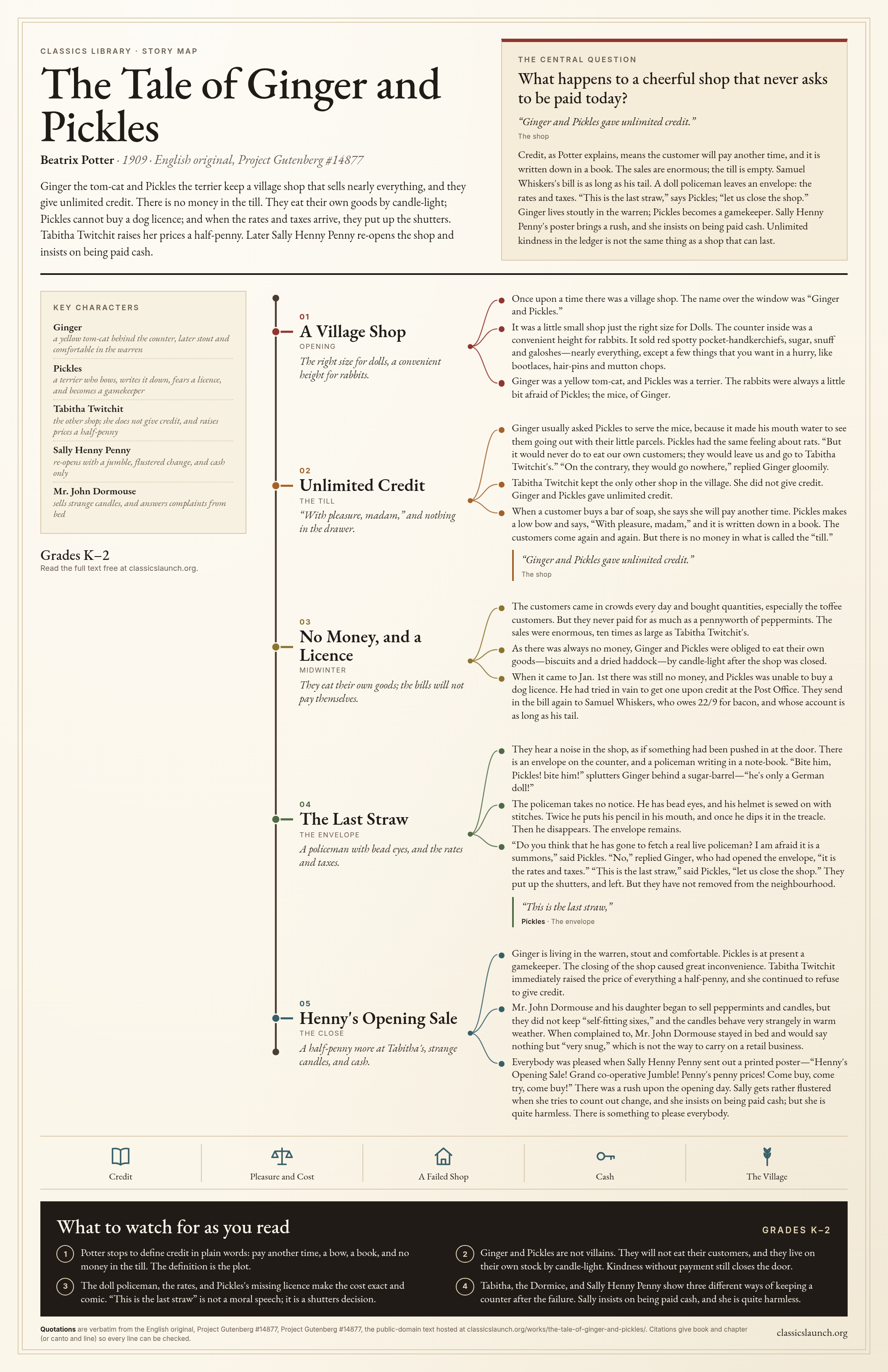
Ginger the tom-cat and Pickles the terrier keep a village shop that sells nearly everything, and they give unlimited credit. There is no money in the till. They eat their own goods by candle-light; Pickles cannot buy a dog licence; and when the rates and taxes arrive, they put up the shutters. Tabitha Twitchit raises her prices a half-penny. Later Sally Henny Penny re-opens the shop and insists on being paid cash.
The central question
What happens to a cheerful shop that never asks to be paid today?
“Ginger and Pickles gave unlimited credit.”
Credit, as Potter explains, means the customer will pay another time, and it is written down in a book. The sales are enormous; the till is empty. Samuel Whiskers's bill is as long as his tail. A doll policeman leaves an envelope: the rates and taxes. “This is the last straw,” says Pickles; “let us close the shop.” Ginger lives stoutly in the warren; Pickles becomes a gamekeeper. Sally Henny Penny's poster brings a rush, and she insists on being paid cash. Unlimited kindness in the ledger is not the same thing as a shop that can last.
- 01
A Village Shop
Opening
The right size for dolls, a convenient height for rabbits.
- Once upon a time there was a village shop. The name over the window was “Ginger and Pickles.”
- It was a little small shop just the right size for Dolls. The counter inside was a convenient height for rabbits. It sold red spotty pocket-handkerchiefs, sugar, snuff and galoshes—nearly everything, except a few things that you want in a hurry, like bootlaces, hair-pins and mutton chops.
- Ginger was a yellow tom-cat, and Pickles was a terrier. The rabbits were always a little bit afraid of Pickles; the mice, of Ginger.
- 02
Unlimited Credit
The till
“With pleasure, madam,” and nothing in the drawer.
- Ginger usually asked Pickles to serve the mice, because it made his mouth water to see them going out with their little parcels. Pickles had the same feeling about rats. “But it would never do to eat our own customers; they would leave us and go to Tabitha Twitchit's.” “On the contrary, they would go nowhere,” replied Ginger gloomily.
- Tabitha Twitchit kept the only other shop in the village. She did not give credit. Ginger and Pickles gave unlimited credit.
- When a customer buys a bar of soap, she says she will pay another time. Pickles makes a low bow and says, “With pleasure, madam,” and it is written down in a book. The customers come again and again. But there is no money in what is called the “till.”
“Ginger and Pickles gave unlimited credit.”
- 03
No Money, and a Licence
Midwinter
They eat their own goods; the bills will not pay themselves.
- The customers came in crowds every day and bought quantities, especially the toffee customers. But they never paid for as much as a pennyworth of peppermints. The sales were enormous, ten times as large as Tabitha Twitchit's.
- As there was always no money, Ginger and Pickles were obliged to eat their own goods—biscuits and a dried haddock—by candle-light after the shop was closed.
- When it came to Jan. 1st there was still no money, and Pickles was unable to buy a dog licence. He had tried in vain to get one upon credit at the Post Office. They send in the bill again to Samuel Whiskers, who owes 22/9 for bacon, and whose account is as long as his tail.
- 04
The Last Straw
The envelope
A policeman with bead eyes, and the rates and taxes.
- They hear a noise in the shop, as if something had been pushed in at the door. There is an envelope on the counter, and a policeman writing in a note-book. “Bite him, Pickles! bite him!” splutters Ginger behind a sugar-barrel—“he's only a German doll!”
- The policeman takes no notice. He has bead eyes, and his helmet is sewed on with stitches. Twice he puts his pencil in his mouth, and once he dips it in the treacle. Then he disappears. The envelope remains.
- “Do you think that he has gone to fetch a real live policeman? I am afraid it is a summons,” said Pickles. “No,” replied Ginger, who had opened the envelope, “it is the rates and taxes.” “This is the last straw,” said Pickles, “let us close the shop.” They put up the shutters, and left. But they have not removed from the neighbourhood.
“This is the last straw,”
- 05
Henny's Opening Sale
The close
A half-penny more at Tabitha's, strange candles, and cash.
- Ginger is living in the warren, stout and comfortable. Pickles is at present a gamekeeper. The closing of the shop caused great inconvenience. Tabitha Twitchit immediately raised the price of everything a half-penny, and she continued to refuse to give credit.
- Mr. John Dormouse and his daughter began to sell peppermints and candles, but they did not keep “self-fitting sixes,” and the candles behave very strangely in warm weather. When complained to, Mr. John Dormouse stayed in bed and would say nothing but “very snug,” which is not the way to carry on a retail business.
- Everybody was pleased when Sally Henny Penny sent out a printed poster—“Henny's Opening Sale! Grand co-operative Jumble! Penny's penny prices! Come buy, come try, come buy!” There was a rush upon the opening day. Sally gets rather flustered when she tries to count out change, and she insists on being paid cash; but she is quite harmless. There is something to please everybody.
- Credit
- Pleasure and Cost
- A Failed Shop
- Cash
- The Village
What to watch for as you read
Grades K–2- Potter stops to define credit in plain words: pay another time, a bow, a book, and no money in the till. The definition is the plot.
- Ginger and Pickles are not villains. They will not eat their customers, and they live on their own stock by candle-light. Kindness without payment still closes the door.
- The doll policeman, the rates, and Pickles's missing licence make the cost exact and comic. “This is the last straw” is not a moral speech; it is a shutters decision.
- Tabitha, the Dormice, and Sally Henny Penny show three different ways of keeping a counter after the failure. Sally insists on being paid cash, and she is quite harmless.
Every quotation is word for word from the English original, Project Gutenberg #14877 hosted in this library and is checked against that text each time the site is built. Citations give book and chapter (or canto and line).