Work record
The Tale of Ginger and Pickles
Beatrix PotterThe Tale of Ginger and Pickles by Beatrix Potter (1909)The Tale of Ginger and Pickles (1909) is a village-shop comedy.1909 · Early 20th Century · Short Stories · English
Read this when a village shop is kind, and credit runs too far.
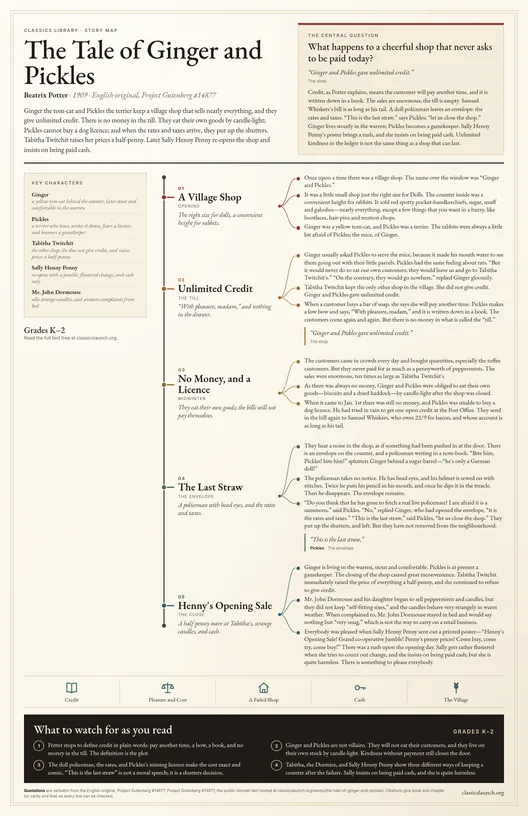 Story mapSee the story mapThe whole book on one page: the story in movements, the characters, and what to watch for. Free to print.
Abstract
The little shop. A cat and a dog keep a tiny village shop that sells nearly everything and suits dolls and rabbits. They are kind and they give credit.
The till. Customers put off paying until the partners cannot meet their own bills. The shop closes; Ginger goes hunting and Pickles looks for other work.
The other counter. The village must buy where there is no credit, and later a hen opens a new small shop. The book is a comedy about kindness, appetite, and a till that will not add up. Young listeners can retell the events in order and talk about the choices without needing a lecture from the narrator. A text-only reading is well paired with an illustrated copy whenever one is at hand. The complete English text of The Tale of Ginger and Pickles is hosted here from a verified public-domain transcription of the 1909 book, so families can read the words freely. Families can linger over the pictures and retell the events in their own words. The sequence is short enough to narrate after a single sitting. Nothing essential is left to a later sequel. Families can linger over the pictures and retell the events in their own words.
Main characters
- Ginger: A yellow tom-cat who keeps shop and finds mice as customers a trial.
- Pickles: A terrier, Ginger's partner, who also gives credit too freely.
- Mrs. Tabitha Twitchit: The rival shopkeeper, who does not give credit and inherits the custom when the shop closes.
Summary
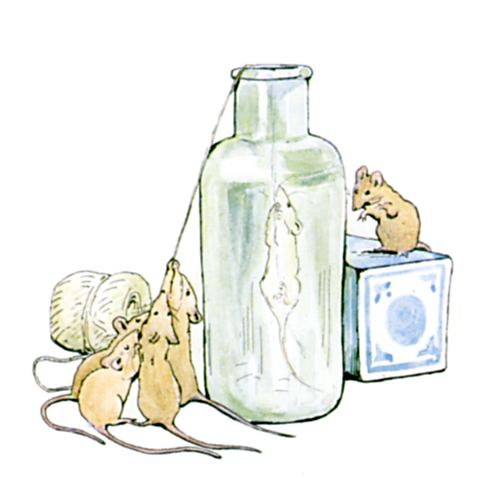
The Tale of Ginger and Pickles (1909) is a village-shop comedy. Over the window is the name Ginger and Pickles. The shop is the right size for dolls, and the counter is a convenient height for rabbits. Ginger, a yellow tom-cat, and Pickles, a terrier, sell nearly everything — sugar, snuff, galoshes, and red spotty handkerchiefs — and they are generous with credit. Lucinda and Jane Doll-cook buy groceries there; so do rabbits, and so, awkwardly, do mice, which makes Ginger's mouth water even as he tries to be polite. The trouble is not the stock but the till. Customers say 'Carry it over till next month' until there is no money for the bills from the wholesale men, Samuel Whiskers among them, who wants bacon. The shop closes. Ginger takes to hunting, Pickles may go into the police, and the village must buy at Tabitha Twitchit's, where there is no credit and the prices feel high. Later a new shop is opened by a village hen, again with small wants and small customers in view. The book lets children see a counter, a ledger, and a closed shutter as clearly as a garden fence. It is funny about appetite and about dogs and cats keeping shop together, and it is plain about what happens when everyone buys and no one pays. Families can talk about promises to pay, about kindness that cannot keep a shop open by itself, and about why Tabitha's tighter counter still serves the village. There is no sermon, only a till that will not add up and a street that notices the difference. The library hosts the complete public-domain English text of the 1909 Warne book. Potter's pictures of the shop interior and the notice on the door are part of the joke and should be seen alongside the words.
Virtues in this work
Plot or Argument
- A shop for everyone
Ginger and Pickles sell nearly everything and let customers carry the bill over.
- Bills that will not wait
The wholesale accounts cannot be paid; the shop closes.
- Tabitha's counter
The village buys where there is no credit, and a hen later opens another small shop.
Characters
- Ginger, protagonist
A yellow tom-cat who keeps shop and finds mice as customers a trial.
- Pickles, protagonist
A terrier, Ginger's partner, who also gives credit too freely.
- Mrs. Tabitha Twitchit, rival
The rival shopkeeper, who does not give credit and inherits the custom when the shop closes.
Lessons
Credit and kindness
The partners are generous, and the till still has to close.
- Why does the shop run out of money?
- What happens to Ginger and Pickles after it closes?
A cat, a dog, and mice
The comedy of appetite sits beside the comedy of shopping.
- Why is it awkward for Ginger to serve mice?
- Who else buys at the shop?
The next shop
Tabitha and later a hen show that a village still needs a counter.
- Where do the customers go when Ginger and Pickles close?
- Does the book say kindness is wrong? What does it say instead?
Context
Potter turns a village counter into a children's comedy about credit, appetite, and what happens when everyone buys and no one pays.
Composition
First published by Frederick Warne in 1909. The local text follows a Project Gutenberg transcription of the English original.
Reception
It is often remembered for the tiny shop, the doll customers, and the closed shutters.
Comparisons
- The Tale of Two Bad Mice
Both make comedy out of a doll-sized domestic world; here the shop is real for the animals, and the problem is money rather than plaster food.
- The Pie and the Patty-Pan
Another village comedy of manners among the same neighborhood of dogs, cats, and tea tables.
Quotes
“Once upon a time there was a village shop. The name over the window was "Ginger and Pickles."”
“It was a little small shop just the right size for Dolls--Lucinda and Jane Doll-cook always bought their groceries at Ginger and Pickles.”
For Students
A reading companion for classical Christian high school students. See the student guide.
Reading Guide
Watch for
- What the shop sells, and to whom.
- Why there is no money for the wholesale bills.
- Where the village buys after the shutters close.
Key terms and names
- Credit
- Buying now and promising to pay later.
- Till
- The drawer or box that holds a shop's money.
- Wholesale
- The larger sellers who supply a small shop and expect to be paid.
- Galoshes
- Rubber overshoes; one of the odd useful things the little shop sells.
Seminar Questions
- Comprehension What kind of shop do Ginger and Pickles keep, and who shops there?
- Comprehension Why do they have to close the shop?
- Interpretation Are Ginger and Pickles foolish, kind, or both?
- Interpretation Why might Tabitha Twitchit's shop feel less pleasant, even if it stays open?
- Big Question Can a promise to pay later be a form of untruth if you will not pay?
- Big Question How does Romans 13:8 help a family talk about owing and paying?
Faith Connections
- Romans 13:8 (Scripture)
Owe no one anything, except to love one another: a way to discuss unpaid bills without harshness.
- Proverbs 11:15 (Scripture)
Surety and rash promises offer a frame for credit given too freely.
Logic and Rhetoric
Central argument: Kindness at a counter is real, and a shop still cannot stay open on promises alone.
Rhetorical device: Irony. The most generous shop in the village is the one that cannot pay its own bills.
Debate: Resolved: A kind shopkeeper still has a duty to keep honest accounts.
Writing Prompts
Essay: Explain why the shop closes and what the village does next. Use two details from the text.
Comparison with The Tale of Two Bad Mice: Both books make a doll-sized world feel real. Compare what the characters want from a house or a shop, and what they cannot actually have.
Creative Prompts
- Classroom
Make a simple shop ledger: what is sold, what is promised, and what is still owed at the end of a week.
- Essay
Why does the shop close? Use two details from the story, not a general opinion about stores.
- Fiction
Write a notice Pickles might pin on the door on the last morning.
Further Reading
Verification notes
Primary text checked against the edition identified in fullText. No unverified quotations or page numbers supplied. Recommended grades concern teaching suitability, not a mechanical reading score.
No verification flags recorded.