Story maps · Grades K–2
The Three Billy-Goats Gruff: A Story Map
The PDF is one tabloid page (11 × 17 in). On letter paper, choose “Fit to page.”
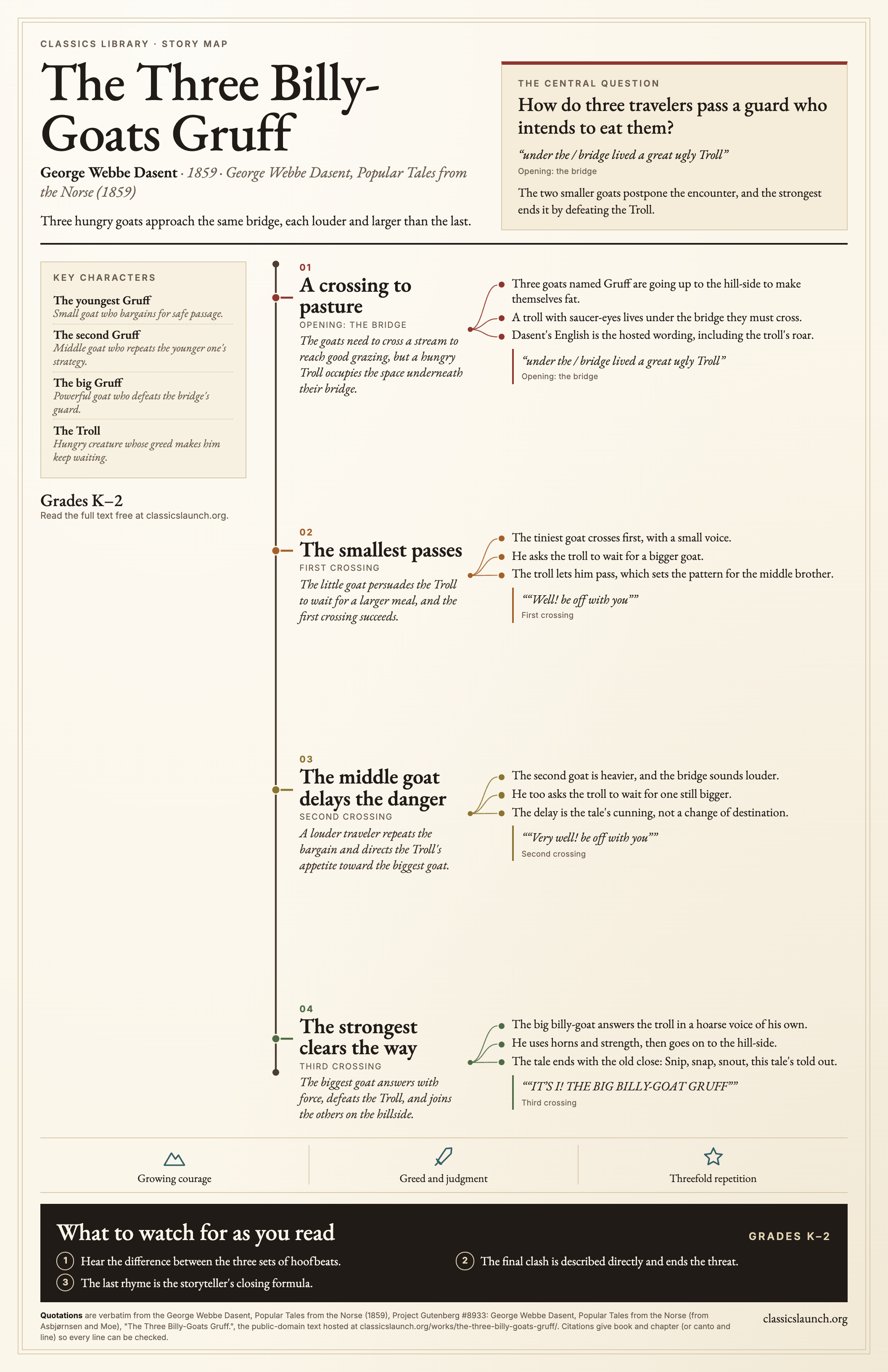
Three hungry goats approach the same bridge, each louder and larger than the last.
The central question
How do three travelers pass a guard who intends to eat them?
“under the / bridge lived a great ugly Troll”
The two smaller goats postpone the encounter, and the strongest ends it by defeating the Troll.
- 01
A crossing to pasture
Opening: the bridge
The goats need to cross a stream to reach good grazing, but a hungry Troll occupies the space underneath their bridge.
- Three goats named Gruff are going up to the hill-side to make themselves fat.
- A troll with saucer-eyes lives under the bridge they must cross.
- Dasent's English is the hosted wording, including the troll's roar.
“under the / bridge lived a great ugly Troll”
- 02
The smallest passes
First crossing
The little goat persuades the Troll to wait for a larger meal, and the first crossing succeeds.
- The tiniest goat crosses first, with a small voice.
- He asks the troll to wait for a bigger goat.
- The troll lets him pass, which sets the pattern for the middle brother.
““Well! be off with you””
- 03
The middle goat delays the danger
Second crossing
A louder traveler repeats the bargain and directs the Troll's appetite toward the biggest goat.
- The second goat is heavier, and the bridge sounds louder.
- He too asks the troll to wait for one still bigger.
- The delay is the tale's cunning, not a change of destination.
““Very well! be off with you””
- 04
The strongest clears the way
Third crossing
The biggest goat answers with force, defeats the Troll, and joins the others on the hillside.
- The big billy-goat answers the troll in a hoarse voice of his own.
- He uses horns and strength, then goes on to the hill-side.
- The tale ends with the old close: Snip, snap, snout, this tale's told out.
““IT’S I! THE BIG BILLY-GOAT GRUFF””
- Growing courage
- Greed and judgment
- Threefold repetition
What to watch for as you read
Grades K–2- Hear the difference between the three sets of hoofbeats.
- The final clash is described directly and ends the threat.
- The last rhyme is the storyteller's closing formula.
Every quotation is word for word from the George Webbe Dasent, Popular Tales from the Norse (1859) hosted in this library and is checked against that text each time the site is built. Citations give book and chapter (or canto and line).