Work record
The Three Billy-Goats Gruff
George Webbe DasentThe Three Billy-Goats Gruff by George Webbe Dasent (1859)Three billy-goats share the name Gruff and an appetite for the grass on a hillside.1859 · 19th Century · Short Stories · English
Read this when three sets of hoofbeats can turn a narrow bridge into a whole adventure.
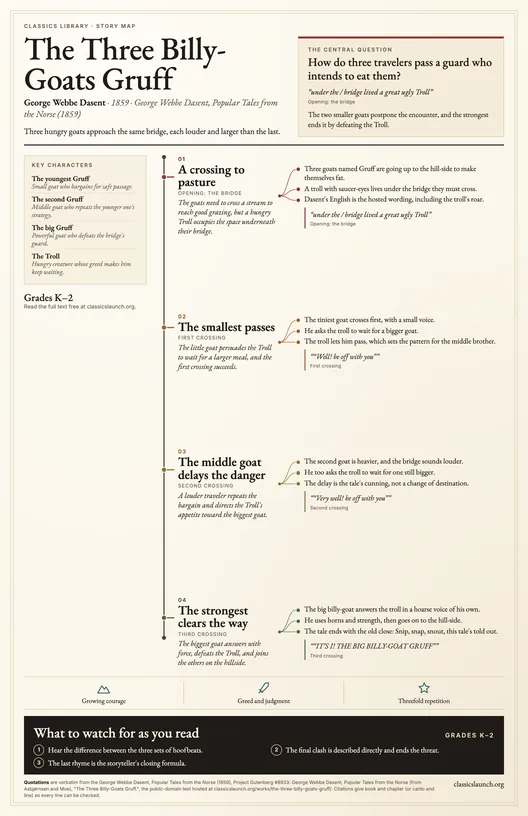 Story mapSee the story mapThe whole book on one page: the story in movements, the characters, and what to watch for. Free to print.
Abstract
Background. Dasent included this Norwegian folktale in Popular Tales from the Norse in 1859, drawing on the collections of Asbjørnsen and Moe. The English version retains the economy of a tale made for speaking. Its landscape requires only a stream, a crossing, and a desirable patch of grazing above the water.
Content. Three hungry brothers approach a passage guarded by a creature who intends to devour them. The first two secure permission to continue by promising a larger meal to follow. Their powerful companion refuses to bargain, overcomes the guard, and joins them in the pasture. An extravagant account of their fatness closes the action.
Themes. Practical cleverness and physical courage perform different jobs within the same adventure. The guard's greed helps defeat his own purpose, because satisfaction is repeatedly postponed in expectation of something better. Access to ordinary nourishment gives the journey its motive; the goats seek grass rather than a treasure, throne, or magical prize.
Significance. Sound is the tale's chief dramatic instrument. Increasingly heavy footsteps prepare for the strongest voice and the decisive clash. A reader can distinguish each traveler through pace and volume while keeping the repeated questions recognizable. The ending's playful formula makes a firm boundary between the folktale encounter and the listeners' world, supporting retelling from memory after a single hearing.
Main characters
- The youngest Gruff: Small goat who bargains for safe passage.
- The second Gruff: Middle goat who repeats the younger one's strategy.
- The big Gruff: Powerful goat who defeats the bridge's guard.
- The Troll: Hungry creature whose greed makes him keep waiting.
Summary
Three billy-goats share the name Gruff and an appetite for the grass on a hillside. To reach that pasture they must cross a bridge over a stream. Beneath the bridge lives a Troll, whose enormous eyes and long nose give young listeners an immediate picture of the danger. A simple journey toward food becomes a contest over who can use the crossing. The youngest goat goes first. His small hoofbeats bring a challenge from below: the Troll wants to know who is passing over his bridge. The goat identifies himself and explains his destination. When the Troll threatens to eat him, the little traveler suggests waiting for the larger goat behind him. The Troll accepts the prospect of a better meal and lets the smallest one pass. The second goat arrives with a stronger voice and a louder approach. He faces the same threat and offers the same reason for delay: a still bigger goat is coming. The largest Gruff changes the pattern. His weight makes the bridge creak, and his rough voice answers the challenge with confidence. Instead of asking to be spared, he invites the Troll to attack. His short verse compares his horns and hard hooves to weapons. He then charges, defeats the creature, and throws him into the stream. The goats reach the hillside, where they grow so fat that the storyteller playfully wonders whether they can manage the walk home. Dasent's English telling keeps the repeated encounters sharply distinct through size, sound, and increasing force. Children can hear the suspense rising before they explain it. The tale also gives an unusually plain consequence to the Troll's appetite: each opportunity to eat persuades him to wait until his intended victim is stronger than he is. The smaller goats survive by postponement; the largest ends the threat by strength. A brief closing rhyme returns the listeners from the noisy bridge to the shared pleasure of a story completed.
Virtues in this work
Plot or Argument
- A crossing to pasture
The goats need to cross a stream to reach good grazing, but a hungry Troll occupies the space underneath their bridge.
- The smallest passes
The little goat persuades the Troll to wait for a larger meal, and the first crossing succeeds.
- The middle goat delays the danger
A louder traveler repeats the bargain and directs the Troll's appetite toward the biggest goat.
- The strongest clears the way
The biggest goat answers with force, defeats the Troll, and joins the others on the hillside.
Characters
- The youngest Gruff, First traveler
Small goat who bargains for safe passage.
- The second Gruff, Second traveler
Middle goat who repeats the younger one's strategy.
- The big Gruff, Final traveler
Powerful goat who defeats the bridge's guard.
- The Troll, Adversary
Hungry creature whose greed makes him keep waiting.
Lessons
Listen to the scale
Each crossing grows louder and more imposing. The sound prepares listeners for a different answer on the third attempt.
- Which goat makes the lightest steps?
- How would you change your voice for the largest goat?
Appetite can mislead
The Troll expects that waiting will improve his dinner. His confidence keeps him from judging the strength of the final traveler.
- Why does he release the smaller goats?
- When does his plan stop working?
Different ways through danger
The first goats use speech to escape a threat. The last has enough strength to remove it.
- How do the smaller goats avoid a fight?
- What makes the last crossing different?
Context
Asbjørnsen and Moe gathered Norwegian folktales during the nineteenth century. Dasent's English volume carried their stories into British family reading and kept many features of spoken narration.
Composition
Popular Tales from the Norse appeared in 1859. This record treats the hosted English telling as its text while naming the Norwegian collection behind it.
Reception
The three crossings became a familiar pattern in nursery storytelling, especially suited to voices, movement, and simple stage performance.
Comparisons
- Household Stories (Grimm's Fairy Tales)
Compare the Troll's appetite and the goats' negotiations with other encounters between small travelers and dangerous creatures.
- Aesop's Fables
The guard's repeated choice invites comparison with fables in which greed defeats a creature's own plans.
Quotes
“under the bridge lived a great ugly Troll”
““Well! be off with you””
““Very well! be off with you””
““IT’S I! THE BIG BILLY-GOAT GRUFF””
For Students
A reading companion for classical Christian high school students. See the student guide.
Reading Guide
Watch for
- Hear the difference between the three sets of hoofbeats.
- The final clash is described directly and ends the threat.
- The last rhyme is the storyteller's closing formula.
Key terms and names
- burn
- A stream, especially in Scottish and northern English usage.
- Troll
- A dangerous creature found in Scandinavian folktales.
- pasture
- Grassy land where animals feed by grazing.
- repetition
- The return of words or actions in a recognizable pattern.
Seminar Questions
- Comprehension Where are the goats going, and why?
- Comprehension What persuades the Troll to let the first two cross?
- Interpretation How does the sound change as the goats arrive?
- Interpretation Why does the third encounter need a different ending?
- Big Question Can waiting for something bigger be a foolish choice?
- Big Question When can clever speech accomplish what strength cannot?
Faith Connections
- Proverbs 28:25 (Scripture)
The proverb connects greed with strife; the Troll's desire for a larger meal supplies a concrete comparison.
- Aesop, The Dog and His Reflection (Great Conversation)
Compare two creatures whose appetite for a greater prize costs them the opportunity already before them.
Logic and Rhetoric
Central argument: The three encounters demonstrate that an appetite which never judges its object can bring about its own defeat.
Rhetorical device: climax. Each arrival increases the traveler's size, the noise on the bridge, and the confidence of the reply.
Debate: Resolved: the Troll loses because greed prevents him from judging danger.
Memory Work
“IT’S I! THE BIG BILLY-GOAT GRUFF”
Writing Prompts
Essay: Explain how the storyteller makes the third crossing sound different from the first two.
Comparison with Household Stories (Grimm's Fairy Tales): Compare this Troll with a greedy creature in a Grimm tale, tracing the decisions that lead to defeat.
Creative Prompts
- Classroom
Perform the three crossings using footsteps and voices that grow heavier with each arrival.
- Adaptation
Draw four panels showing the bridge before and after each goat has crossed.
- Dialogue
Invent a conversation among the goats after they reach the pasture, giving each a different memory.
Further Reading
- Popular Tales from the Norse, George Webbe Dasent
- East of the Sun and West of the Moon, Peter Christen Asbjørnsen and Jørgen Moe
Verification notes
All quotations match the hosted Dasent text from Project Gutenberg #8933, including curly apostrophes and capitals. Norwegian oral sources are distinguished from Dasent's 1859 English telling.
No verification flags recorded.