Story maps · Grades 7–12
The Travels of Marco Polo: A Story Map
The PDF is one tabloid page (11 × 17 in). On letter paper, choose “Fit to page.”
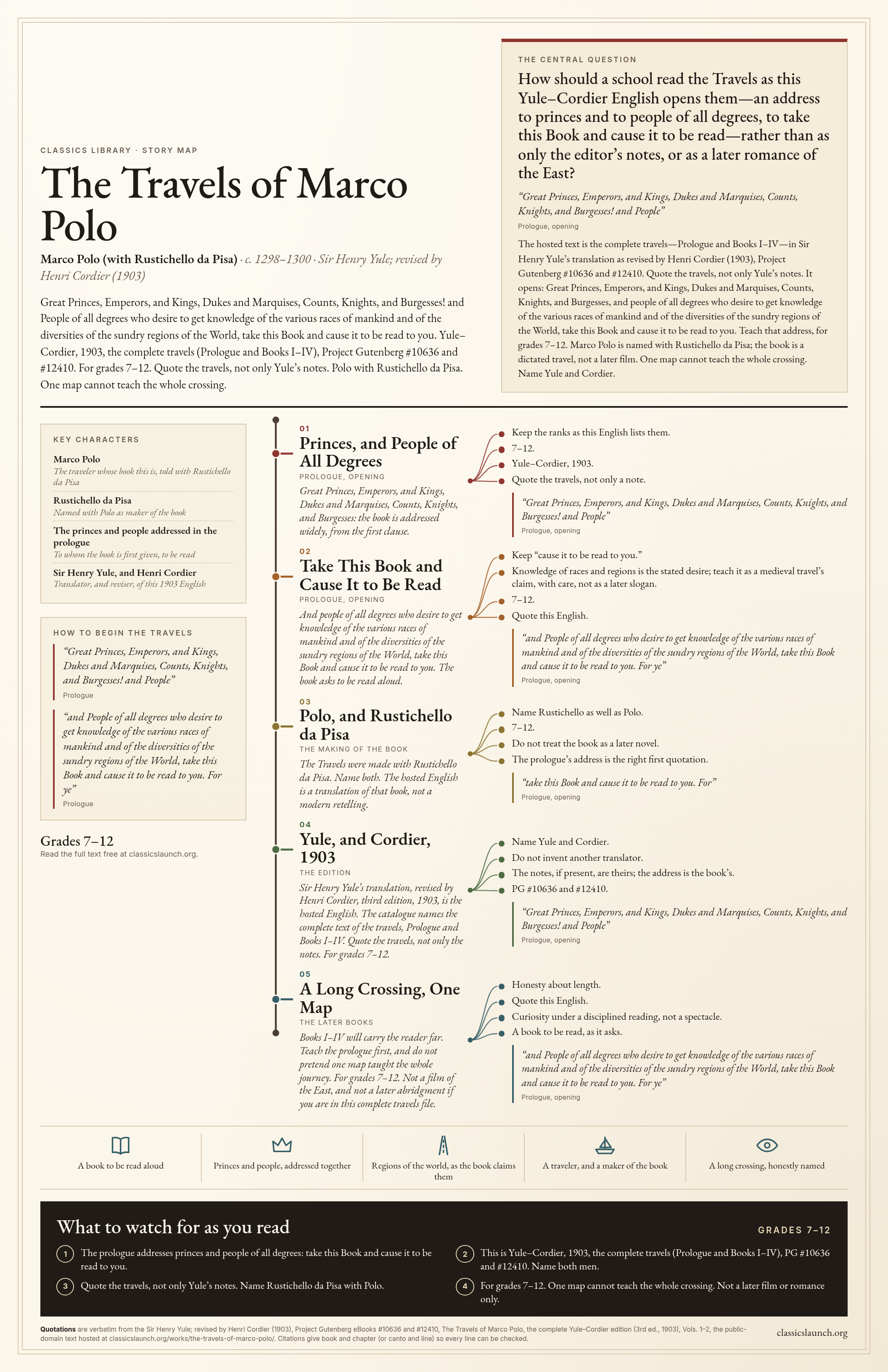
Great Princes, Emperors, and Kings, Dukes and Marquises, Counts, Knights, and Burgesses! and People of all degrees who desire to get knowledge of the various races of mankind and of the diversities of the sundry regions of the World, take this Book and cause it to be read to you. Yule–Cordier, 1903, the complete travels (Prologue and Books I–IV), Project Gutenberg #10636 and #12410. For grades 7–12. Quote the travels, not only Yule’s notes. Polo with Rustichello da Pisa. One map cannot teach the whole crossing.
The central question
How should a school read the Travels as this Yule–Cordier English opens them—an address to princes and to people of all degrees, to take this Book and cause it to be read—rather than as only the editor’s notes, or as a later romance of the East?
“Great Princes, Emperors, and Kings, Dukes and Marquises, Counts, Knights, and Burgesses! and People”
The hosted text is the complete travels—Prologue and Books I–IV—in Sir Henry Yule’s translation as revised by Henri Cordier (1903), Project Gutenberg #10636 and #12410. Quote the travels, not only Yule’s notes. It opens: Great Princes, Emperors, and Kings, Dukes and Marquises, Counts, Knights, and Burgesses, and people of all degrees who desire to get knowledge of the various races of mankind and of the diversities of the sundry regions of the World, take this Book and cause it to be read to you. Teach that address, for grades 7–12. Marco Polo is named with Rustichello da Pisa; the book is a dictated travel, not a later film. One map cannot teach the whole crossing. Name Yule and Cordier.
- 01
Princes, and People of All Degrees
Prologue, opening
Great Princes, Emperors, and Kings, Dukes and Marquises, Counts, Knights, and Burgesses: the book is addressed widely, from the first clause.
- Keep the ranks as this English lists them.
- 7–12.
- Yule–Cordier, 1903.
- Quote the travels, not only a note.
“Great Princes, Emperors, and Kings, Dukes and Marquises, Counts, Knights, and Burgesses! and People”
- 02
Take This Book and Cause It to Be Read
Prologue, opening
And people of all degrees who desire to get knowledge of the various races of mankind and of the diversities of the sundry regions of the World, take this Book and cause it to be read to you. The book asks to be read aloud.
- Keep “cause it to be read to you.”
- Knowledge of races and regions is the stated desire; teach it as a medieval travel’s claim, with care, not as a later slogan.
- 7–12.
- Quote this English.
“and People of all degrees who desire to get knowledge of the various races of mankind and of the diversities of the sundry regions of the World, take this Book and cause it to be read to you. For ye”
- 03
Polo, and Rustichello da Pisa
The making of the book
The Travels were made with Rustichello da Pisa. Name both. The hosted English is a translation of that book, not a modern retelling.
- Name Rustichello as well as Polo.
- 7–12.
- Do not treat the book as a later novel.
- The prologue’s address is the right first quotation.
“take this Book and cause it to be read to you. For”
- 04
Yule, and Cordier, 1903
The edition
Sir Henry Yule’s translation, revised by Henri Cordier, third edition, 1903, is the hosted English. The catalogue names the complete text of the travels, Prologue and Books I–IV. Quote the travels, not only the notes. For grades 7–12.
- Name Yule and Cordier.
- Do not invent another translator.
- The notes, if present, are theirs; the address is the book’s.
- PG #10636 and #12410.
“Great Princes, Emperors, and Kings, Dukes and Marquises, Counts, Knights, and Burgesses! and People”
- 05
A Long Crossing, One Map
The later books
Books I–IV will carry the reader far. Teach the prologue first, and do not pretend one map taught the whole journey. For grades 7–12. Not a film of the East, and not a later abridgment if you are in this complete travels file.
- Honesty about length.
- Quote this English.
- Curiosity under a disciplined reading, not a spectacle.
- A book to be read, as it asks.
“and People of all degrees who desire to get knowledge of the various races of mankind and of the diversities of the sundry regions of the World, take this Book and cause it to be read to you. For ye”
- A book to be read aloud
- Princes and people, addressed together
- Regions of the world, as the book claims them
- A traveler, and a maker of the book
- A long crossing, honestly named
What to watch for as you read
Grades 7–12- The prologue addresses princes and people of all degrees: take this Book and cause it to be read to you.
- This is Yule–Cordier, 1903, the complete travels (Prologue and Books I–IV), PG #10636 and #12410. Name both men.
- Quote the travels, not only Yule’s notes. Name Rustichello da Pisa with Polo.
- For grades 7–12. One map cannot teach the whole crossing. Not a later film or romance only.
Every quotation is word for word from the Sir Henry Yule; revised by Henri Cordier (1903) hosted in this library and is checked against that text each time the site is built. Citations give book and chapter (or canto and line).