Story maps · Grades 6–12
The True Story of My Life: A Story Map
The PDF is one tabloid page (11 × 17 in). On letter paper, choose “Fit to page.”
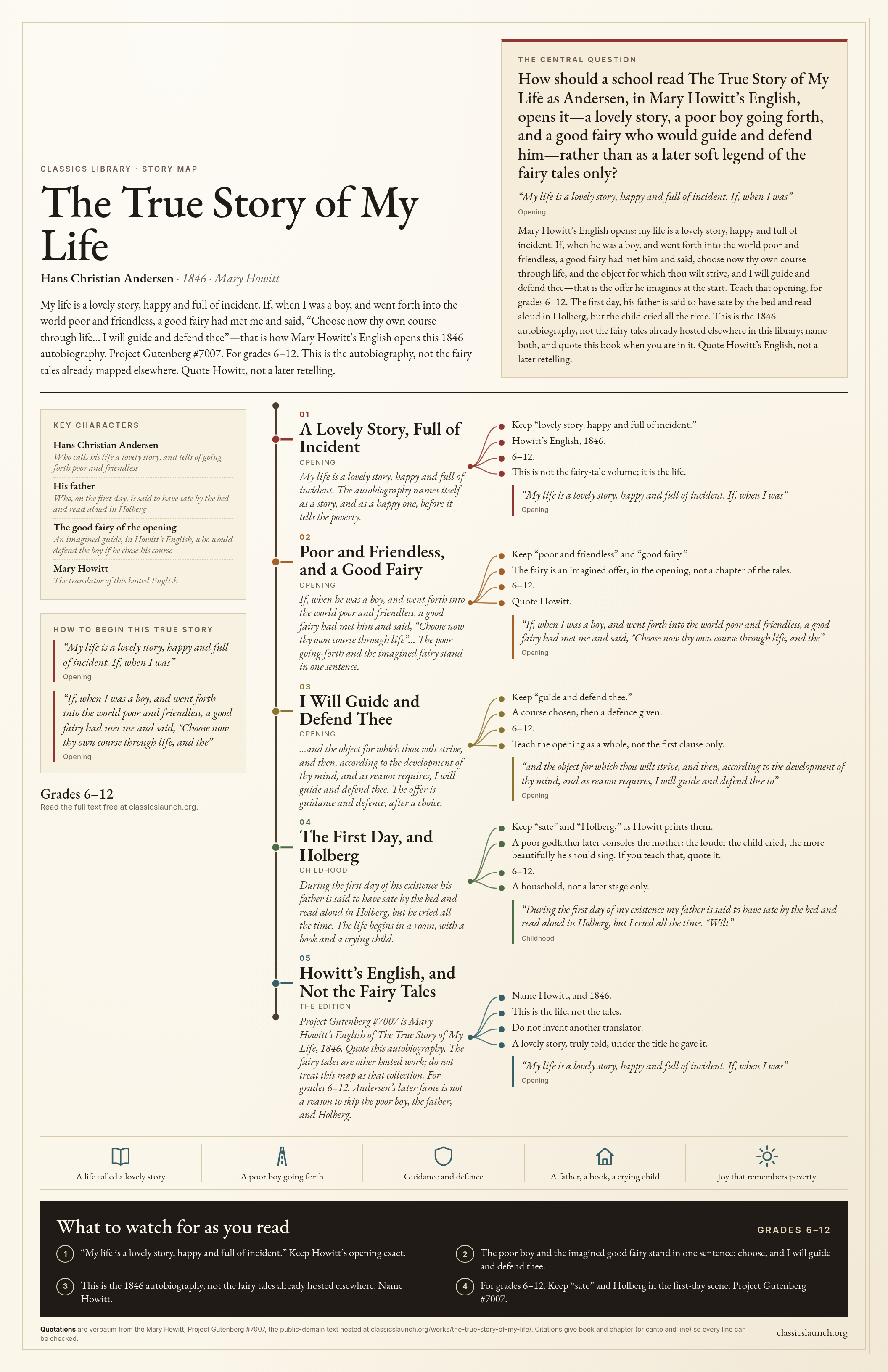
My life is a lovely story, happy and full of incident. If, when I was a boy, and went forth into the world poor and friendless, a good fairy had met me and said, “Choose now thy own course through life… I will guide and defend thee”—that is how Mary Howitt’s English opens this 1846 autobiography. Project Gutenberg #7007. For grades 6–12. This is the autobiography, not the fairy tales already mapped elsewhere. Quote Howitt, not a later retelling.
The central question
How should a school read The True Story of My Life as Andersen, in Mary Howitt’s English, opens it—a lovely story, a poor boy going forth, and a good fairy who would guide and defend him—rather than as a later soft legend of the fairy tales only?
“My life is a lovely story, happy and full of incident. If, when I was”
Mary Howitt’s English opens: my life is a lovely story, happy and full of incident. If, when he was a boy, and went forth into the world poor and friendless, a good fairy had met him and said, choose now thy own course through life, and the object for which thou wilt strive, and I will guide and defend thee—that is the offer he imagines at the start. Teach that opening, for grades 6–12. The first day, his father is said to have sate by the bed and read aloud in Holberg, but the child cried all the time. This is the 1846 autobiography, not the fairy tales already hosted elsewhere in this library; name both, and quote this book when you are in it. Quote Howitt’s English, not a later retelling.
- 01
A Lovely Story, Full of Incident
Opening
My life is a lovely story, happy and full of incident. The autobiography names itself as a story, and as a happy one, before it tells the poverty.
- Keep “lovely story, happy and full of incident.”
- Howitt’s English, 1846.
- 6–12.
- This is not the fairy-tale volume; it is the life.
“My life is a lovely story, happy and full of incident. If, when I was”
- 02
Poor and Friendless, and a Good Fairy
Opening
If, when he was a boy, and went forth into the world poor and friendless, a good fairy had met him and said, “Choose now thy own course through life”… The poor going-forth and the imagined fairy stand in one sentence.
- Keep “poor and friendless” and “good fairy.”
- The fairy is an imagined offer, in the opening, not a chapter of the tales.
- 6–12.
- Quote Howitt.
“If, when I was a boy, and went forth into the world poor and friendless, a good fairy had met me and said, "Choose now thy own course through life, and the”
- 03
I Will Guide and Defend Thee
Opening
…and the object for which thou wilt strive, and then, according to the development of thy mind, and as reason requires, I will guide and defend thee. The offer is guidance and defence, after a choice.
- Keep “guide and defend thee.”
- A course chosen, then a defence given.
- 6–12.
- Teach the opening as a whole, not the first clause only.
“and the object for which thou wilt strive, and then, according to the development of thy mind, and as reason requires, I will guide and defend thee to”
- 04
The First Day, and Holberg
Childhood
During the first day of his existence his father is said to have sate by the bed and read aloud in Holberg, but he cried all the time. The life begins in a room, with a book and a crying child.
- Keep “sate” and “Holberg,” as Howitt prints them.
- A poor godfather later consoles the mother: the louder the child cried, the more beautifully he should sing. If you teach that, quote it.
- 6–12.
- A household, not a later stage only.
“During the first day of my existence my father is said to have sate by the bed and read aloud in Holberg, but I cried all the time. "Wilt”
- 05
Howitt’s English, and Not the Fairy Tales
The edition
Project Gutenberg #7007 is Mary Howitt’s English of The True Story of My Life, 1846. Quote this autobiography. The fairy tales are other hosted work; do not treat this map as that collection. For grades 6–12. Andersen’s later fame is not a reason to skip the poor boy, the father, and Holberg.
- Name Howitt, and 1846.
- This is the life, not the tales.
- Do not invent another translator.
- A lovely story, truly told, under the title he gave it.
“My life is a lovely story, happy and full of incident. If, when I was”
- A life called a lovely story
- A poor boy going forth
- Guidance and defence
- A father, a book, a crying child
- Joy that remembers poverty
What to watch for as you read
Grades 6–12- “My life is a lovely story, happy and full of incident.” Keep Howitt’s opening exact.
- The poor boy and the imagined good fairy stand in one sentence: choose, and I will guide and defend thee.
- This is the 1846 autobiography, not the fairy tales already hosted elsewhere. Name Howitt.
- For grades 6–12. Keep “sate” and Holberg in the first-day scene. Project Gutenberg #7007.
Every quotation is word for word from the Mary Howitt hosted in this library and is checked against that text each time the site is built. Citations give book and chapter (or canto and line).