Story maps · Grades 3–5
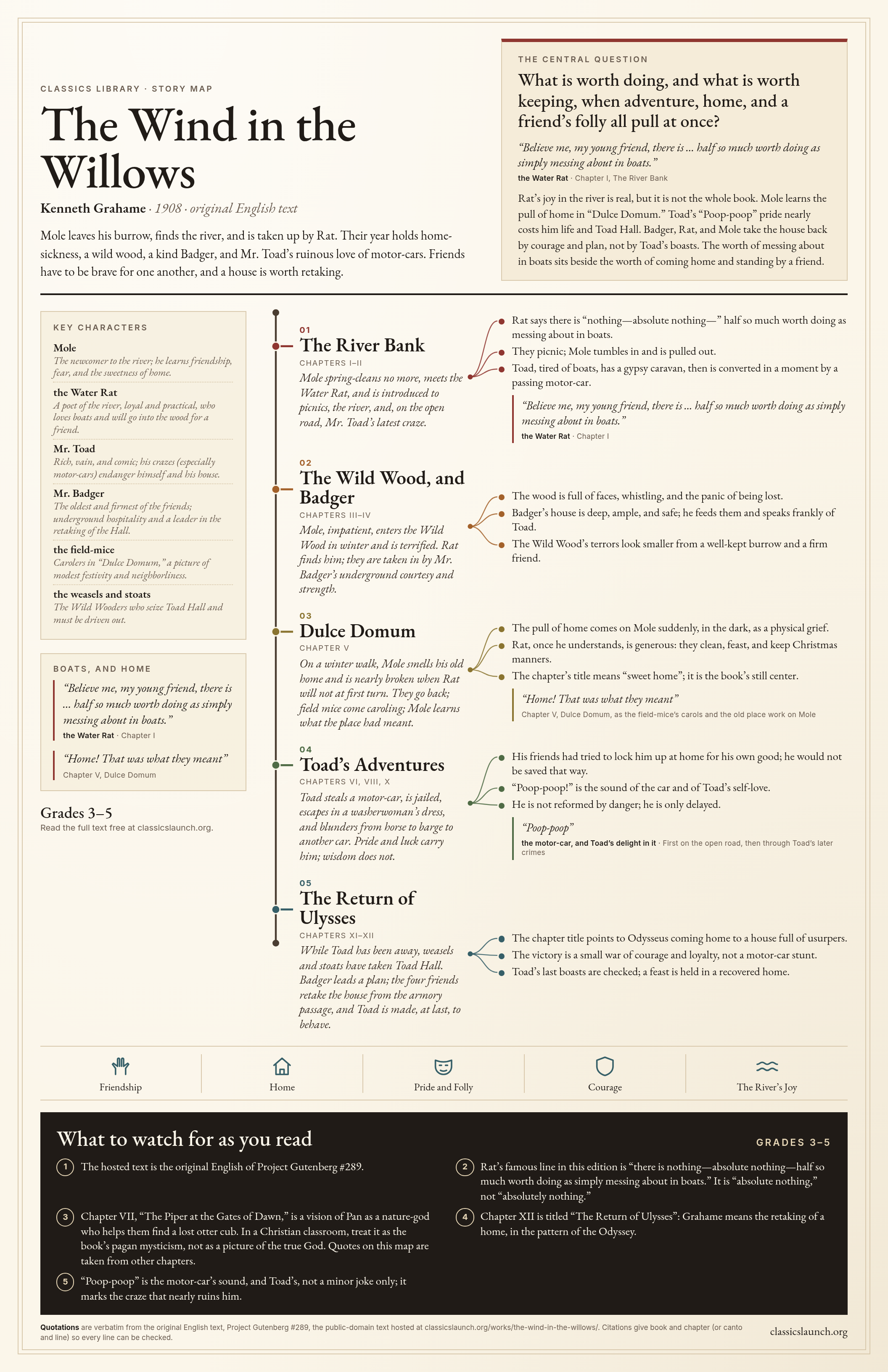
The Wind in the Willows: A Story Map
The PDF is one tabloid page (11 × 17 in). On letter paper, choose “Fit to page.”
Mole leaves his burrow, finds the river, and is taken up by Rat. Their year holds home-sickness, a wild wood, a kind Badger, and Mr. Toad’s ruinous love of motor-cars. Friends have to be brave for one another, and a house is worth retaking.
The central question
What is worth doing, and what is worth keeping, when adventure, home, and a friend’s folly all pull at once?
“Believe me, my young friend, there is … half so much worth doing as simply messing about in boats.”
Rat’s joy in the river is real, but it is not the whole book. Mole learns the pull of home in “Dulce Domum.” Toad’s “Poop-poop” pride nearly costs him life and Toad Hall. Badger, Rat, and Mole take the house back by courage and plan, not by Toad’s boasts. The worth of messing about in boats sits beside the worth of coming home and standing by a friend.
- 01
The River Bank
Chapters I–II
Mole spring-cleans no more, meets the Water Rat, and is introduced to picnics, the river, and, on the open road, Mr. Toad’s latest craze.
- Rat says there is “nothing—absolute nothing—” half so much worth doing as messing about in boats.
- They picnic; Mole tumbles in and is pulled out.
- Toad, tired of boats, has a gypsy caravan, then is converted in a moment by a passing motor-car.
“Believe me, my young friend, there is … half so much worth doing as simply messing about in boats.”
- 02
The Wild Wood, and Badger
Chapters III–IV
Mole, impatient, enters the Wild Wood in winter and is terrified. Rat finds him; they are taken in by Mr. Badger’s underground courtesy and strength.
- The wood is full of faces, whistling, and the panic of being lost.
- Badger’s house is deep, ample, and safe; he feeds them and speaks frankly of Toad.
- The Wild Wood’s terrors look smaller from a well-kept burrow and a firm friend.
- 03
Dulce Domum
Chapter V
On a winter walk, Mole smells his old home and is nearly broken when Rat will not at first turn. They go back; field mice come caroling; Mole learns what the place had meant.
- The pull of home comes on Mole suddenly, in the dark, as a physical grief.
- Rat, once he understands, is generous: they clean, feast, and keep Christmas manners.
- The chapter’s title means “sweet home”; it is the book’s still center.
“Home! That was what they meant”
- 04
Toad’s Adventures
Chapters VI, VIII, X
Toad steals a motor-car, is jailed, escapes in a washerwoman’s dress, and blunders from horse to barge to another car. Pride and luck carry him; wisdom does not.
- His friends had tried to lock him up at home for his own good; he would not be saved that way.
- “Poop-poop!” is the sound of the car and of Toad’s self-love.
- He is not reformed by danger; he is only delayed.
“Poop-poop”
- 05
The Return of Ulysses
Chapters XI–XII
While Toad has been away, weasels and stoats have taken Toad Hall. Badger leads a plan; the four friends retake the house from the armory passage, and Toad is made, at last, to behave.
- The chapter title points to Odysseus coming home to a house full of usurpers.
- The victory is a small war of courage and loyalty, not a motor-car stunt.
- Toad’s last boasts are checked; a feast is held in a recovered home.
- Friendship
- Home
- Pride and Folly
- Courage
- The River’s Joy
What to watch for as you read
Grades 3–5- The hosted text is the original English of Project Gutenberg #289.
- Rat’s famous line in this edition is “there is nothing—absolute nothing—half so much worth doing as simply messing about in boats.” It is “absolute nothing,” not “absolutely nothing.”
- Chapter VII, “The Piper at the Gates of Dawn,” is a vision of Pan as a nature-god who helps them find a lost otter cub. In a Christian classroom, treat it as the book’s pagan mysticism, not as a picture of the true God. Quotes on this map are taken from other chapters.
- Chapter XII is titled “The Return of Ulysses”: Grahame means the retaking of a home, in the pattern of the Odyssey.
- “Poop-poop” is the motor-car’s sound, and Toad’s, not a minor joke only; it marks the craze that nearly ruins him.
Every quotation is word for word from the original English text hosted in this library and is checked against that text each time the site is built. Citations give book and chapter (or canto and line).