Story maps · Grades 9–12
Theodore Roosevelt: An Autobiography: A Story Map
The PDF is one tabloid page (11 × 17 in). On letter paper, choose “Fit to page.”
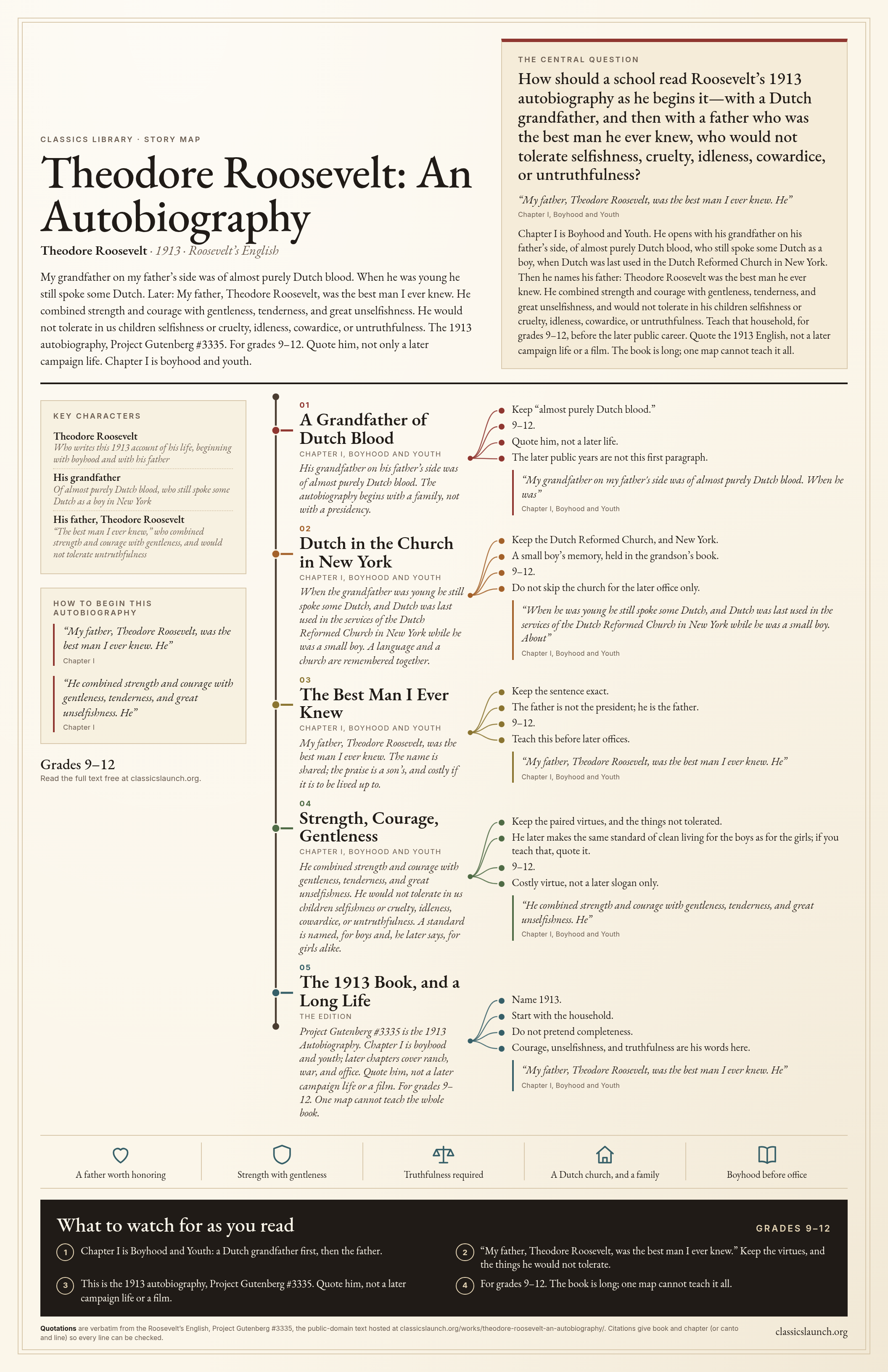
My grandfather on my father’s side was of almost purely Dutch blood. When he was young he still spoke some Dutch. Later: My father, Theodore Roosevelt, was the best man I ever knew. He combined strength and courage with gentleness, tenderness, and great unselfishness. He would not tolerate in us children selfishness or cruelty, idleness, cowardice, or untruthfulness. The 1913 autobiography, Project Gutenberg #3335. For grades 9–12. Quote him, not only a later campaign life. Chapter I is boyhood and youth.
The central question
How should a school read Roosevelt’s 1913 autobiography as he begins it—with a Dutch grandfather, and then with a father who was the best man he ever knew, who would not tolerate selfishness, cruelty, idleness, cowardice, or untruthfulness?
“My father, Theodore Roosevelt, was the best man I ever knew. He”
Chapter I is Boyhood and Youth. He opens with his grandfather on his father’s side, of almost purely Dutch blood, who still spoke some Dutch as a boy, when Dutch was last used in the Dutch Reformed Church in New York. Then he names his father: Theodore Roosevelt was the best man he ever knew. He combined strength and courage with gentleness, tenderness, and great unselfishness, and would not tolerate in his children selfishness or cruelty, idleness, cowardice, or untruthfulness. Teach that household, for grades 9–12, before the later public career. Quote the 1913 English, not a later campaign life or a film. The book is long; one map cannot teach it all.
- 01
A Grandfather of Dutch Blood
Chapter I, Boyhood and Youth
His grandfather on his father’s side was of almost purely Dutch blood. The autobiography begins with a family, not with a presidency.
- Keep “almost purely Dutch blood.”
- 9–12.
- Quote him, not a later life.
- The later public years are not this first paragraph.
“My grandfather on my father's side was of almost purely Dutch blood. When he was”
- 02
Dutch in the Church in New York
Chapter I, Boyhood and Youth
When the grandfather was young he still spoke some Dutch, and Dutch was last used in the services of the Dutch Reformed Church in New York while he was a small boy. A language and a church are remembered together.
- Keep the Dutch Reformed Church, and New York.
- A small boy’s memory, held in the grandson’s book.
- 9–12.
- Do not skip the church for the later office only.
“When he was young he still spoke some Dutch, and Dutch was last used in the services of the Dutch Reformed Church in New York while he was a small boy. About”
- 03
The Best Man I Ever Knew
Chapter I, Boyhood and Youth
My father, Theodore Roosevelt, was the best man I ever knew. The name is shared; the praise is a son’s, and costly if it is to be lived up to.
- Keep the sentence exact.
- The father is not the president; he is the father.
- 9–12.
- Teach this before later offices.
“My father, Theodore Roosevelt, was the best man I ever knew. He”
- 04
Strength, Courage, Gentleness
Chapter I, Boyhood and Youth
He combined strength and courage with gentleness, tenderness, and great unselfishness. He would not tolerate in us children selfishness or cruelty, idleness, cowardice, or untruthfulness. A standard is named, for boys and, he later says, for girls alike.
- Keep the paired virtues, and the things not tolerated.
- He later makes the same standard of clean living for the boys as for the girls; if you teach that, quote it.
- 9–12.
- Costly virtue, not a later slogan only.
“He combined strength and courage with gentleness, tenderness, and great unselfishness. He”
- 05
The 1913 Book, and a Long Life
The edition
Project Gutenberg #3335 is the 1913 Autobiography. Chapter I is boyhood and youth; later chapters cover ranch, war, and office. Quote him, not a later campaign life or a film. For grades 9–12. One map cannot teach the whole book.
- Name 1913.
- Start with the household.
- Do not pretend completeness.
- Courage, unselfishness, and truthfulness are his words here.
“My father, Theodore Roosevelt, was the best man I ever knew. He”
- A father worth honoring
- Strength with gentleness
- Truthfulness required
- A Dutch church, and a family
- Boyhood before office
What to watch for as you read
Grades 9–12- Chapter I is Boyhood and Youth: a Dutch grandfather first, then the father.
- “My father, Theodore Roosevelt, was the best man I ever knew.” Keep the virtues, and the things he would not tolerate.
- This is the 1913 autobiography, Project Gutenberg #3335. Quote him, not a later campaign life or a film.
- For grades 9–12. The book is long; one map cannot teach it all.
Every quotation is word for word from the Roosevelt’s English hosted in this library and is checked against that text each time the site is built. Citations give book and chapter (or canto and line).