Story maps · Grades 3–5
Through the Looking-Glass, and What Alice Found There: A Story Map
The PDF is one tabloid page (11 × 17 in). On letter paper, choose “Fit to page.”
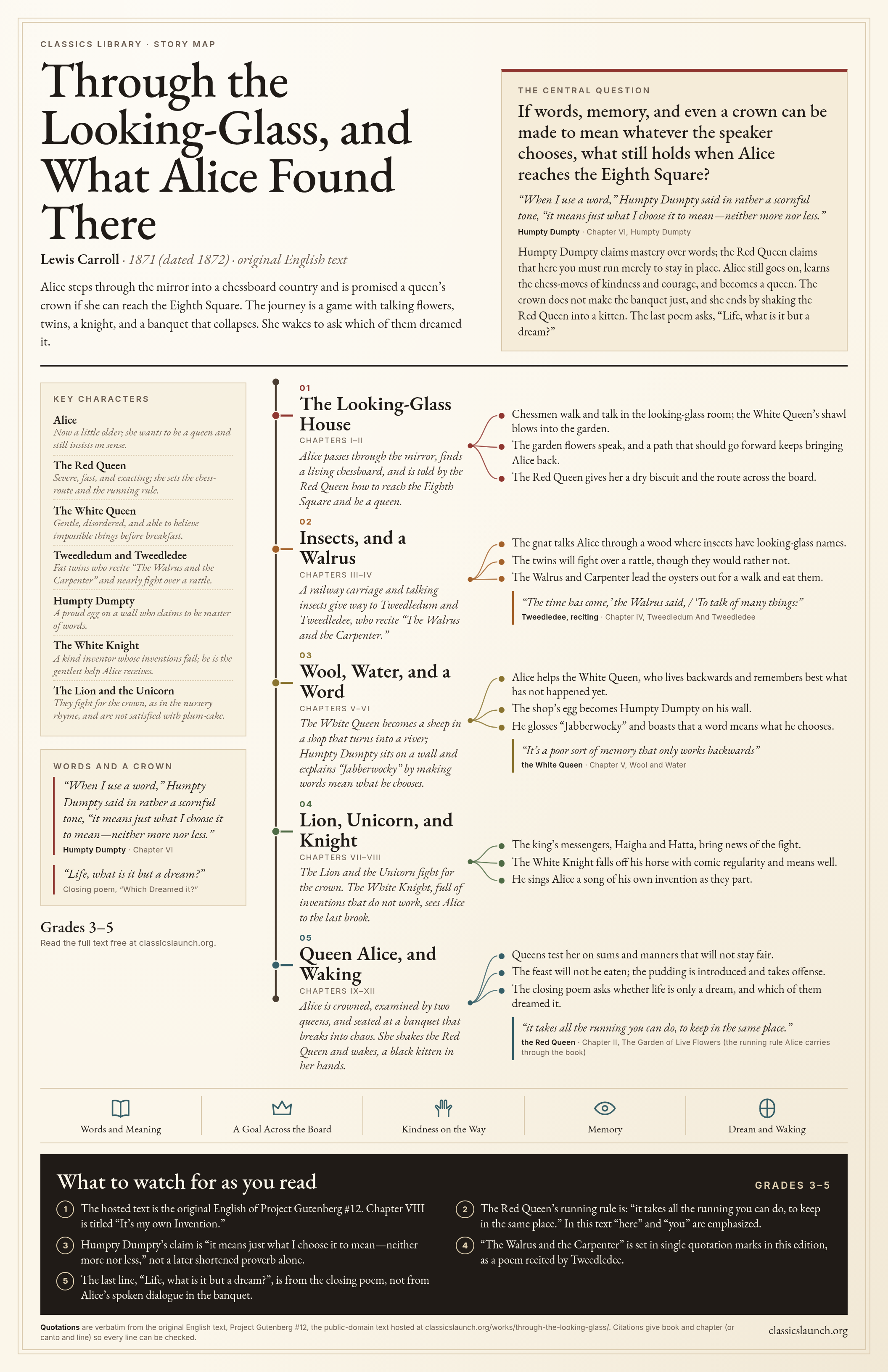
Alice steps through the mirror into a chessboard country and is promised a queen’s crown if she can reach the Eighth Square. The journey is a game with talking flowers, twins, a knight, and a banquet that collapses. She wakes to ask which of them dreamed it.
The central question
If words, memory, and even a crown can be made to mean whatever the speaker chooses, what still holds when Alice reaches the Eighth Square?
“When I use a word,” Humpty Dumpty said in rather a scornful tone, “it means just what I choose it to mean—neither more nor less.”
Humpty Dumpty claims mastery over words; the Red Queen claims that here you must run merely to stay in place. Alice still goes on, learns the chess-moves of kindness and courage, and becomes a queen. The crown does not make the banquet just, and she ends by shaking the Red Queen into a kitten. The last poem asks, “Life, what is it but a dream?”
- 01
The Looking-Glass House
Chapters I–II
Alice passes through the mirror, finds a living chessboard, and is told by the Red Queen how to reach the Eighth Square and be a queen.
- Chessmen walk and talk in the looking-glass room; the White Queen’s shawl blows into the garden.
- The garden flowers speak, and a path that should go forward keeps bringing Alice back.
- The Red Queen gives her a dry biscuit and the route across the board.
- 02
Insects, and a Walrus
Chapters III–IV
A railway carriage and talking insects give way to Tweedledum and Tweedledee, who recite “The Walrus and the Carpenter.”
- The gnat talks Alice through a wood where insects have looking-glass names.
- The twins will fight over a rattle, though they would rather not.
- The Walrus and Carpenter lead the oysters out for a walk and eat them.
“The time has come,’ the Walrus said, / ‘To talk of many things:”
- 03
Wool, Water, and a Word
Chapters V–VI
The White Queen becomes a sheep in a shop that turns into a river; Humpty Dumpty sits on a wall and explains “Jabberwocky” by making words mean what he chooses.
- Alice helps the White Queen, who lives backwards and remembers best what has not happened yet.
- The shop’s egg becomes Humpty Dumpty on his wall.
- He glosses “Jabberwocky” and boasts that a word means what he chooses.
“It’s a poor sort of memory that only works backwards”
- 04
Lion, Unicorn, and Knight
Chapters VII–VIII
The Lion and the Unicorn fight for the crown. The White Knight, full of inventions that do not work, sees Alice to the last brook.
- The king’s messengers, Haigha and Hatta, bring news of the fight.
- The White Knight falls off his horse with comic regularity and means well.
- He sings Alice a song of his own invention as they part.
- 05
Queen Alice, and Waking
Chapters IX–XII
Alice is crowned, examined by two queens, and seated at a banquet that breaks into chaos. She shakes the Red Queen and wakes, a black kitten in her hands.
- Queens test her on sums and manners that will not stay fair.
- The feast will not be eaten; the pudding is introduced and takes offense.
- The closing poem asks whether life is only a dream, and which of them dreamed it.
“it takes all the running you can do, to keep in the same place.”
- Words and Meaning
- A Goal Across the Board
- Kindness on the Way
- Memory
- Dream and Waking
What to watch for as you read
Grades 3–5- The hosted text is the original English of Project Gutenberg #12. Chapter VIII is titled “It’s my own Invention.”
- The Red Queen’s running rule is: “it takes all the running you can do, to keep in the same place.” In this text “here” and “you” are emphasized.
- Humpty Dumpty’s claim is “it means just what I choose it to mean—neither more nor less,” not a later shortened proverb alone.
- “The Walrus and the Carpenter” is set in single quotation marks in this edition, as a poem recited by Tweedledee.
- The last line, “Life, what is it but a dream?”, is from the closing poem, not from Alice’s spoken dialogue in the banquet.
Every quotation is word for word from the original English text hosted in this library and is checked against that text each time the site is built. Citations give book and chapter (or canto and line).