Story maps · Grades 11–12
The Old Regime and the Revolution: A Story Map
The PDF is one tabloid page (11 × 17 in). On letter paper, choose “Fit to page.”
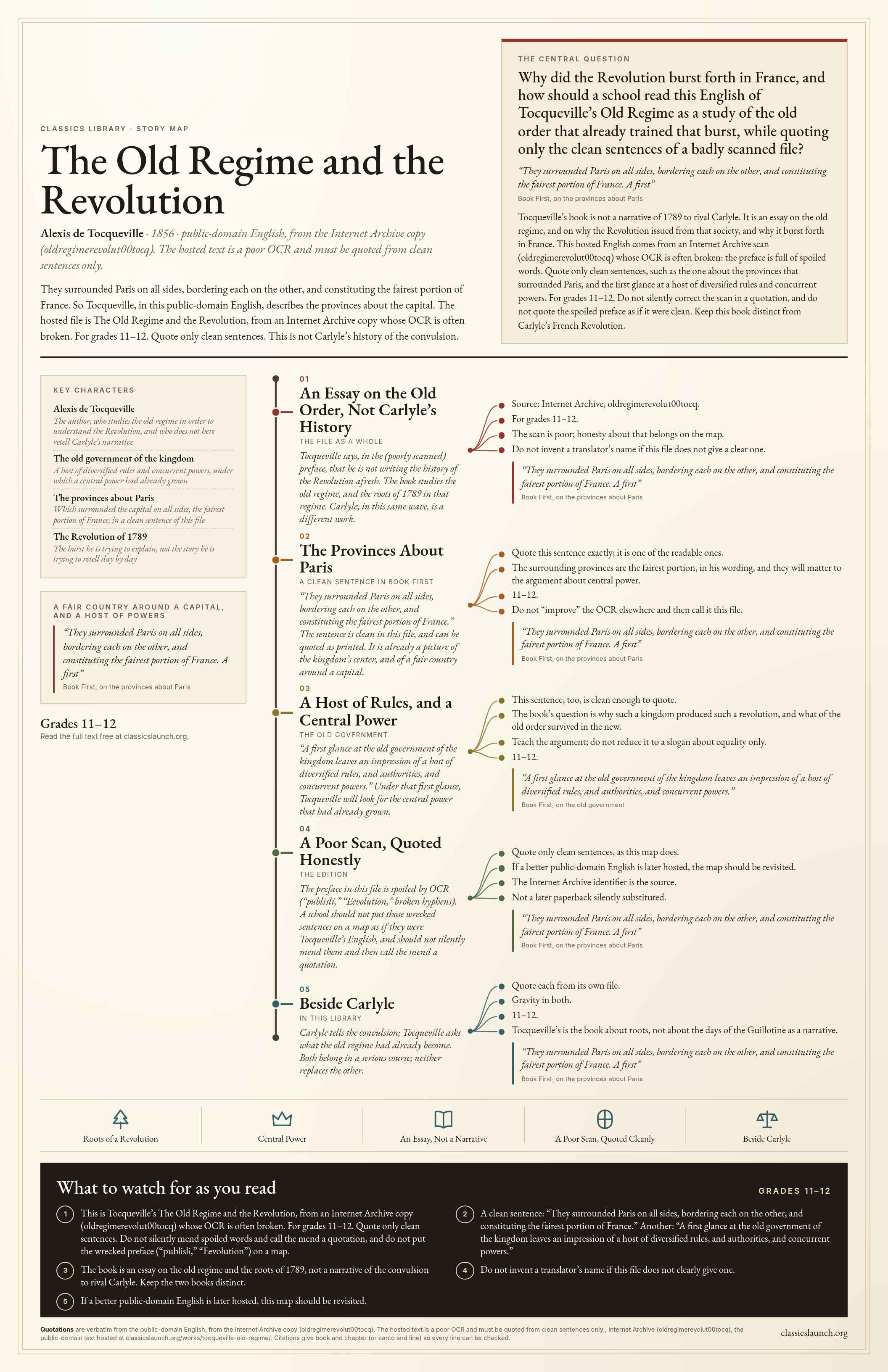
They surrounded Paris on all sides, bordering each on the other, and constituting the fairest portion of France. So Tocqueville, in this public-domain English, describes the provinces about the capital. The hosted file is The Old Regime and the Revolution, from an Internet Archive copy whose OCR is often broken. For grades 11–12. Quote only clean sentences. This is not Carlyle’s history of the convulsion.
The central question
Why did the Revolution burst forth in France, and how should a school read this English of Tocqueville’s Old Regime as a study of the old order that already trained that burst, while quoting only the clean sentences of a badly scanned file?
“They surrounded Paris on all sides, bordering each on the other, and constituting the fairest portion of France. A first”
Tocqueville’s book is not a narrative of 1789 to rival Carlyle. It is an essay on the old regime, and on why the Revolution issued from that society, and why it burst forth in France. This hosted English comes from an Internet Archive scan (oldregimerevolut00tocq) whose OCR is often broken: the preface is full of spoiled words. Quote only clean sentences, such as the one about the provinces that surrounded Paris, and the first glance at a host of diversified rules and concurrent powers. For grades 11–12. Do not silently correct the scan in a quotation, and do not quote the spoiled preface as if it were clean. Keep this book distinct from Carlyle’s French Revolution.
- 01
An Essay on the Old Order, Not Carlyle’s History
The file as a whole
Tocqueville says, in the (poorly scanned) preface, that he is not writing the history of the Revolution afresh. The book studies the old regime, and the roots of 1789 in that regime. Carlyle, in this same wave, is a different work.
- Source: Internet Archive, oldregimerevolut00tocq.
- For grades 11–12.
- The scan is poor; honesty about that belongs on the map.
- Do not invent a translator’s name if this file does not give a clear one.
“They surrounded Paris on all sides, bordering each on the other, and constituting the fairest portion of France. A first”
- 02
The Provinces About Paris
A clean sentence in Book First
“They surrounded Paris on all sides, bordering each on the other, and constituting the fairest portion of France.” The sentence is clean in this file, and can be quoted as printed. It is already a picture of the kingdom’s center, and of a fair country around a capital.
- Quote this sentence exactly; it is one of the readable ones.
- The surrounding provinces are the fairest portion, in his wording, and they will matter to the argument about central power.
- 11–12.
- Do not “improve” the OCR elsewhere and then call it this file.
“They surrounded Paris on all sides, bordering each on the other, and constituting the fairest portion of France. A first”
- 03
A Host of Rules, and a Central Power
The old government
“A first glance at the old government of the kingdom leaves an impression of a host of diversified rules, and authorities, and concurrent powers.” Under that first glance, Tocqueville will look for the central power that had already grown.
- This sentence, too, is clean enough to quote.
- The book’s question is why such a kingdom produced such a revolution, and what of the old order survived in the new.
- Teach the argument; do not reduce it to a slogan about equality only.
- 11–12.
“A first glance at the old government of the kingdom leaves an impression of a host of diversified rules, and authorities, and concurrent powers.”
- 04
A Poor Scan, Quoted Honestly
The edition
The preface in this file is spoiled by OCR (“publisli,” “Eevolution,” broken hyphens). A school should not put those wrecked sentences on a map as if they were Tocqueville’s English, and should not silently mend them and then call the mend a quotation.
- Quote only clean sentences, as this map does.
- If a better public-domain English is later hosted, the map should be revisited.
- The Internet Archive identifier is the source.
- Not a later paperback silently substituted.
“They surrounded Paris on all sides, bordering each on the other, and constituting the fairest portion of France. A first”
- 05
Beside Carlyle
In this library
Carlyle tells the convulsion; Tocqueville asks what the old regime had already become. Both belong in a serious course; neither replaces the other.
- Quote each from its own file.
- Gravity in both.
- 11–12.
- Tocqueville’s is the book about roots, not about the days of the Guillotine as a narrative.
“They surrounded Paris on all sides, bordering each on the other, and constituting the fairest portion of France. A first”
- Roots of a Revolution
- Central Power
- An Essay, Not a Narrative
- A Poor Scan, Quoted Cleanly
- Beside Carlyle
What to watch for as you read
Grades 11–12- This is Tocqueville’s The Old Regime and the Revolution, from an Internet Archive copy (oldregimerevolut00tocq) whose OCR is often broken. For grades 11–12. Quote only clean sentences. Do not silently mend spoiled words and call the mend a quotation, and do not put the wrecked preface (“publisli,” “Eevolution”) on a map.
- A clean sentence: “They surrounded Paris on all sides, bordering each on the other, and constituting the fairest portion of France.” Another: “A first glance at the old government of the kingdom leaves an impression of a host of diversified rules, and authorities, and concurrent powers.”
- The book is an essay on the old regime and the roots of 1789, not a narrative of the convulsion to rival Carlyle. Keep the two books distinct.
- Do not invent a translator’s name if this file does not clearly give one.
- If a better public-domain English is later hosted, this map should be revisited.
Every quotation is word for word from the public-domain English, from the Internet Archive copy (oldregimerevolut00tocq). The hosted text is a poor OCR and must be quoted from clean sentences only. hosted in this library and is checked against that text each time the site is built. Citations give book and chapter (or canto and line).