Story maps · Grades 11–12
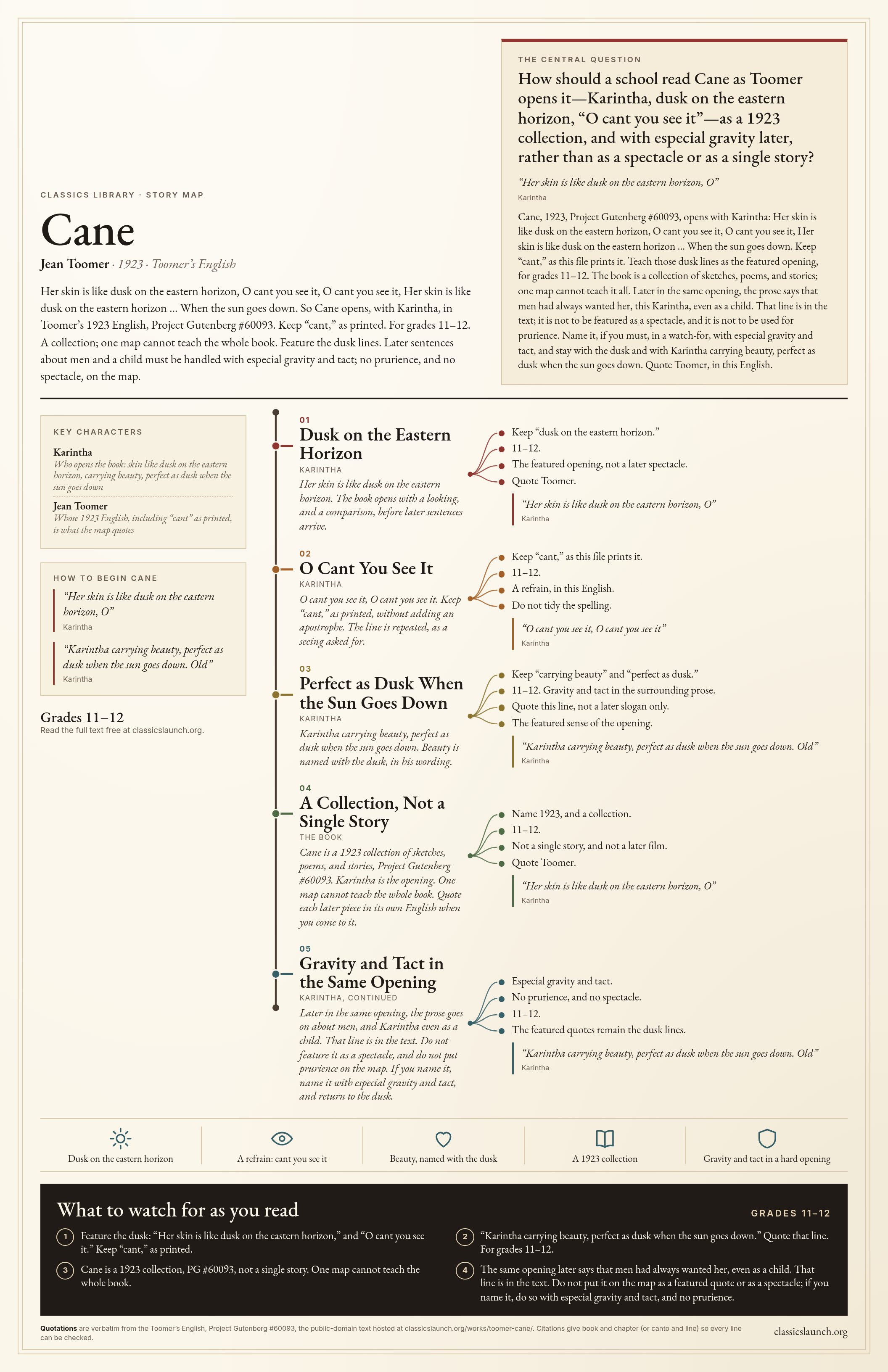
Cane: A Story Map
The PDF is one tabloid page (11 × 17 in). On letter paper, choose “Fit to page.”
Her skin is like dusk on the eastern horizon, O cant you see it, O cant you see it, Her skin is like dusk on the eastern horizon … When the sun goes down. So Cane opens, with Karintha, in Toomer’s 1923 English, Project Gutenberg #60093. Keep “cant,” as printed. For grades 11–12. A collection; one map cannot teach the whole book. Feature the dusk lines. Later sentences about men and a child must be handled with especial gravity and tact; no prurience, and no spectacle, on the map.
The central question
How should a school read Cane as Toomer opens it—Karintha, dusk on the eastern horizon, “O cant you see it”—as a 1923 collection, and with especial gravity later, rather than as a spectacle or as a single story?
“Her skin is like dusk on the eastern horizon, O”
Cane, 1923, Project Gutenberg #60093, opens with Karintha: Her skin is like dusk on the eastern horizon, O cant you see it, O cant you see it, Her skin is like dusk on the eastern horizon … When the sun goes down. Keep “cant,” as this file prints it. Teach those dusk lines as the featured opening, for grades 11–12. The book is a collection of sketches, poems, and stories; one map cannot teach it all. Later in the same opening, the prose says that men had always wanted her, this Karintha, even as a child. That line is in the text; it is not to be featured as a spectacle, and it is not to be used for prurience. Name it, if you must, in a watch-for, with especial gravity and tact, and stay with the dusk and with Karintha carrying beauty, perfect as dusk when the sun goes down. Quote Toomer, in this English.
- 01
Dusk on the Eastern Horizon
Karintha
Her skin is like dusk on the eastern horizon. The book opens with a looking, and a comparison, before later sentences arrive.
- Keep “dusk on the eastern horizon.”
- 11–12.
- The featured opening, not a later spectacle.
- Quote Toomer.
“Her skin is like dusk on the eastern horizon, O”
- 02
O Cant You See It
Karintha
O cant you see it, O cant you see it. Keep “cant,” as printed, without adding an apostrophe. The line is repeated, as a seeing asked for.
- Keep “cant,” as this file prints it.
- 11–12.
- A refrain, in this English.
- Do not tidy the spelling.
“O cant you see it, O cant you see it”
- 03
Perfect as Dusk When the Sun Goes Down
Karintha
Karintha carrying beauty, perfect as dusk when the sun goes down. Beauty is named with the dusk, in his wording.
- Keep “carrying beauty” and “perfect as dusk.”
- 11–12. Gravity and tact in the surrounding prose.
- Quote this line, not a later slogan only.
- The featured sense of the opening.
“Karintha carrying beauty, perfect as dusk when the sun goes down. Old”
- 04
A Collection, Not a Single Story
The book
Cane is a 1923 collection of sketches, poems, and stories, Project Gutenberg #60093. Karintha is the opening. One map cannot teach the whole book. Quote each later piece in its own English when you come to it.
- Name 1923, and a collection.
- 11–12.
- Not a single story, and not a later film.
- Quote Toomer.
“Her skin is like dusk on the eastern horizon, O”
- 05
Gravity and Tact in the Same Opening
Karintha, continued
Later in the same opening, the prose goes on about men, and Karintha even as a child. That line is in the text. Do not feature it as a spectacle, and do not put prurience on the map. If you name it, name it with especial gravity and tact, and return to the dusk.
- Especial gravity and tact.
- No prurience, and no spectacle.
- 11–12.
- The featured quotes remain the dusk lines.
“Karintha carrying beauty, perfect as dusk when the sun goes down. Old”
- Dusk on the eastern horizon
- A refrain: cant you see it
- Beauty, named with the dusk
- A 1923 collection
- Gravity and tact in a hard opening
What to watch for as you read
Grades 11–12- Feature the dusk: “Her skin is like dusk on the eastern horizon,” and “O cant you see it.” Keep “cant,” as printed.
- “Karintha carrying beauty, perfect as dusk when the sun goes down.” Quote that line. For grades 11–12.
- Cane is a 1923 collection, PG #60093, not a single story. One map cannot teach the whole book.
- The same opening later says that men had always wanted her, even as a child. That line is in the text. Do not put it on the map as a featured quote or as a spectacle; if you name it, do so with especial gravity and tact, and no prurience.
Every quotation is word for word from the Toomer’s English hosted in this library and is checked against that text each time the site is built. Citations give book and chapter (or canto and line).