Story maps · Grades 9–12
A Sportsman’s Sketches: A Story Map
The PDF is one tabloid page (11 × 17 in). On letter paper, choose “Fit to page.”
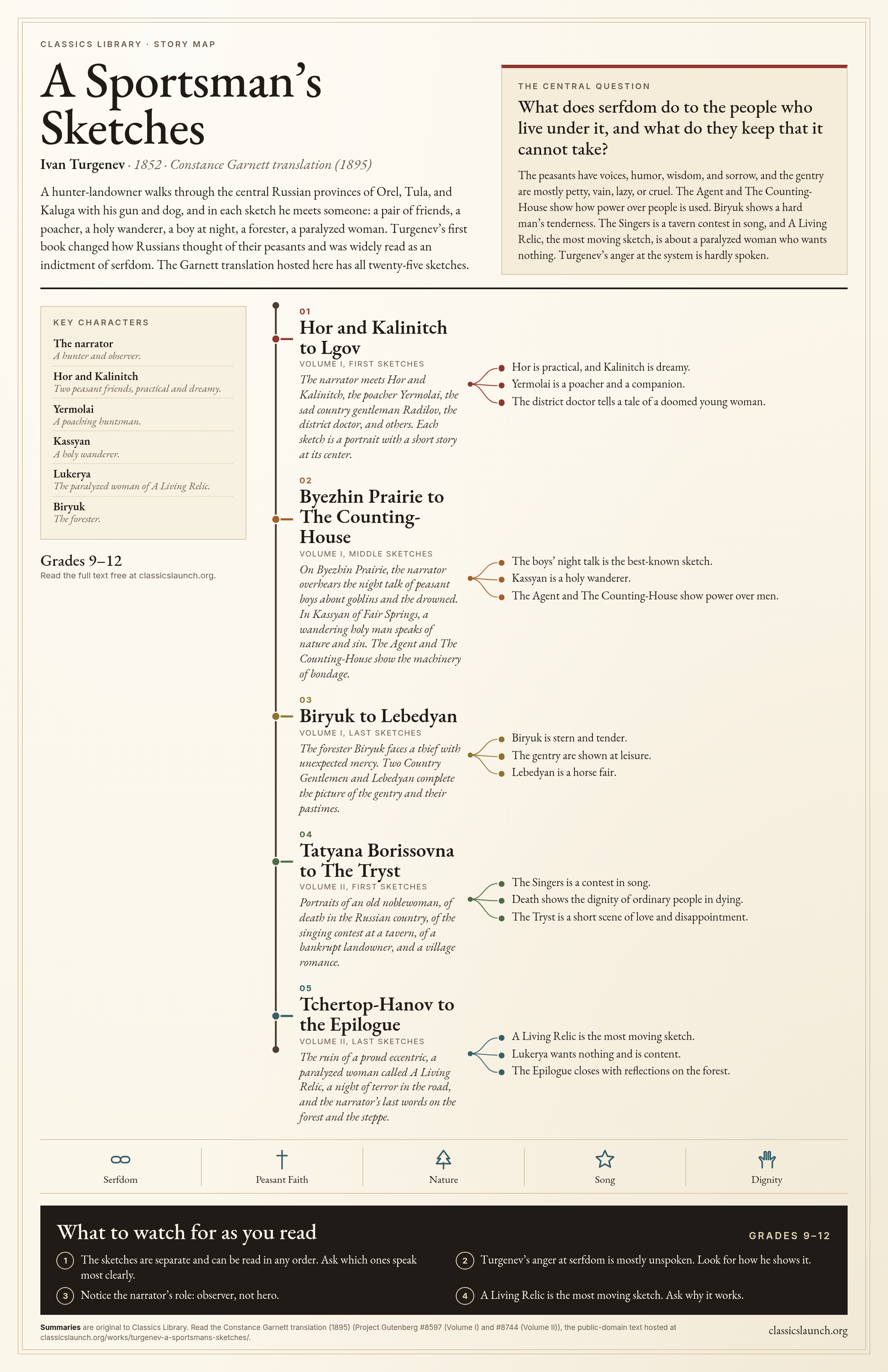
A hunter-landowner walks through the central Russian provinces of Orel, Tula, and Kaluga with his gun and dog, and in each sketch he meets someone: a pair of friends, a poacher, a holy wanderer, a boy at night, a forester, a paralyzed woman. Turgenev’s first book changed how Russians thought of their peasants and was widely read as an indictment of serfdom. The Garnett translation hosted here has all twenty-five sketches.
The central question
What does serfdom do to the people who live under it, and what do they keep that it cannot take?
The peasants have voices, humor, wisdom, and sorrow, and the gentry are mostly petty, vain, lazy, or cruel. The Agent and The Counting-House show how power over people is used. Biryuk shows a hard man’s tenderness. The Singers is a tavern contest in song, and A Living Relic, the most moving sketch, is about a paralyzed woman who wants nothing. Turgenev’s anger at the system is hardly spoken.
- 01
Hor and Kalinitch to Lgov
Volume I, first sketches
The narrator meets Hor and Kalinitch, the poacher Yermolai, the sad country gentleman Radilov, the district doctor, and others. Each sketch is a portrait with a short story at its center.
- Hor is practical, and Kalinitch is dreamy.
- Yermolai is a poacher and a companion.
- The district doctor tells a tale of a doomed young woman.
- 02
Byezhin Prairie to The Counting-House
Volume I, middle sketches
On Byezhin Prairie, the narrator overhears the night talk of peasant boys about goblins and the drowned. In Kassyan of Fair Springs, a wandering holy man speaks of nature and sin. The Agent and The Counting-House show the machinery of bondage.
- The boys’ night talk is the best-known sketch.
- Kassyan is a holy wanderer.
- The Agent and The Counting-House show power over men.
- 03
Biryuk to Lebedyan
Volume I, last sketches
The forester Biryuk faces a thief with unexpected mercy. Two Country Gentlemen and Lebedyan complete the picture of the gentry and their pastimes.
- Biryuk is stern and tender.
- The gentry are shown at leisure.
- Lebedyan is a horse fair.
- 04
Tatyana Borissovna to The Tryst
Volume II, first sketches
Portraits of an old noblewoman, of death in the Russian country, of the singing contest at a tavern, of a bankrupt landowner, and a village romance.
- The Singers is a contest in song.
- Death shows the dignity of ordinary people in dying.
- The Tryst is a short scene of love and disappointment.
- 05
Tchertop-Hanov to the Epilogue
Volume II, last sketches
The ruin of a proud eccentric, a paralyzed woman called A Living Relic, a night of terror in the road, and the narrator’s last words on the forest and the steppe.
- A Living Relic is the most moving sketch.
- Lukerya wants nothing and is content.
- The Epilogue closes with reflections on the forest.
- Serfdom
- Peasant Faith
- Nature
- Song
- Dignity
What to watch for as you read
Grades 9–12- The sketches are separate and can be read in any order. Ask which ones speak most clearly.
- Turgenev’s anger at serfdom is mostly unspoken. Look for how he shows it.
- Notice the narrator’s role: observer, not hero.
- A Living Relic is the most moving sketch. Ask why it works.
Every quotation is word for word from the Constance Garnett translation (1895) hosted in this library and is checked against that text each time the site is built. Citations give book and chapter (or canto and line).