Work record
A Sportsman's Sketches
Ivan TurgenevA Sportsman's Notebook; Sketches from a Hunter's Album; A Sportsman's Sketches (Turgenev)A Sportsman's Sketches by Ivan Turgenev (1852)A Sportsman's Sketches is the book that made Turgenev's name and changed how Russians thought of their peasants.Also known as: A Sportsman's Notebook · Sketches from a Hunter's Album · A Sportsman's Sketches (Turgenev)
1852 · 19th Century · Short Stories · Russian
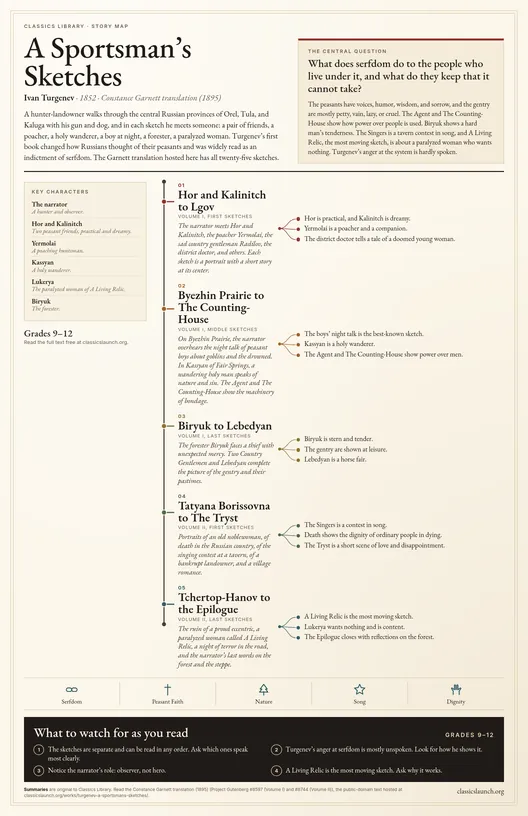 Story mapSee the story mapThe whole book on one page: the story in movements, the characters, and what to watch for. Free to print.
Abstract
Background. Turgenev began the sketches in the 1840s and published them in The Contemporary and as a book in 1852. They made his reputation and are said to have contributed to the climate in which serfdom was abolished.
Plot. A hunter walks through the Russian countryside and describes the people he meets, among them serfs, landowners, a doctor, a holy wanderer, and a woman who has been paralysed for years. Each sketch is an encounter, and together they make a picture of rural Russia.
Ideas. The book argues by example that serfs are persons with minds and faith, and that serfdom degrades masters and servants alike. Its religion is simple and quiet, and its nature is a gift.
Text. The Garnett translation is smooth and readable, with detailed landscape and plain talk. Because the sketches are separate, a class can read a few in any order. Teachers can pair this work with the library's study guide, seminar questions and memory-work selection to prepare a discussion, a short essay or a recitation. The full text is hosted on this site, and each quotation in the guide has been checked against the hosted translation.
Main characters
- The narrator: A gentleman hunter
- Hor and Kalinitch: Two peasant friends
- Kassyan: A holy wanderer
- Lukerya: A paralysed woman who is content
- Biryuk: A stern forester

Summary
A Sportsman's Sketches is the book that made Turgenev's name and changed how Russians thought of their peasants. It is a collection of linked stories, told in the first person by a hunter-landowner who travels with his gun and dog through the central Russian provinces of Orel, Tula and Kaluga. In each sketch he meets a figure of the country: a pair of friends, the practical Hor and the dreamy Kalinitch, who show two kinds of peasant; Yermolai, a poacher; a miller's wife; the landowner Radilov; the district doctor with his tale of a doomed young woman; the peasant proprietor Ovsyanikov; the holy wanderer Kassyan; and a gang of boys keeping watch over horses at night, telling ghost stories on Byezhin Prairie. The sketches turn on the fact of serfdom. The peasants are human beings with their own voices, humour, wisdom and sorrow, and the gentry are mostly shown as petty, vain, lazy or cruel. The Agent and The Counting-House show how power over human beings is used. Biryuk, the forester, who has a house of hungry children and catches a starving thief, shows how a hard man can also be tender. The Singers is an extraordinary scene at a village tavern in which two men compete in song and a poor man's voice makes everyone weep. Death shows the dignity of ordinary Russian people in dying, and the final sketches, The Rattling of Wheels and Epilogue, close with a hunter's reflections on the forest and steppe. The most moving of all is A Living Relic, in which the narrator finds a former beauty, Lukerya, lying paralysed in a shed, living on the prayers of strangers, who tells him that she wants nothing and is content with all, thank God. Her vision of Christ is told in a plain, childlike voice. Turgenev's own sympathy for the sufferer, and his anger at the system that has made her helpless, are hardly spoken. The sketches were printed in the magazine The Contemporary in 1847–1851 and as a book in 1852, and were widely read as an indictment of serfdom. Turgenev was arrested and exiled to his estate for a short time after writing an obituary of Gogol, though the sketches were also a reason. The Garnett translation hosted here collects all twenty-five sketches. Christian readers will find a rich and unsentimental picture of peasant faith, from Kassyan's pilgrim hope to Lukerya's trust, and a plain witness to the wrong done to the poor by a system of bondage.
Virtues in this work
- Charity: Biryuk's mercy to a thief and the narrator's pity for Lukerya show charity at work among the poor.
- Fortitude: Lukerya's patient endurance of her illness is the book's picture of fortitude.
- Faith: Kassyan's reverence and Lukerya's trust are the book's religious center.
- Justice: The book is a quiet witness against the injustice of serfdom.
Plot or Argument
- Volume I: Hor and Kalinitch to Lgov
The narrator meets Hor and Kalinitch, the poacher Yermolai, the sad country gentleman Radilov, the district doctor, and others. Each sketch is a portrait with a short story at its center.
- Volume I: Byezhin Prairie to The Counting-House
On Byezhin Prairie, the narrator overhears the night talk of peasant boys about goblins and the drowned. In Kassyan of Fair Springs, a wandering holy man speaks of the world of nature and sin. The Agent and The Counting-House show the machinery of bondage.
- Volume I: Biryuk to Lebedyan
The forester Biryuk faces a thief with unexpected mercy. Two Country Gentlemen and Lebedyan complete the picture of the gentry and their pastimes.
- Volume II: Tatyana Borissovna to The Tryst
Portraits of an old noblewoman, of death in the Russian country, of the singing contest at a tavern, of a bankrupt landowner and a village romance.
- Volume II: Tchertop-Hanov to the Epilogue
The ruin of a proud eccentric, a paralysed woman who is called A Living Relic, a night of terror in the road, and the narrator's last words on the forest and the steppe.
Characters
- The narrator, hunter and observer
A gentleman sportsman who travels the countryside with his gun, and who sees and listens more than he judges.
- Hor and Kalinitch, the two friends
Two peasants of the Orel country, one practical and prosperous, one dreamy and poor, who open the book and set its tone.
- Yermolai, the huntsman
A poacher and serf, hard-living and shrewd, who serves the narrator as guide.
- Kassyan, the holy wanderer
A strange, devout, gentle man who travels the country seeking truth and who defends the sanctity of living things.
- Lukerya, the Living Relic
A paralysed serf woman, once a beauty, who lies in a shed and prays, content and uncomplaining.
- Biryuk, the forester
A grim, silent man who guards the forest and shows pity to a thief.
Lessons
The poor are persons
The most important thing in the book is the way each peasant is allowed a voice. Hor, Kalinitch, Kassyan and Lukerya are not types but people with their own sense of life, and the narrator's respect for them is the book's argument against serfdom.
- Which peasant in the sketches is most memorable, and why?
- How does Turgenev's respect for the peasants undermine the claims of serfdom?
Patience in suffering
Lukerya's life is the book's clearest picture of a faith that endures. She lies in a hut, cannot move, and yet says she is content. The reader should ask what this faith means, and what a just society would owe such a person.
- How does Lukerya explain her own contentment?
- Is her faith an answer to injustice or a way of bearing it?
The land is a gift
Turgenev's descriptions of forest, steppe and light are part of his moral argument: the land is generous and the men who are bound to it deserve to be free. Kassyan's talk of the sinfulness of killing and of the good gifts of God is the religious form of the same reverence.
- What does Kassyan believe about the earth and its creatures?
- How does nature appear in the hunting scenes?
Context
The sketches are set in the central provinces of European Russia in the 1840s, when serfdom bound about half the peasants to their landowners, who could buy, sell, beat and exile them. The book was not a political pamphlet, but its sympathetic and realistic picture of serfs made it one of the strongest influences on educated opinion before the emancipation of 1861.
Composition
Turgenev began the sketches in 1846 when he was a young writer in St. Petersburg, and published the first, Hor and Kalinitch, in The Contemporary in 1847. They were collected as a book in 1852. The hosted Garnett translation includes all twenty-five sketches in two volumes.
Reception
The book was praised by critics and the public and was blamed by the authorities, who saw it as an attack on the landowners. Turgenev was arrested in 1852 for an obituary of Gogol and exiled to his estate for over a year. The sketches are said to have influenced Alexander II in his decision to abolish serfdom.
Comparisons
- Fathers and Sons
Turgenev's best-known novel is about the younger generation and its break with the old, and it complements the sketches' picture of the older countryside.
- Dead Souls
Gogol's novel of the same Russia, with serfs as property, is the comic sister of Turgenev's sympathetic and sober sketches.
- The Steppe
Chekhov's story of a boy on the steppe takes up Turgenev's tradition of landscape and peasant voices a generation later.
- The House of the Dead
Dostoevsky's record of life among convicts is another view of the Russian people from below.
- Uncle Tom's Cabin
Stowe's novel did for American slavery what Turgenev's sketches did for Russian serfdom, by making readers see slaves as persons.
Quotes
Frequently cited
“At first it was very wearisome; but later on I got used to it, I got more patient--it was nothing; there are others worse off still.”
Frequently cited
“I want nothing; I am content with all, thank God!”
“many other Christians go in bast-shoes, roaming over the world, seeking truth, yea!”
“bread, the good gift of God, and the water of heaven, and the tame beasts that have come down to us from our fathers of old.”
“How wonderfully indeed the Russian peasant dies! The temper in which he meets his end cannot be called indifference or stolidity; he dies as though he were performing a solemn rite, coolly and simply.”
“Look at this, again: anyone in health may easily fall into sin; but I'm cut off even from sin.”
“it was for their sake Almighty God had mercy on us.”
For Students
A reading companion for classical Christian high school students. See the student guide.
Reading Guide
Watch for
- How each sketch is built on a short encounter between the narrator and a single person.
- What each sketch shows about the power of landowners over serfs.
- The descriptions of nature at the opening of many sketches.
Key terms and names
- Serf
- A peasant bound to the land and to his landowner, who could be sold or punished; abolished in Russia in 1861.
- Barin
- A Russian landowner, master of serfs; the term used by the peasants of the narrator.
- Bast-shoes
- Simple peasant footwear woven from the bark of the lime tree.
- Holy fool
- A wandering ascetic regarded as touched by God; Kassyan is of this kind.
Seminar Questions
- Comprehension Who is the narrator, and what does he do?
- Comprehension Who is Lukerya, and where is she found?
- Interpretation Why does Turgenev choose short sketches in place of a long novel?
- Interpretation What does Kassyan teach the narrator?
- Interpretation How does the book show the cruelty of serfdom without preaching?
- Big Question Can a book change a society by showing people as they are? How did this one?
- Big Question Is Lukerya's contentment a virtue, or a sign of a crushing system?
Faith Connections
- Philippians 4:11–13 (Scripture)
'I have learned in whatever situation I am to be content.' Lukerya is a plain-spoken illustration of Paul's saying.
- Psalm 104:10–24 (Scripture)
The Psalm's hymn to God's care for rivers, forests and living things is the right text to read with Kassyan and the nature writing.
- Exodus 3:7 (Scripture)
'I have surely seen the affliction of my people... and have heard their cry.' The book's sympathy for the serfs is rooted in the Biblical concern for the oppressed.
Logic and Rhetoric
Central argument: The peasants of Russia are human beings with minds, faith and dignity, and a system that treats them as property is a wrong. The book argues by presenting individual portraits, not by statement.
Rhetorical device: understatement. Lukerya's story is told in a quiet voice, with the narrator's anger left unsaid, which makes its moral force greater.
Debate: Resolved: That a collection of sketches can be a stronger protest than a political pamphlet.
Memory Work
Look at this, again: anyone in health may easily fall into sin; but I'm cut off even from sin.
How wonderfully indeed the Russian peasant dies! The temper in which he meets his end cannot be called indifference or stolidity; he dies as though he were performing a solemn rite, coolly and simply.
Writing Prompts
Essay: Choose two sketches and compare the way Turgenev draws a landowner and a peasant. How does he show who is the more human?
Comparison with Dead Souls: Compare Turgenev's and Gogol's treatment of serfs. How does laughter in one and sympathy in the other serve the same cause?
Medical Lens
Several sketches deal with illness and death in the country, among them The District Doctor, in which a physician tells of a young woman he attended in a fever and could not save; Death, which describes how the Russian peasant dies; and A Living Relic, with a paralysed woman in a hut. Turgenev treats these with attention to bodily detail and without sentiment.
- IV. The District Doctor
A country doctor tells of a feverish young woman in his care whom he could not save.
- XVI. Death
Several deaths in the country are described, and the narrator reflects on how calmly the Russian peasant meets death.
- XXIII. A Living Relic
A paralysed serf woman lies in a shed, cared for by neighbours.
Creative Prompts
- Essay
Choose one sketch and show how Turgenev gives a peasant a voice. Quote at least two passages.
- Fiction
Write a sketch of your own, in the first person, of one meeting with an unusual person on a journey. Keep the narrator mostly silent.
- Classroom
Read A Living Relic aloud and discuss how Lukerya's faith strikes a modern reader. Does it comfort or trouble?
- Essay
Turgenev never calls for the end of serfdom in so many words. How does the book make the argument?
Further Reading
- Fathers and Sons, Ivan Turgenev
Turgenev's best-known novel; hosted in this library.
- Rudin, Ivan Turgenev
Turgenev's first novel; hosted in this library.
- Notes from the House of the Dead, Fyodor Dostoevsky
A memoir of the Russian people in prison; hosted in this library.
- Turgenev: His Life and Times, Leonard Schapiro
A readable life of the author.
Verification notes
Full text from Project Gutenberg, Constance Garnett's translation (dated 1895 in the hosted source) of all twenty-five sketches, in public domain. Quotes were checked against the hosted text. The claim that the sketches influenced Alexander II is a traditional report and is not verified here.
- Whether Garnett's 1895 volumes include all of the sketches that Turgenev added later in his life.
- The claim of influence on Alexander II.