Story maps · Grades 9–12
Twenty Years at Hull-House: A Story Map
The PDF is one tabloid page (11 × 17 in). On letter paper, choose “Fit to page.”
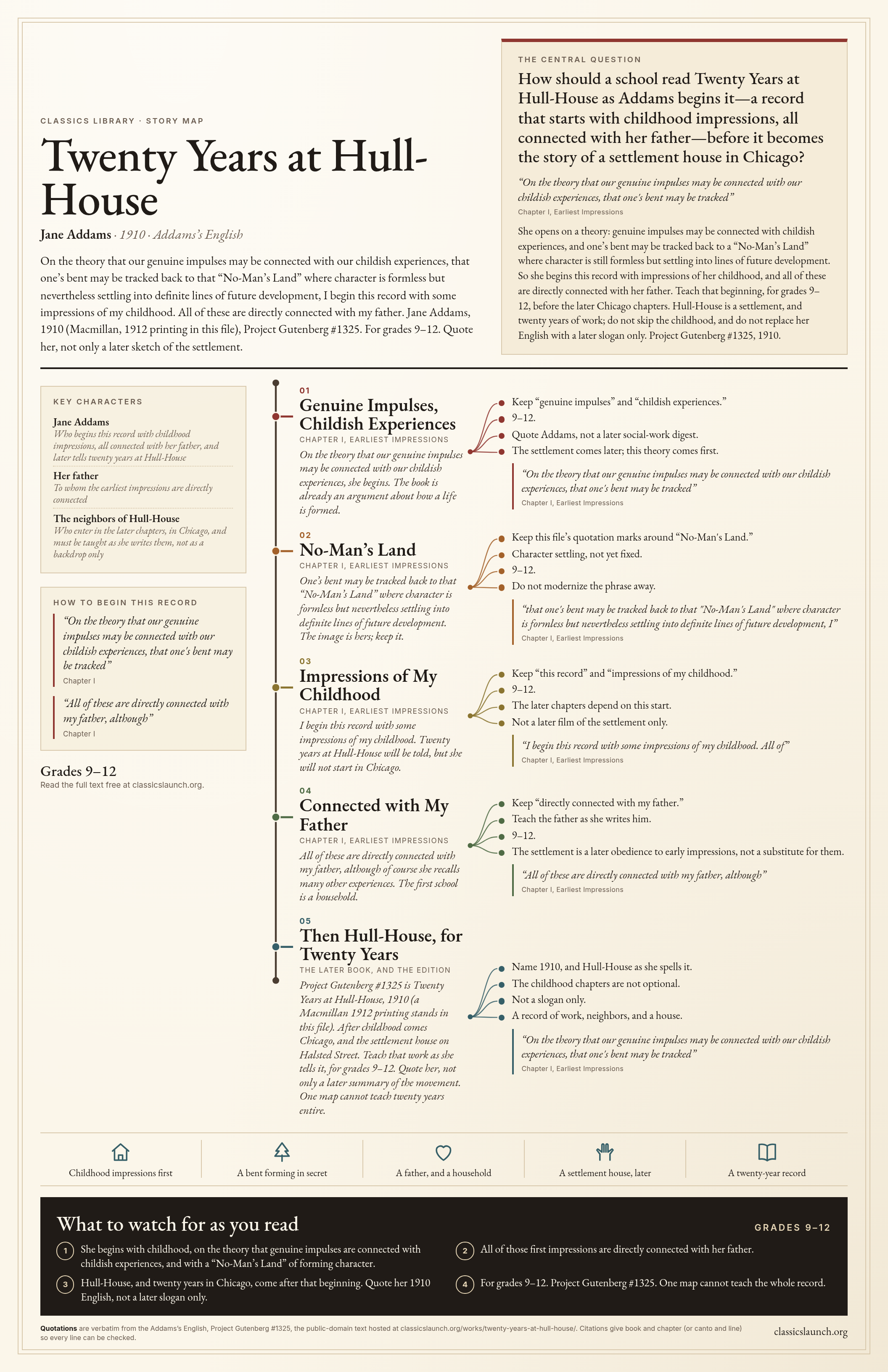
On the theory that our genuine impulses may be connected with our childish experiences, that one’s bent may be tracked back to that “No-Man’s Land” where character is formless but nevertheless settling into definite lines of future development, I begin this record with some impressions of my childhood. All of these are directly connected with my father. Jane Addams, 1910 (Macmillan, 1912 printing in this file), Project Gutenberg #1325. For grades 9–12. Quote her, not only a later sketch of the settlement.
The central question
How should a school read Twenty Years at Hull-House as Addams begins it—a record that starts with childhood impressions, all connected with her father—before it becomes the story of a settlement house in Chicago?
“On the theory that our genuine impulses may be connected with our childish experiences, that one's bent may be tracked”
She opens on a theory: genuine impulses may be connected with childish experiences, and one’s bent may be tracked back to a “No-Man’s Land” where character is still formless but settling into lines of future development. So she begins this record with impressions of her childhood, and all of these are directly connected with her father. Teach that beginning, for grades 9–12, before the later Chicago chapters. Hull-House is a settlement, and twenty years of work; do not skip the childhood, and do not replace her English with a later slogan only. Project Gutenberg #1325, 1910.
- 01
Genuine Impulses, Childish Experiences
Chapter I, Earliest Impressions
On the theory that our genuine impulses may be connected with our childish experiences, she begins. The book is already an argument about how a life is formed.
- Keep “genuine impulses” and “childish experiences.”
- 9–12.
- Quote Addams, not a later social-work digest.
- The settlement comes later; this theory comes first.
“On the theory that our genuine impulses may be connected with our childish experiences, that one's bent may be tracked”
- 02
No-Man’s Land
Chapter I, Earliest Impressions
One’s bent may be tracked back to that “No-Man’s Land” where character is formless but nevertheless settling into definite lines of future development. The image is hers; keep it.
- Keep this file’s quotation marks around “No-Man's Land.”
- Character settling, not yet fixed.
- 9–12.
- Do not modernize the phrase away.
“that one's bent may be tracked back to that "No-Man's Land" where character is formless but nevertheless settling into definite lines of future development, I”
- 03
Impressions of My Childhood
Chapter I, Earliest Impressions
I begin this record with some impressions of my childhood. Twenty years at Hull-House will be told, but she will not start in Chicago.
- Keep “this record” and “impressions of my childhood.”
- 9–12.
- The later chapters depend on this start.
- Not a later film of the settlement only.
“I begin this record with some impressions of my childhood. All of”
- 04
Connected with My Father
Chapter I, Earliest Impressions
All of these are directly connected with my father, although of course she recalls many other experiences. The first school is a household.
- Keep “directly connected with my father.”
- Teach the father as she writes him.
- 9–12.
- The settlement is a later obedience to early impressions, not a substitute for them.
“All of these are directly connected with my father, although”
- 05
Then Hull-House, for Twenty Years
The later book, and the edition
Project Gutenberg #1325 is Twenty Years at Hull-House, 1910 (a Macmillan 1912 printing stands in this file). After childhood comes Chicago, and the settlement house on Halsted Street. Teach that work as she tells it, for grades 9–12. Quote her, not only a later summary of the movement. One map cannot teach twenty years entire.
- Name 1910, and Hull-House as she spells it.
- The childhood chapters are not optional.
- Not a slogan only.
- A record of work, neighbors, and a house.
“On the theory that our genuine impulses may be connected with our childish experiences, that one's bent may be tracked”
- Childhood impressions first
- A bent forming in secret
- A father, and a household
- A settlement house, later
- A twenty-year record
What to watch for as you read
Grades 9–12- She begins with childhood, on the theory that genuine impulses are connected with childish experiences, and with a “No-Man’s Land” of forming character.
- All of those first impressions are directly connected with her father.
- Hull-House, and twenty years in Chicago, come after that beginning. Quote her 1910 English, not a later slogan only.
- For grades 9–12. Project Gutenberg #1325. One map cannot teach the whole record.
Every quotation is word for word from the Addams’s English hosted in this library and is checked against that text each time the site is built. Citations give book and chapter (or canto and line).