Story maps · Grades 6–8
Uncle Remus, His Songs and His Sayings: A Story Map
The PDF is one tabloid page (11 × 17 in). On letter paper, choose “Fit to page.”
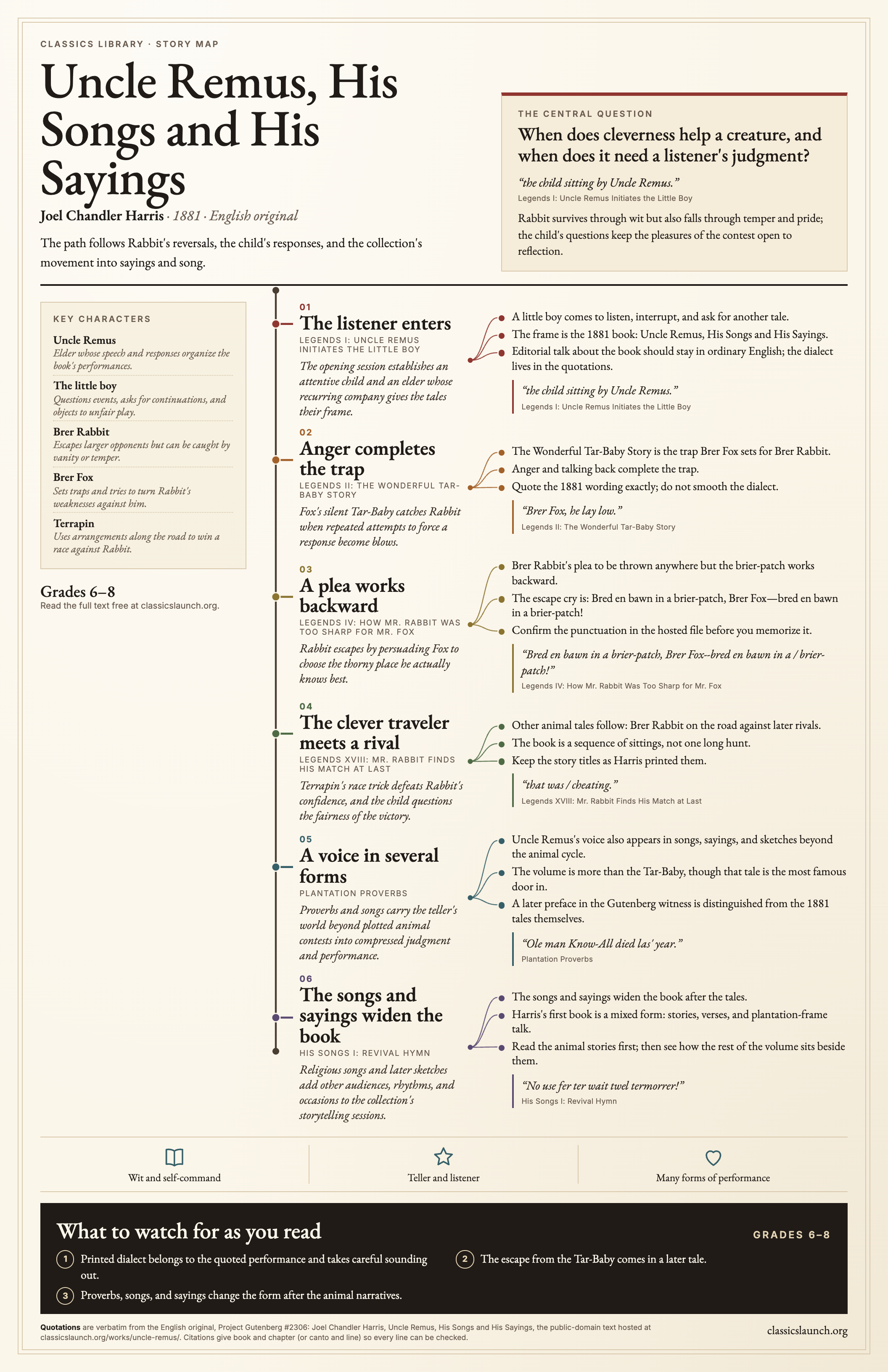
The path follows Rabbit's reversals, the child's responses, and the collection's movement into sayings and song.
The central question
When does cleverness help a creature, and when does it need a listener's judgment?
“the child sitting by Uncle Remus.”
Rabbit survives through wit but also falls through temper and pride; the child's questions keep the pleasures of the contest open to reflection.
- 01
The listener enters
Legends I: Uncle Remus Initiates the Little Boy
The opening session establishes an attentive child and an elder whose recurring company gives the tales their frame.
- A little boy comes to listen, interrupt, and ask for another tale.
- The frame is the 1881 book: Uncle Remus, His Songs and His Sayings.
- Editorial talk about the book should stay in ordinary English; the dialect lives in the quotations.
“the child sitting by Uncle Remus.”
- 02
Anger completes the trap
Legends II: The Wonderful Tar-Baby Story
Fox's silent Tar-Baby catches Rabbit when repeated attempts to force a response become blows.
- The Wonderful Tar-Baby Story is the trap Brer Fox sets for Brer Rabbit.
- Anger and talking back complete the trap.
- Quote the 1881 wording exactly; do not smooth the dialect.
“Brer Fox, he lay low.”
- 03
A plea works backward
Legends IV: How Mr. Rabbit Was Too Sharp for Mr. Fox
Rabbit escapes by persuading Fox to choose the thorny place he actually knows best.
- Brer Rabbit's plea to be thrown anywhere but the brier-patch works backward.
- The escape cry is: Bred en bawn in a brier-patch, Brer Fox—bred en bawn in a brier-patch!
- Confirm the punctuation in the hosted file before you memorize it.
“Bred en bawn in a brier-patch, Brer Fox--bred en bawn in a / brier-patch!”
- 04
The clever traveler meets a rival
Legends XVIII: Mr. Rabbit Finds His Match at Last
Terrapin's race trick defeats Rabbit's confidence, and the child questions the fairness of the victory.
- Other animal tales follow: Brer Rabbit on the road against later rivals.
- The book is a sequence of sittings, not one long hunt.
- Keep the story titles as Harris printed them.
“that was / cheating.”
- 05
A voice in several forms
Plantation Proverbs
Proverbs and songs carry the teller's world beyond plotted animal contests into compressed judgment and performance.
- Uncle Remus's voice also appears in songs, sayings, and sketches beyond the animal cycle.
- The volume is more than the Tar-Baby, though that tale is the most famous door in.
- A later preface in the Gutenberg witness is distinguished from the 1881 tales themselves.
“Ole man Know-All died las' year.”
- 06
The songs and sayings widen the book
His Songs I: Revival Hymn
Religious songs and later sketches add other audiences, rhythms, and occasions to the collection's storytelling sessions.
- The songs and sayings widen the book after the tales.
- Harris's first book is a mixed form: stories, verses, and plantation-frame talk.
- Read the animal stories first; then see how the rest of the volume sits beside them.
“No use fer ter wait twel termorrer!”
- Wit and self-command
- Teller and listener
- Many forms of performance
What to watch for as you read
Grades 6–8- Printed dialect belongs to the quoted performance and takes careful sounding out.
- The escape from the Tar-Baby comes in a later tale.
- Proverbs, songs, and sayings change the form after the animal narratives.
Every quotation is word for word from the English original hosted in this library and is checked against that text each time the site is built. Citations give book and chapter (or canto and line).