Work record
Uncle Remus, His Songs and His Sayings
Joel Chandler HarrisUncle Remus, His Songs and His Sayings by Joel Chandler Harris (1881)Uncle Remus, His Songs and His Sayings places a storytelling elder at the center of a varied book.1881 · 19th Century · Collection · English
Read this when a clever rabbit's escape needs a patient teller and a child ready to interrupt.
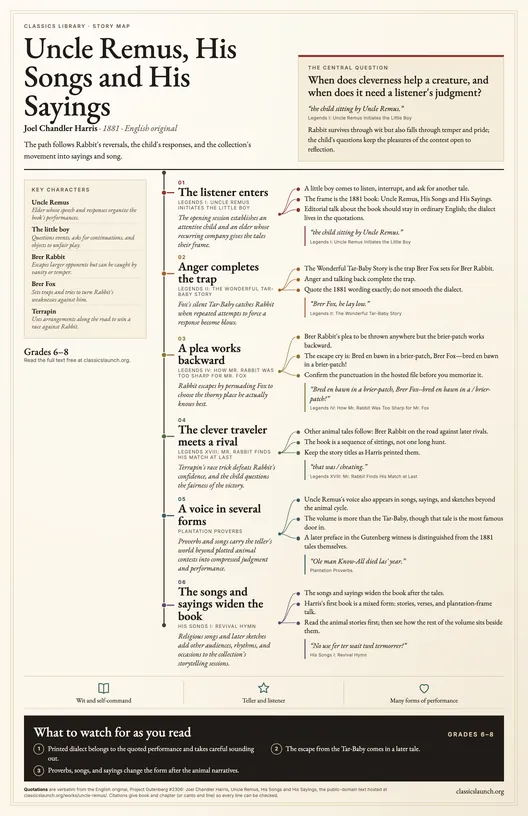 Story mapSee the story mapThe whole book on one page: the story in movements, the characters, and what to watch for. Free to print.
Abstract
Background. Harris's first Uncle Remus volume appeared in 1881, bringing together materials shaped from African American storytelling and Southern newspaper writing. The hosted Gutenberg witness also carries a later-edition preface. Its collection structure includes more than the familiar animal tales, and the record keeps those additional songs, proverbs, and sketches in view.
Content. The frame places a child beside an elder whose stories repeatedly set Rabbit against Fox and other creatures. A sticky figure catches the boastful traveler, persuasive misdirection secures an escape, and Terrapin later proves capable of deceiving him. Short sayings and sung pieces vary the manner of performance beyond plotted contests.
Themes. Resourcefulness allows small creatures to survive, but appetite, temper, and vanity can make the clever vulnerable too. The listener's objections give judgment a place within amusement. Companionship also matters: a tale unfolds through attention and response, with questions linking one evening's unfinished business to the next gathering beside the same narrator.
Significance. Printed dialect demands patient attention to sound and spelling, while editorial discussion can remain in ordinary English. Read this way, the book offers a particular literary encounter with oral forms rather than a simple rulebook of approved behavior. Its recurring voices and changing genres reward careful selection, retelling, and comparison with other traditions of animal wit.
Main characters
- Uncle Remus: Elder whose speech and responses organize the book's performances.
- The little boy: Questions events, asks for continuations, and objects to unfair play.
- Brer Rabbit: Escapes larger opponents but can be caught by vanity or temper.
- Brer Fox: Sets traps and tries to turn Rabbit's weaknesses against him.
- Terrapin: Uses arrangements along the road to win a race against Rabbit.
Summary
Uncle Remus, His Songs and His Sayings places a storytelling elder at the center of a varied book. In its plantation-frame storytelling, a young boy listens, interrupts, asks for explanations, and returns for another tale. The exchanges keep the listener present instead of treating the animal adventures as detached fables. Harris's printed dialect shapes the storyteller's sound, while the surrounding narrative gives the sessions their domestic setting. Brer Rabbit and Brer Fox provide the most familiar contest. Fox repeatedly tries to catch Rabbit, and Rabbit repeatedly uses quick judgment or persuasive speech to escape. The Tar-Baby episode turns that confidence against him. Fox makes a silent figure that will not answer a greeting. Rabbit mistakes silence for an insult, strikes it, and becomes caught in the sticky material. The trap succeeds because his own anger supplies the force. The escape appears in a later session, after the boy asks what happened next. Rabbit pretends to dread being thrown into a thorny patch, leading Fox to choose the place that is actually familiar and safe for him. The pleasure lies in hearing speech work in the opposite direction from its apparent request. Yet Rabbit does not always command the contest. Terrapin's race uses helpers to make the faster traveler believe his opponent is continually ahead. The boy recognizes the trick as cheating, preventing admiration for cleverness from becoming an automatic verdict that every trick is right. The volume extends beyond these encounters into further animal stories, proverbs, songs, a war story, and the sketches collected as sayings. Religious refrains, working rhythms, household remarks, and comic encounters give the book several forms of performance. Its title therefore describes a genuinely mixed collection, not merely the adventures of one rabbit. The strongest reading attends to relations among teller, listener, and tale. The boy's questions create pauses and continuations; the elder can qualify an expectation or postpone an answer. Animal appetite, vanity, boastfulness, and resourcefulness become material for shared amusement and judgment. The book preserves Harris's literary presentation of an oral inheritance, and its distinctiveness rests in that interplay of voice, recurring characters, and responsive company.
Virtues in this work
- Prudence: The trap and race episodes reward attention to appearances, motives, and the limits of confidence.
- Temperance: Rabbit's angry demand for an answer shows why self-command matters.
- Friendship: The recurring sessions depend on the patient company of teller and listener.
Plot or Argument
- The listener enters
The opening session establishes an attentive child and an elder whose recurring company gives the tales their frame.
- Anger completes the trap
Fox's silent Tar-Baby catches Rabbit when repeated attempts to force a response become blows.
- A plea works backward
Rabbit escapes by persuading Fox to choose the thorny place he actually knows best.
- The clever traveler meets a rival
Terrapin's race trick defeats Rabbit's confidence, and the child questions the fairness of the victory.
- A voice in several forms
Proverbs and songs carry the teller's world beyond plotted animal contests into compressed judgment and performance.
- The songs and sayings widen the book
Religious songs and later sketches add other audiences, rhythms, and occasions to the collection's storytelling sessions.
Characters
- Uncle Remus, Frame storyteller
Elder whose speech and responses organize the book's performances.
- The little boy, Listener
Questions events, asks for continuations, and objects to unfair play.
- Brer Rabbit, Resourceful animal
Escapes larger opponents but can be caught by vanity or temper.
- Brer Fox, Recurring adversary
Sets traps and tries to turn Rabbit's weaknesses against him.
- Terrapin, Unexpected rival
Uses arrangements along the road to win a race against Rabbit.
Lessons
Temper can spring a trap
Rabbit's trouble begins when he insists on receiving an answer. The silent figure defeats him through his own repeated blows.
- Why does the figure's silence anger him?
- What could have kept him out of the trap?
Admiration needs judgment
A successful trick can be entertaining without being fair. The boy's objection to the race keeps both responses available within the story.
- How does Terrapin win?
- Why is the listener's objection worth keeping?
A listener helps make the telling
The child's questions connect sessions and draw out explanations. Storytelling here is a shared activity with room for interruption.
- Why does the boy ask about the trapped rabbit later?
- What would disappear if the frame were removed?
Context
The 1881 collection draws on African American oral narrative traditions as presented by a Georgia journalist. Its plantation-frame storytelling places animal contests beside the recurring relationship of an elder and a child, while songs and sketches give the book a broader range.
Composition
The work first appeared in 1881. The hosted Gutenberg witness includes a later preface about a new illustrated edition; its body supplies the quotations used here.
Reception
The recurring Rabbit and Fox tales became widely familiar, but this volume's own arrangement also preserves proverbs, sung forms, and responsive conversations that are easily lost in isolated retellings.
Comparisons
- Aesop's Fables
Both use animal conduct to invite judgment, but the responsive frame and extended dialect performance give Harris's volume a different texture.
- Just So Stories
Compare the child listener's place in the telling and the use of recurring verbal patterns to make stories memorable.
- The Jungle Book
Both build recurring animal worlds, while their ways of presenting rule, wit, and danger differ substantially.
Quotes
“the child sitting by Uncle Remus.”
“Brer Fox, he lay low.”
“Bred en bawn in a brier-patch, Brer Fox--bred en bawn in a brier-patch!”
“that was cheating.”
“Ole man Know-All died las' year.”
“No use fer ter wait twel termorrer!”
For Students
A reading companion for classical Christian high school students. See the student guide.
Reading Guide
Watch for
- Printed dialect belongs to the quoted performance and takes careful sounding out.
- The escape from the Tar-Baby comes in a later tale.
- Proverbs, songs, and sayings change the form after the animal narratives.
Key terms and names
- frame narrative
- A surrounding situation in which other stories are told.
- trickster
- A character who gains advantage by deception, quick invention, or surprise.
- dialect
- A variety of speech with particular vocabulary, pronunciation, and grammar.
- proverb
- A brief traditional saying that compresses a practical observation.
- misdirection
- Leading another person's attention or expectations toward the wrong conclusion.
Seminar Questions
- Comprehension Why does Rabbit strike the silent figure?
- Comprehension How does the boy respond to Terrapin's victory?
- Interpretation What does Fox misunderstand about the thorny hiding place?
- Interpretation How does the frame create suspense between separate sessions?
- Big Question Is cleverness by itself a sufficient reason to admire a deed?
- Big Question What does an attentive listener contribute to an oral story?
Faith Connections
- Proverbs 16:32 (Scripture)
The praise of restraint gives a close companion to Rabbit's failure to govern his anger at silence.
- James 1:19–20 (Scripture)
The call to listen readily and grow angry slowly can be considered beside the sequence that makes the trap effective.
Logic and Rhetoric
Central argument: The recurring contests make ingenuity enjoyable while the listener's questions preserve space to judge its motives and fairness.
Rhetorical device: dramatic irony. The audience knows the silent figure is a trap while the traveler treats its failure to answer as a personal insult.
Debate: Resolved: the child's objections make the animal tales richer than an uninterrupted account of successful tricks.
Memory Work
that was cheating.
Writing Prompts
Essay: Explain how the trap story and the race give Rabbit different relations to cleverness, pride, and self-command.
Comparison with Aesop's Fables: Compare one Rabbit episode with an Aesop fable, attending to the role of the listener and the way judgment enters.
Medical Lens
The sayings include a distinct toothache sketch; this is a minor comic bodily episode rather than a sustained medical concern.
- His Sayings VI: Uncle Remus with the Toothache
The toothache sketch makes bodily pain the occasion for conversation and comic response.
Creative Prompts
- Dialogue
Write a new standard-English frame conversation in which a child asks whether a clever victory was fair.
- Classroom
Trace Rabbit's movements in the trap story, marking each moment when he could have stopped.
- Essay
Explain how a listener's question changes the order or emphasis of a story you have heard aloud.
Further Reading
- Nights with Uncle Remus, Joel Chandler Harris
- Mules and Men, Zora Neale Hurston
Verification notes
All quotations are exact, short body substrings of the hosted Project Gutenberg #2306 text, including the line break in Rabbit's escape cry. The 1881 work is distinguished from the later-edition preface included in this witness. Editorial prose uses ordinary English rather than imitating the printed dialect.
No verification flags recorded.