Story maps · Grades 11–12
Chronicle of the Fourth Crusade and the Conquest of Constantinople: A Story Map
The PDF is one tabloid page (11 × 17 in). On letter paper, choose “Fit to page.”
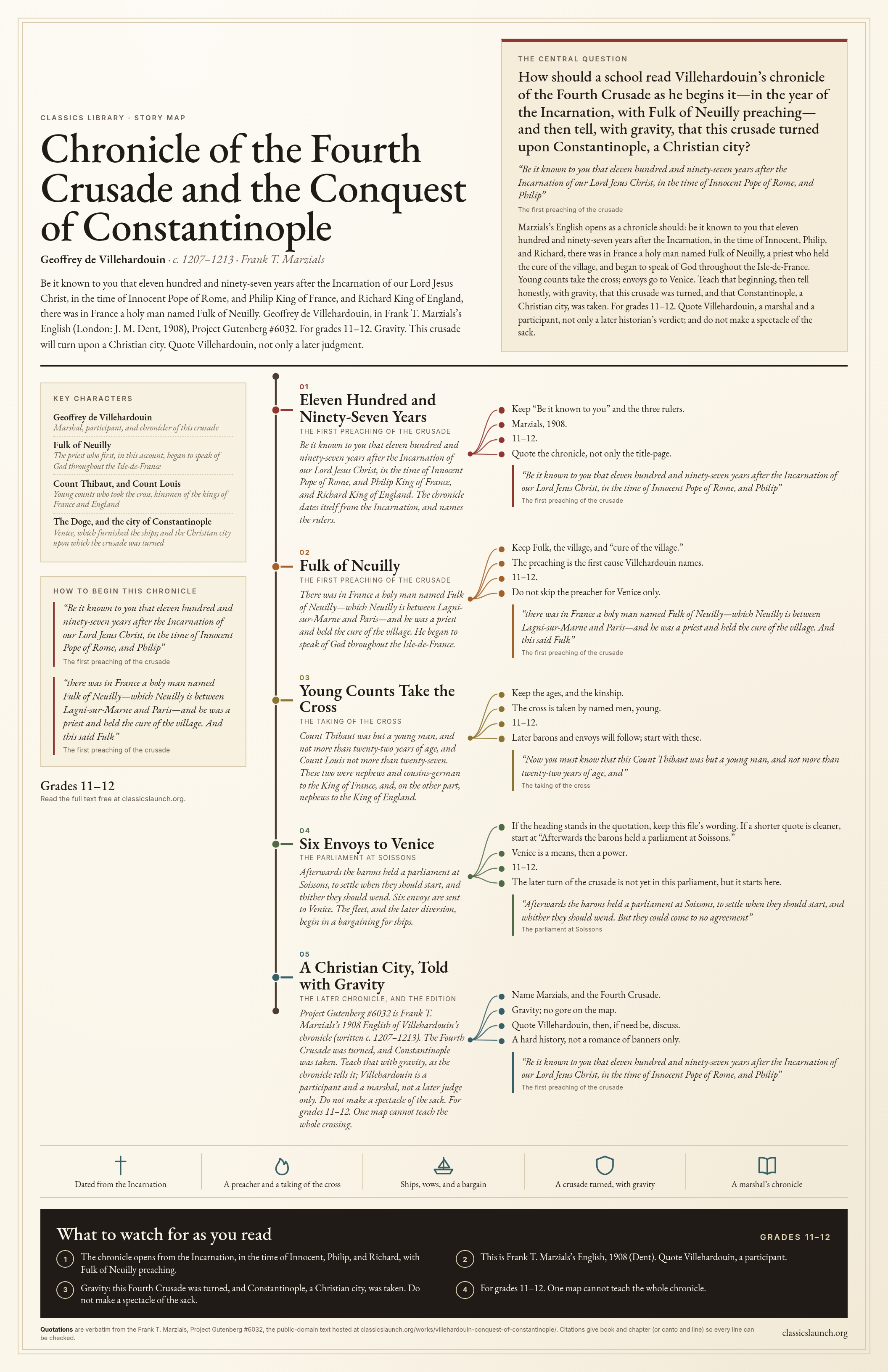
Be it known to you that eleven hundred and ninety-seven years after the Incarnation of our Lord Jesus Christ, in the time of Innocent Pope of Rome, and Philip King of France, and Richard King of England, there was in France a holy man named Fulk of Neuilly. Geoffrey de Villehardouin, in Frank T. Marzials’s English (London: J. M. Dent, 1908), Project Gutenberg #6032. For grades 11–12. Gravity. This crusade will turn upon a Christian city. Quote Villehardouin, not only a later judgment.
The central question
How should a school read Villehardouin’s chronicle of the Fourth Crusade as he begins it—in the year of the Incarnation, with Fulk of Neuilly preaching—and then tell, with gravity, that this crusade turned upon Constantinople, a Christian city?
“Be it known to you that eleven hundred and ninety-seven years after the Incarnation of our Lord Jesus Christ, in the time of Innocent Pope of Rome, and Philip”
Marzials’s English opens as a chronicle should: be it known to you that eleven hundred and ninety-seven years after the Incarnation, in the time of Innocent, Philip, and Richard, there was in France a holy man named Fulk of Neuilly, a priest who held the cure of the village, and began to speak of God throughout the Isle-de-France. Young counts take the cross; envoys go to Venice. Teach that beginning, then tell honestly, with gravity, that this crusade was turned, and that Constantinople, a Christian city, was taken. For grades 11–12. Quote Villehardouin, a marshal and a participant, not only a later historian’s verdict; and do not make a spectacle of the sack.
- 01
Eleven Hundred and Ninety-Seven Years
The first preaching of the crusade
Be it known to you that eleven hundred and ninety-seven years after the Incarnation of our Lord Jesus Christ, in the time of Innocent Pope of Rome, and Philip King of France, and Richard King of England. The chronicle dates itself from the Incarnation, and names the rulers.
- Keep “Be it known to you” and the three rulers.
- Marzials, 1908.
- 11–12.
- Quote the chronicle, not only the title-page.
“Be it known to you that eleven hundred and ninety-seven years after the Incarnation of our Lord Jesus Christ, in the time of Innocent Pope of Rome, and Philip”
- 02
Fulk of Neuilly
The first preaching of the crusade
There was in France a holy man named Fulk of Neuilly—which Neuilly is between Lagni-sur-Marne and Paris—and he was a priest and held the cure of the village. He began to speak of God throughout the Isle-de-France.
- Keep Fulk, the village, and “cure of the village.”
- The preaching is the first cause Villehardouin names.
- 11–12.
- Do not skip the preacher for Venice only.
“there was in France a holy man named Fulk of Neuilly—which Neuilly is between Lagni-sur-Marne and Paris—and he was a priest and held the cure of the village. And this said Fulk”
- 03
Young Counts Take the Cross
The taking of the cross
Count Thibaut was but a young man, and not more than twenty-two years of age, and Count Louis not more than twenty-seven. These two were nephews and cousins-german to the King of France, and, on the other part, nephews to the King of England.
- Keep the ages, and the kinship.
- The cross is taken by named men, young.
- 11–12.
- Later barons and envoys will follow; start with these.
“Now you must know that this Count Thibaut was but a young man, and not more than twenty-two years of age, and”
- 04
Six Envoys to Venice
The parliament at Soissons
Afterwards the barons held a parliament at Soissons, to settle when they should start, and thither they should wend. Six envoys are sent to Venice. The fleet, and the later diversion, begin in a bargaining for ships.
- If the heading stands in the quotation, keep this file’s wording. If a shorter quote is cleaner, start at “Afterwards the barons held a parliament at Soissons.”
- Venice is a means, then a power.
- 11–12.
- The later turn of the crusade is not yet in this parliament, but it starts here.
“Afterwards the barons held a parliament at Soissons, to settle when they should start, and whither they should wend. But they could come to no agreement”
- 05
A Christian City, Told with Gravity
The later chronicle, and the edition
Project Gutenberg #6032 is Frank T. Marzials’s 1908 English of Villehardouin’s chronicle (written c. 1207–1213). The Fourth Crusade was turned, and Constantinople was taken. Teach that with gravity, as the chronicle tells it; Villehardouin is a participant and a marshal, not a later judge only. Do not make a spectacle of the sack. For grades 11–12. One map cannot teach the whole crossing.
- Name Marzials, and the Fourth Crusade.
- Gravity; no gore on the map.
- Quote Villehardouin, then, if need be, discuss.
- A hard history, not a romance of banners only.
“Be it known to you that eleven hundred and ninety-seven years after the Incarnation of our Lord Jesus Christ, in the time of Innocent Pope of Rome, and Philip”
- Dated from the Incarnation
- A preacher and a taking of the cross
- Ships, vows, and a bargain
- A crusade turned, with gravity
- A marshal’s chronicle
What to watch for as you read
Grades 11–12- The chronicle opens from the Incarnation, in the time of Innocent, Philip, and Richard, with Fulk of Neuilly preaching.
- This is Frank T. Marzials’s English, 1908 (Dent). Quote Villehardouin, a participant.
- Gravity: this Fourth Crusade was turned, and Constantinople, a Christian city, was taken. Do not make a spectacle of the sack.
- For grades 11–12. One map cannot teach the whole chronicle.
Every quotation is word for word from the Frank T. Marzials hosted in this library and is checked against that text each time the site is built. Citations give book and chapter (or canto and line).