Story maps · Grades 9–12
The Story of the Volsungs (Volsunga Saga): A Story Map
The PDF is one tabloid page (11 × 17 in). On letter paper, choose “Fit to page.”
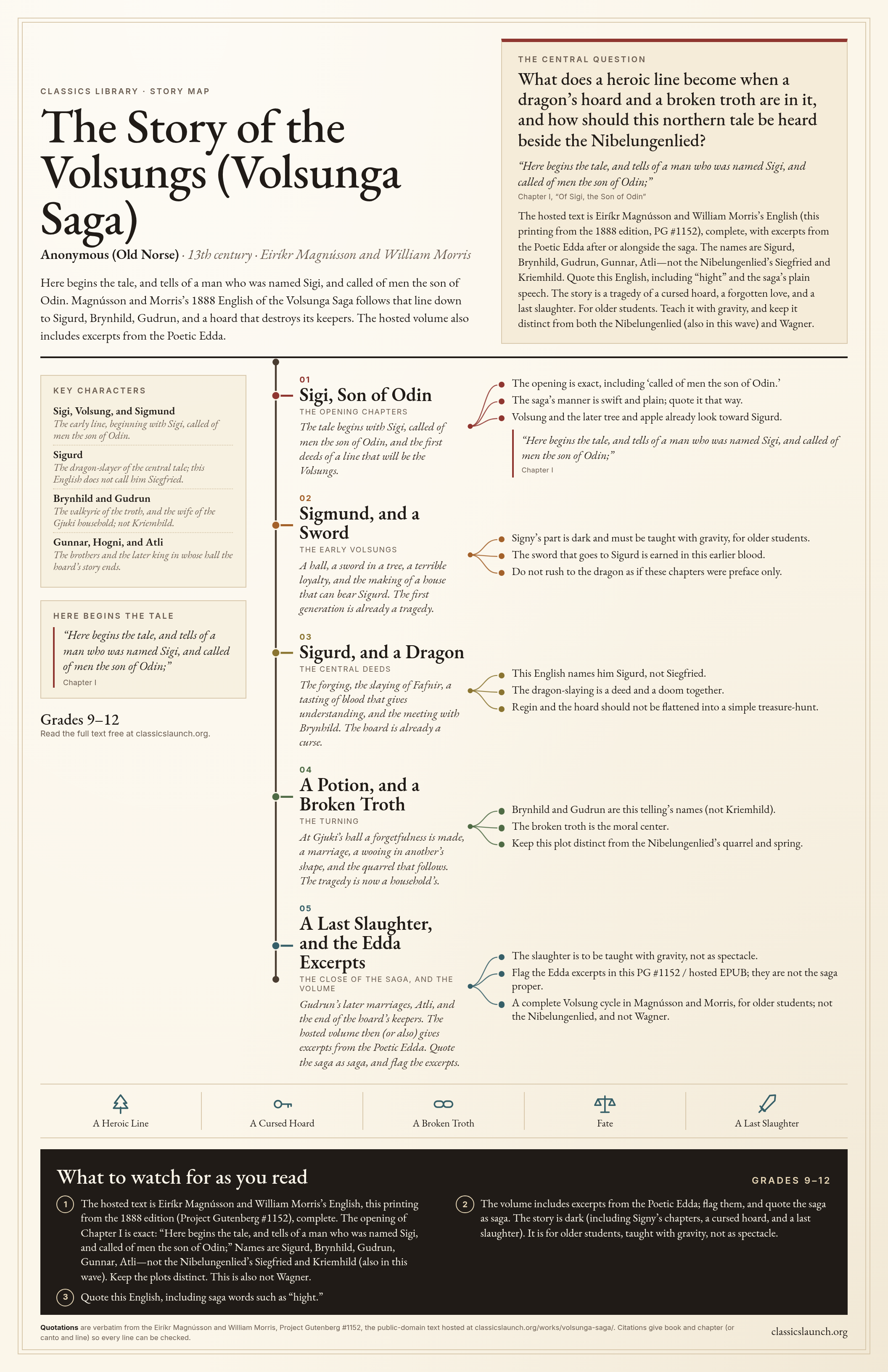
Here begins the tale, and tells of a man who was named Sigi, and called of men the son of Odin. Magnússon and Morris’s 1888 English of the Volsunga Saga follows that line down to Sigurd, Brynhild, Gudrun, and a hoard that destroys its keepers. The hosted volume also includes excerpts from the Poetic Edda.
The central question
What does a heroic line become when a dragon’s hoard and a broken troth are in it, and how should this northern tale be heard beside the Nibelungenlied?
“Here begins the tale, and tells of a man who was named Sigi, and called of men the son of Odin;”
The hosted text is Eiríkr Magnússon and William Morris’s English (this printing from the 1888 edition, PG #1152), complete, with excerpts from the Poetic Edda after or alongside the saga. The names are Sigurd, Brynhild, Gudrun, Gunnar, Atli—not the Nibelungenlied’s Siegfried and Kriemhild. Quote this English, including “hight” and the saga’s plain speech. The story is a tragedy of a cursed hoard, a forgotten love, and a last slaughter. For older students. Teach it with gravity, and keep it distinct from both the Nibelungenlied (also in this wave) and Wagner.
- 01
Sigi, Son of Odin
The opening chapters
The tale begins with Sigi, called of men the son of Odin, and the first deeds of a line that will be the Volsungs.
- The opening is exact, including ‘called of men the son of Odin.’
- The saga’s manner is swift and plain; quote it that way.
- Volsung and the later tree and apple already look toward Sigurd.
“Here begins the tale, and tells of a man who was named Sigi, and called of men the son of Odin;”
- 02
Sigmund, and a Sword
The early Volsungs
A hall, a sword in a tree, a terrible loyalty, and the making of a house that can bear Sigurd. The first generation is already a tragedy.
- Signy’s part is dark and must be taught with gravity, for older students.
- The sword that goes to Sigurd is earned in this earlier blood.
- Do not rush to the dragon as if these chapters were preface only.
- 03
Sigurd, and a Dragon
The central deeds
The forging, the slaying of Fafnir, a tasting of blood that gives understanding, and the meeting with Brynhild. The hoard is already a curse.
- This English names him Sigurd, not Siegfried.
- The dragon-slaying is a deed and a doom together.
- Regin and the hoard should not be flattened into a simple treasure-hunt.
- 04
A Potion, and a Broken Troth
The turning
At Gjuki’s hall a forgetfulness is made, a marriage, a wooing in another’s shape, and the quarrel that follows. The tragedy is now a household’s.
- Brynhild and Gudrun are this telling’s names (not Kriemhild).
- The broken troth is the moral center.
- Keep this plot distinct from the Nibelungenlied’s quarrel and spring.
- 05
A Last Slaughter, and the Edda Excerpts
The close of the saga, and the volume
Gudrun’s later marriages, Atli, and the end of the hoard’s keepers. The hosted volume then (or also) gives excerpts from the Poetic Edda. Quote the saga as saga, and flag the excerpts.
- The slaughter is to be taught with gravity, not as spectacle.
- Flag the Edda excerpts in this PG #1152 / hosted EPUB; they are not the saga proper.
- A complete Volsung cycle in Magnússon and Morris, for older students; not the Nibelungenlied, and not Wagner.
- A Heroic Line
- A Cursed Hoard
- A Broken Troth
- Fate
- A Last Slaughter
What to watch for as you read
Grades 9–12- The hosted text is Eiríkr Magnússon and William Morris’s English, this printing from the 1888 edition (Project Gutenberg #1152), complete. The opening of Chapter I is exact: “Here begins the tale, and tells of a man who was named Sigi, and called of men the son of Odin;” Names are Sigurd, Brynhild, Gudrun, Gunnar, Atli—not the Nibelungenlied’s Siegfried and Kriemhild (also in this wave). Keep the plots distinct. This is also not Wagner.
- The volume includes excerpts from the Poetic Edda; flag them, and quote the saga as saga. The story is dark (including Signy’s chapters, a cursed hoard, and a last slaughter). It is for older students, taught with gravity, not as spectacle.
- Quote this English, including saga words such as “hight.”
Every quotation is word for word from the Eiríkr Magnússon and William Morris hosted in this library and is checked against that text each time the site is built. Citations give book and chapter (or canto and line).