Story maps · Grades 6–12
What Men Live By and Other Tales: A Story Map
The PDF is one tabloid page (11 × 17 in). On letter paper, choose “Fit to page.”
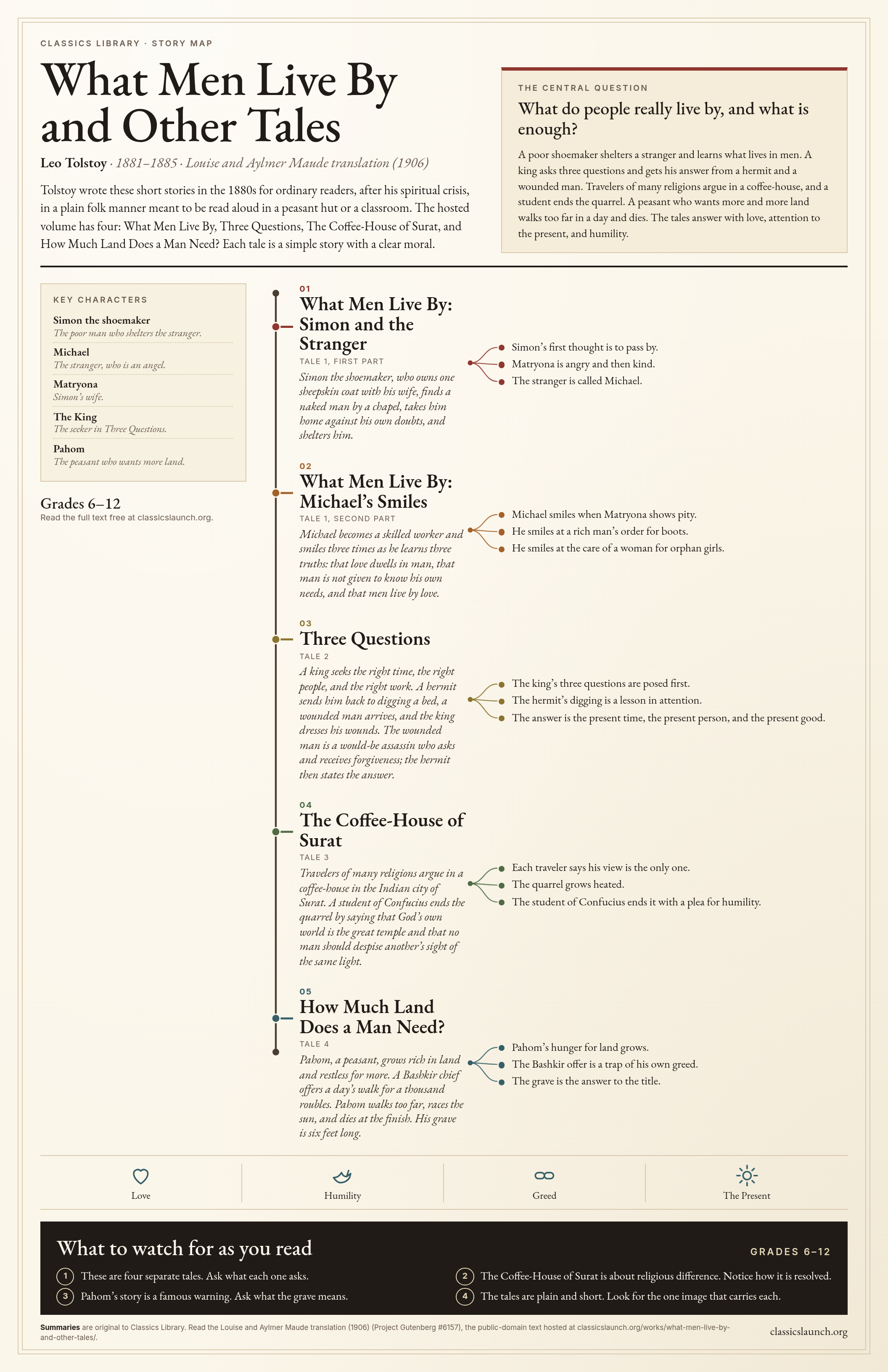
Tolstoy wrote these short stories in the 1880s for ordinary readers, after his spiritual crisis, in a plain folk manner meant to be read aloud in a peasant hut or a classroom. The hosted volume has four: What Men Live By, Three Questions, The Coffee-House of Surat, and How Much Land Does a Man Need? Each tale is a simple story with a clear moral.
The central question
What do people really live by, and what is enough?
A poor shoemaker shelters a stranger and learns what lives in men. A king asks three questions and gets his answer from a hermit and a wounded man. Travelers of many religions argue in a coffee-house, and a student ends the quarrel. A peasant who wants more and more land walks too far in a day and dies. The tales answer with love, attention to the present, and humility.
- 01
What Men Live By: Simon and the Stranger
Tale 1, first part
Simon the shoemaker, who owns one sheepskin coat with his wife, finds a naked man by a chapel, takes him home against his own doubts, and shelters him.
- Simon’s first thought is to pass by.
- Matryona is angry and then kind.
- The stranger is called Michael.
- 02
What Men Live By: Michael’s Smiles
Tale 1, second part
Michael becomes a skilled worker and smiles three times as he learns three truths: that love dwells in man, that man is not given to know his own needs, and that men live by love.
- Michael smiles when Matryona shows pity.
- He smiles at a rich man’s order for boots.
- He smiles at the care of a woman for orphan girls.
- 03
Three Questions
Tale 2
A king seeks the right time, the right people, and the right work. A hermit sends him back to digging a bed, a wounded man arrives, and the king dresses his wounds. The wounded man is a would-be assassin who asks and receives forgiveness; the hermit then states the answer.
- The king’s three questions are posed first.
- The hermit’s digging is a lesson in attention.
- The answer is the present time, the present person, and the present good.
- 04
The Coffee-House of Surat
Tale 3
Travelers of many religions argue in a coffee-house in the Indian city of Surat. A student of Confucius ends the quarrel by saying that God’s own world is the great temple and that no man should despise another’s sight of the same light.
- Each traveler says his view is the only one.
- The quarrel grows heated.
- The student of Confucius ends it with a plea for humility.
- 05
How Much Land Does a Man Need?
Tale 4
Pahom, a peasant, grows rich in land and restless for more. A Bashkir chief offers a day’s walk for a thousand roubles. Pahom walks too far, races the sun, and dies at the finish. His grave is six feet long.
- Pahom’s hunger for land grows.
- The Bashkir offer is a trap of his own greed.
- The grave is the answer to the title.
- Love
- Humility
- Greed
- The Present
What to watch for as you read
Grades 6–12- These are four separate tales. Ask what each one asks.
- The Coffee-House of Surat is about religious difference. Notice how it is resolved.
- Pahom’s story is a famous warning. Ask what the grave means.
- The tales are plain and short. Look for the one image that carries each.
Every quotation is word for word from the Louise and Aylmer Maude translation (1906) hosted in this library and is checked against that text each time the site is built. Citations give book and chapter (or canto and line).