Work record
What Men Live By and Other Tales
Leo TolstoyWhat Men Live By and Other Tales (Tolstoy)What Men Live By and Other Tales by Leo Tolstoy (1881–1906)What Men Live By and Other Tales gathers four of the short stories Tolstoy wrote in the 1880s for ordinary readers, after his spiritual crisis, in a plain folk manner meant to be read aloud in a peasant hut or a classroom.Also known as: What Men Live By and Other Tales (Tolstoy)
1881–1906 · 19th Century · Short Stories · Russian
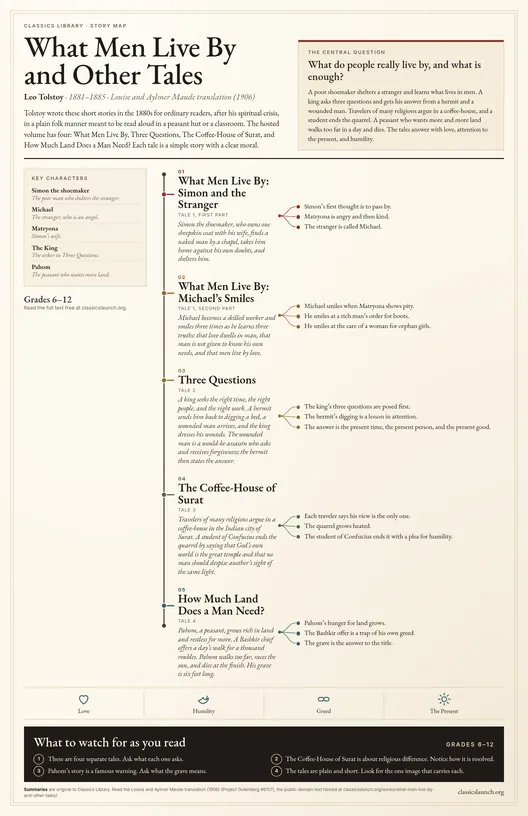 Story mapSee the story mapThe whole book on one page: the story in movements, the characters, and what to watch for. Free to print.
Abstract
Background. Tolstoy's plain tales of the 1880s were written for cheap books sold to peasants, and he reworked old legends and a French fable into them. The Maude translation of 1906 helped carry them to English readers, and the tales have been read in schools and churches ever since for their directness and their moral clarity.
Plot. A shoemaker shelters a stranger who is an angel in disguise. A king asks a hermit three questions and is answered by a wounded man. Travellers of many faiths argue in a coffee-house in India. A peasant who wanted more land walks himself to death trying to claim it between sunrise and sunset.
Ideas. The stories teach that men live by love, that the present moment and the person near at hand are the proper business of life, that greed has a measure, and that religious pride should be answered with patience. One of them, however, treats all faiths as equal paths to the same God, which Christian readers should weigh against the Gospel itself.
Text. The English is short, direct and made for reading aloud, with a few translator's notes on money and land at the end. The hosted collection prints four tales, each of which can be read in a single sitting and discussed apart.
Main characters
- Simon: A poor shoemaker who takes in a stranger
- Michael: The stranger who is an angel
- The King: A ruler seeking the three secrets
- Pahom: A peasant who covets more land

Summary
What Men Live By and Other Tales gathers four of the short stories Tolstoy wrote in the 1880s for ordinary readers, after his spiritual crisis, in a plain folk manner meant to be read aloud in a peasant hut or a classroom. The first, What Men Live By, is the best known. A poor shoemaker named Simon, who owns one sheepskin coat with his wife, finds a naked stranger shivering by a roadside chapel and, after a hard struggle with his own misgiving and his wife's anger, takes him home. The stranger, Michael, works as his apprentice, smiles three times, and turns out to be an angel who has been sent to earth to learn three truths: what dwells in man, what is not given to man, and what men live by. The answer, given at the close, is that they live not by care for themselves but by love. The second tale, Three Questions, is a short parable about a king who wishes to know the right time for every act, the right people to heed, and the most important thing to do. A hermit, digging his garden, answers by letting the king help him and then by letting him save the life of a wounded stranger, who proves to be an enemy who meant to kill him. The most important time is now, the most important man is the one in front of you, and the most important work is to do him good. The third, The Coffee-House of Surat, is a fable in which travellers of every faith quarrel over whose God is true, until a Chinese student of Confucius answers that all temples are copies of the one God has built in the world. It is the one tale in the collection that Christian readers should discuss with care, since it argues for a general benevolence among religions and not for the exclusive claims of the Gospel. The last, How Much Land Does a Man Need?, tells of Pahom, a peasant who says that if he had enough land he would not fear the devil himself, and who is led by the devil from one purchase to the next. In the end the Bashkirs offer him as much as he can walk around in a day for a thousand roubles; he walks too far, runs back at sunset, and falls dead at the goal. His servant digs him a grave six feet long. The tales share a simple method: a clear moral question, a plain style, and an ending that does not need to be explained. Their weakness is their sureness that doctrine can be reduced to ethics; their strength is that they put the commandment to love before the child and the peasant as well as the philosopher.
Virtues in this work
- Charity: The shoemaker's hospitality and the king's care of his enemy are the book's two clearest pictures of charity.
- Humility: The hermit's spade and the angel's apprenticeship set humility before wisdom.
- Temperance: Pahom's story is a lesson in the lack of it: a man who cannot stop asking for more land.
- Prudence: The king learns that true prudence is attention to the present need and not a plan for every case.
Plot or Argument
- What Men Live By
Simon the shoemaker finds a naked man by a chapel, takes him home against his own doubts, and shelters him. The man, Michael, becomes a skilled worker and smiles when he understands each of three sayings: that love dwells in man, that man is not given to know his own needs, and that men live by love.
- Three Questions
A king seeks the right time, the right people and the right work. A hermit sends him back to digging a bed, a wounded man arrives, and the king dresses his wounds. The wounded man is a would-be assassin who asks and receives forgiveness; the hermit then states the answer.
- The Coffee-House of Surat
Travellers of many religions argue in a coffee-house in the Indian city of Surat. A student of Confucius ends the quarrel by saying that God's own world is the great temple and that no man should despise another's sight of the same light.
- How Much Land Does a Man Need?
Pahom, a peasant, grows rich in land and restless for more. A Bashkir chief offers a day's walk for a thousand roubles. Pahom walks too far, races the sun, and dies at the finish; his grave is six feet long.
Characters
- Simon the shoemaker, protagonist of the first tale
A poor workman with one coat shared with his wife, who learns to take in a stranger and to see in him a guest he cannot afford to refuse.
- Michael, the angel
A stranger who works as an apprentice, smiles three times, and reveals himself as an angel sent down to learn what men live by.
- Matryona, Simon's wife
A hard-pressed woman who first rebukes her husband and then, moved by pity, feeds the stranger; her change is the first sign of the lesson.
- The King, protagonist of Three Questions
A ruler who wishes to be sure of every decision, and who learns that the greatest act is nearest at hand.
- Pahom, protagonist of the last tale
A peasant who is never satisfied with his land and who is brought by his greed to a day's race against the sun.
Lessons
Love is the answer to what men live by
The first tale puts the whole of Tolstoy's later teaching in a shoemaker's hut: God gives life, men do not know what they need, and in practice they live by love. The angel is punished for refusing a mother's plea and saved by seeing a stranger's love for orphans. A reader should see that the teaching rests on the Epistle of John, which the book prints as its opening text.
- Who shows love in this tale, and what does each pay for it?
- Why does the angel only smile when he understands, and what has he understood each time?
Now is the important time
The king in Three Questions wants a method for acting well and is shown that there is none apart from loving the person in front of him. The hermit's answer is plain, and it may be tested on any ordinary school day: attend to the person you are with, and do him good.
- Why is the wounded man 'the most important man'?
- Is it easier to do good now or to plan to do good later? What does the hermit say?
Greed has a measure, and it is six feet
Pahom's wish for just a little more land is the oldest of the stories. The devil does not need to tempt him with evil; he only has to let him choose. The final sentence of the tale is one of the best-known in Russian literature.
- What does Pahom want when the story begins, and what does he want at the end?
- Where in the tale does Pahom stop to ask whether he has enough?
Context
The tales belong to the 1880s and early 1900s, when Tolstoy was famous across Europe and was giving his time to writing for peasant readers. The first three stories rest on older materials: What Men Live By on a folk legend and on the First Epistle of John, Three Questions on a parable, and The Coffee-House of Surat on a tale by Bernardin de Saint-Pierre. How Much Land Does a Man Need? was written in 1886.
Composition
They were published through the Posrednik press, which Tolstoy and his friends founded in 1884 to put cheap and wholesome reading into the hands of ordinary Russians. The Maude translation hosted here is the 1906 Oxford version, from which the four tales are drawn.
Reception
The first and last tales have been constant favourites for children and adults; many readers rank How Much Land Does a Man Need? among the finest short stories in any language. Readers of faith have praised the Gospel spirit of the first tale and criticised the leveling of religions in the Surat story.
Comparisons
- Master and Man
Another Tolstoy tale in which a rich man comes to love a poor man in the face of death, with the same message and a much darker night.
- The Death of Ivan Ilyich
The longer story asks the same question as the angel does, what men live by, and finds the answer in a servant's simple mercy.
- A Confession
Tolstoy's own account of the crisis that produced these folk tales, and of why he turned to the Gospels for the answer.
- The Pilgrim's Progress
Bunyan's allegory has the same plain directness and the same sense that the Christian life is a road with real dangers and real help.
- A Tale of Two Cities
Dickens's novel ends on a sacrificial act that echoes the angel's lesson about love as the thing by which men are saved.
Quotes
Frequently cited
“I have learnt that all men live not by care for themselves but by love.”
Frequently cited
“He who has love, is in God, and God is in him, for God is love.”
Frequently cited
“Remember then: there is only one time that is important--Now! It is the most important time because it is the only time when we have any power. The most necessary man is he with whom you are, for no man knows whether he will ever have dealings with any one else: and the most important affair is, to do him good, because for that purpose alone was man sent into this life!”
Frequently cited
“Six feet from his head to his heels was all he needed.”
“We know that we have passed out of death into life, because we love the brethren. He that loveth not abideth in death.”
“Nor is it given to any man to know whether, when evening comes, he will need boots for his body or slippers for his corpse.”
“Therefore, let him who sees the sun's whole light filling the world, refrain from blaming or despising the superstitious man, who in his own idol sees one ray of that same light. Let him not despise even the unbeliever who is blind and cannot see the sun at all.”
For Students
A reading companion for classical Christian high school students. See the student guide.
Reading Guide
Watch for
- The three smiles of Michael and what has just happened before each one.
- How often the tales are interrupted by a question that cannot be answered by calculation.
- The way in which Tolstoy lets the ending of each story stop on a plain fact, not a sermon.
Key terms and names
- Apprentice
- A young worker learning a craft under a master; Michael serves Simon in this role.
- Parable
- A short story told to teach a moral or spiritual lesson, as Tolstoy borrows the form from the Gospels.
- Bashkir
- A people of the Russian steppe, whose generous chief offers Pahom as much land as he can walk around in a day.
- Posrednik
- The cheap-book press that Tolstoy and friends founded to give common readers wholesome stories.
Seminar Questions
- Comprehension Why does Simon bring the stranger home, and what does his wife say?
- Comprehension What are the three questions the king asks, and who finally answers them?
- Interpretation Why does the angel need to learn three things, and not only one?
- Interpretation What does the devil do in the last tale, and what does Pahom do for himself?
- Interpretation What does the Chinese student say about all religions, and how do Christians answer him?
- Big Question Is Tolstoy right that men live by love and not by care for themselves? Argue from the tale and from the Epistle of John.
- Big Question Does the Surat tale tell the truth about God, or only about men who quarrel? Argue from Scripture.
Faith Connections
- 1 John 3:14–18 (Scripture)
The book's own epigraph. The apostle's call to love in deed and truth is the whole argument of the first tale, and a class should read it before the story.
- Hebrews 13:2 (Scripture)
'Do not neglect to show hospitality to strangers, for thereby some have entertained angels unawares.' Simon's acceptance of Michael is a retelling of this verse.
- Luke 12:15–21 (Scripture)
Pahom is a close cousin of the rich fool, who asks his soul to take its ease and is told that it will be required of him that night.
- John 14:6 (Scripture)
Christ's exclusive statement that no one comes to the Father except through him is the right text to bring against the Surat tale.
Logic and Rhetoric
Central argument: Men live not by care for themselves but by love; every other aim, whether wealth, wisdom or power, is subordinate to that. The tales argue by example, letting a shoemaker, a king and a peasant each show the claim in action.
Rhetorical device: rule of three. The angel smiles three times and states three truths in the first tale; the king asks three questions in the second.
Debate: Resolved: That a good story can teach the commandment of love more truly than a sermon.
Memory Work
I have learnt that all men live not by care for themselves but by love.
He who has love, is in God, and God is in him, for God is love.
Writing Prompts
Essay: Compare Simon's choice to take in the stranger with the king's choice to nurse his enemy. What does each cost him, and what does each gain?
Comparison with Master and Man: Compare the master's night in the snow with Simon's night in his hut. What does Tolstoy think is the one thing needful?
Medical Lens
These are moral tales with no clinical interest apart from the exhausted death at the end of the last one, which describes Pahom's running, his bleeding mouth and his collapse in the language of a man who has overrun his own strength.
Creative Prompts
- Essay
Choose one of the four tales and explain the single sentence that holds its meaning. Then explain why Tolstoy chose to tell the lesson in a story and not in an argument.
- Fiction
Write a new tale in Tolstoy's plain manner in which a stranger comes to a modern home and teaches one lesson. Keep it under 800 words and let the ending speak for itself.
- Classroom
Read What Men Live By aloud in three parts, one for each of the angel's smiles. After each, ask what the angel has learned and what the shoemaker has learned.
- Dialogue
Write a dialogue between Pahom and the hermit of Three Questions on the day Pahom first has land enough.
Further Reading
- Twenty-Three Tales, Leo Tolstoy
The collection from which these four tales are selected.
- Master and Man, Leo Tolstoy
A longer tale of death and charity, hosted in this library.
- The Kingdom of God Is Within You, Leo Tolstoy
Tolstoy's own statement of the Gospel as he understood it.
- The Pilgrim's Progress, John Bunyan
The plain-spoken Christian allegory that Tolstoy's tales often resemble.
Verification notes
Full text from Project Gutenberg #6157, the 1906 Maude translation of four tales from Twenty-Three Tales, in public domain. Quotes were checked against the hosted text.
- Exact dates of Tolstoy's composition of each of the four tales.