Story maps · Grades 10–12
The Ballad of Reading Gaol: A Story Map
The PDF is one tabloid page (11 × 17 in). On letter paper, choose “Fit to page.”
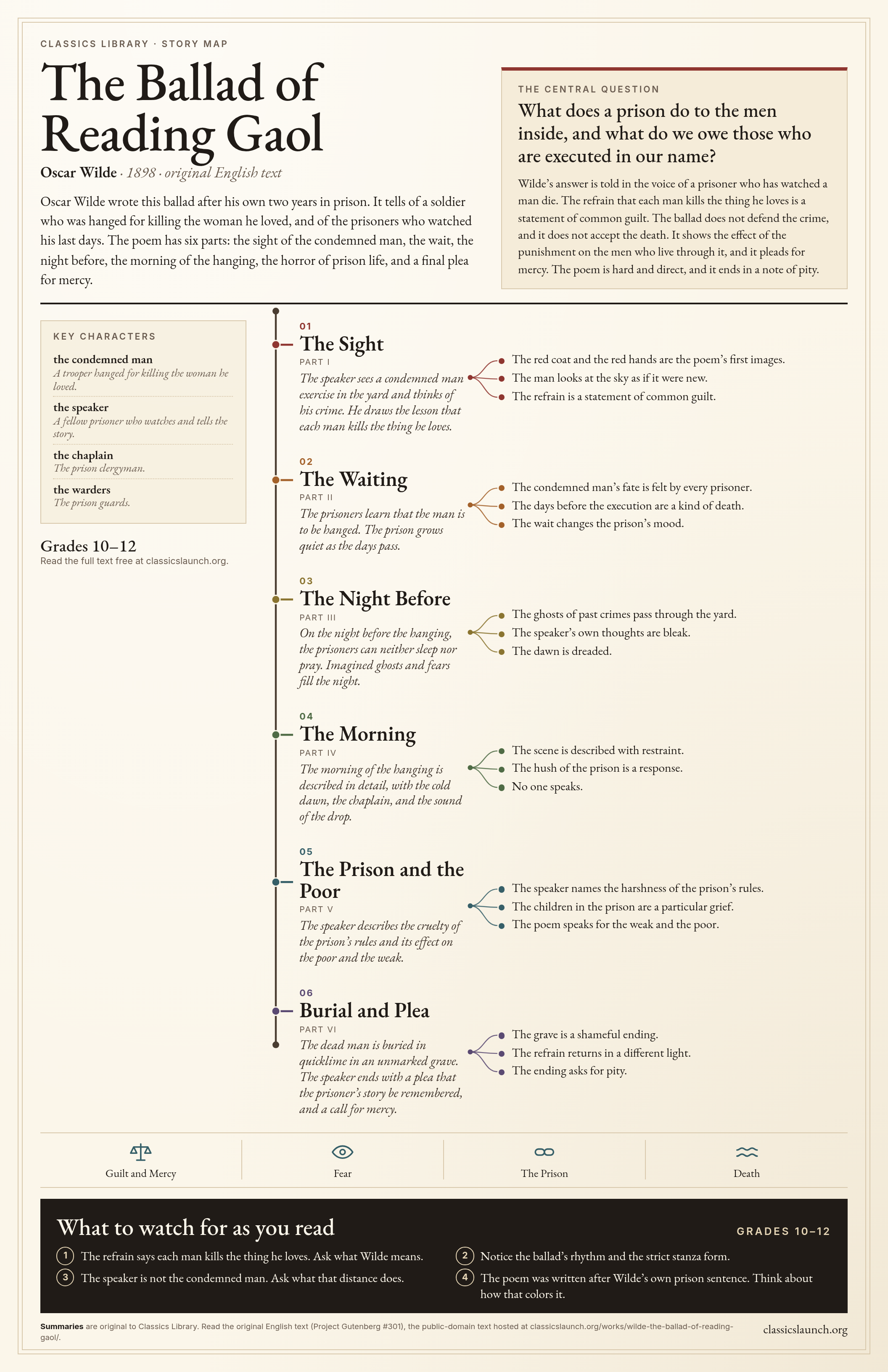
Oscar Wilde wrote this ballad after his own two years in prison. It tells of a soldier who was hanged for killing the woman he loved, and of the prisoners who watched his last days. The poem has six parts: the sight of the condemned man, the wait, the night before, the morning of the hanging, the horror of prison life, and a final plea for mercy.
The central question
What does a prison do to the men inside, and what do we owe those who are executed in our name?
Wilde’s answer is told in the voice of a prisoner who has watched a man die. The refrain that each man kills the thing he loves is a statement of common guilt. The ballad does not defend the crime, and it does not accept the death. It shows the effect of the punishment on the men who live through it, and it pleads for mercy. The poem is hard and direct, and it ends in a note of pity.
- 01
The Sight
Part I
The speaker sees a condemned man exercise in the yard and thinks of his crime. He draws the lesson that each man kills the thing he loves.
- The red coat and the red hands are the poem’s first images.
- The man looks at the sky as if it were new.
- The refrain is a statement of common guilt.
- 02
The Waiting
Part II
The prisoners learn that the man is to be hanged. The prison grows quiet as the days pass.
- The condemned man’s fate is felt by every prisoner.
- The days before the execution are a kind of death.
- The wait changes the prison’s mood.
- 03
The Night Before
Part III
On the night before the hanging, the prisoners can neither sleep nor pray. Imagined ghosts and fears fill the night.
- The ghosts of past crimes pass through the yard.
- The speaker’s own thoughts are bleak.
- The dawn is dreaded.
- 04
The Morning
Part IV
The morning of the hanging is described in detail, with the cold dawn, the chaplain, and the sound of the drop.
- The scene is described with restraint.
- The hush of the prison is a response.
- No one speaks.
- 05
The Prison and the Poor
Part V
The speaker describes the cruelty of the prison’s rules and its effect on the poor and the weak.
- The speaker names the harshness of the prison’s rules.
- The children in the prison are a particular grief.
- The poem speaks for the weak and the poor.
- 06
Burial and Plea
Part VI
The dead man is buried in quicklime in an unmarked grave. The speaker ends with a plea that the prisoner’s story be remembered, and a call for mercy.
- The grave is a shameful ending.
- The refrain returns in a different light.
- The ending asks for pity.
- Guilt and Mercy
- Fear
- The Prison
- Death
What to watch for as you read
Grades 10–12- The refrain says each man kills the thing he loves. Ask what Wilde means.
- Notice the ballad’s rhythm and the strict stanza form.
- The speaker is not the condemned man. Ask what that distance does.
- The poem was written after Wilde’s own prison sentence. Think about how that colors it.
Every quotation is word for word from the original English text hosted in this library and is checked against that text each time the site is built. Citations give book and chapter (or canto and line).