Work record
The Ballad of Reading Gaol
Oscar WildeBallad of Reading Gaol; The Ballad of Reading Jail; C.3.3.The Ballad of Reading Gaol by Oscar Wilde (1898)The Ballad of Reading Gaol is Oscar Wilde's last major work and one of the most widely read poems of the late Victorian age.Also known as: Ballad of Reading Gaol · The Ballad of Reading Jail · C.3.3.
1898 · 19th Century · Poetry · English
Read this when mercy must be weighed against law, and a prison poem turns to Christ.
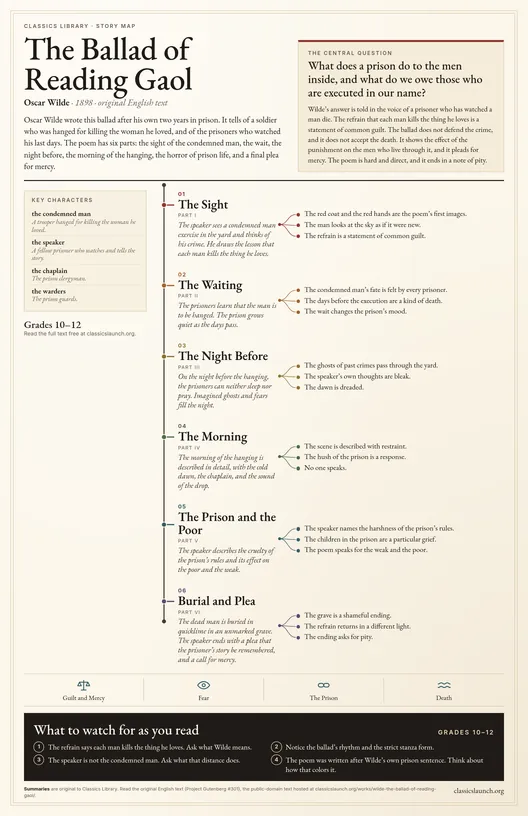 Story mapSee the story mapThe whole book on one page: the story in movements, the characters, and what to watch for. Free to print.
Abstract
Background. A celebrated writer wrote this poem after leaving prison, recalling the hanging of a soldier at Reading while he was still inside. It was first printed under his old cell number and has since become one of the most quoted poems of its age.
Plot. A prisoner watches a condemned man walk the yard and learns that he must hang. The poem follows the weeks of waiting, the sleepless last night and the execution, and ends at the grave in the prison yard.
Ideas. The poem holds that every person wounds what he loves and that human law without mercy cannot heal. It points to a broken and contrite heart as the way by which Christ enters, and it criticizes a system that hides its cruelty.
Text. The text is complete, in six parts, from the Gutenberg file of the 1898 poem, and every quotation in this guide was checked against it. It contains an execution and prison cruelty, so it suits older students. Teachers can pair this work with the library's study guide, seminar questions and memory-work selection to prepare a discussion, a short essay or a recitation. The full text is hosted on this site, and each quotation in the guide has been checked against the hosted text.
Main characters
- The speaker: A fellow prisoner telling the story
- The condemned man: A trooper hanged for murdering his wife
- The chaplain: The prison clergyman
- The Governor and Warders: Officers of the prison
Summary
The Ballad of Reading Gaol is Oscar Wilde's last major work and one of the most widely read poems of the late Victorian age. Wilde wrote it in 1897 after serving two years' hard labour for his conviction under the laws of 1895, and it was first printed in February 1898 under the prisoner number of his old cell, C.3.3. The poem is a ballad in six-line stanzas with a rhythm like a hymn or a folk song. It tells of a young soldier of the Royal Horse Guards who is hanged at Reading for the murder of his wife, and of the weeks the prisoners spend watching him walk his exercise yard before the morning of the execution. The speaker is a fellow prisoner, never named, who sees the condemned man only at a distance. He does not excuse the crime, and the poem says plainly that the man had killed the thing he loved and so had to die. What he refuses to accept is that the killer is a different kind of creature from the rest of us. In the best-known stanzas he declares that each man kills the thing he loves, by a bitter look, a flattering word, a kiss or a sword, and that most of us do not die for it. The poem then moves through the last night, the clock at eight, the hanging itself and the burial in quicklime, and goes on to a long meditation on the prison system, its cruelty to children and to the weak, and the way it hides its work from the sight of Christ. What gives the poem its force is the way it joins judgment to mercy. Wilde does not claim that law is unnecessary, but he insists that the law's severity is not the last word. In the fifth part he turns to the figure of Christ and to the thief who was promised paradise, and he suggests that the only way into a hard heart is through a broken one. The condemned man's repentance, 'a broken and a contrite heart,' is set beside the prison that offers only shame. The short last part returns to the grave in the prison yard, asks the reader to waste no foolish tear, and ends by repeating that all men kill the thing they love. For a classical Christian classroom the ballad is a short, painful lesson in sin, repentance and compassion, written by a man who knew public disgrace. It should be taught with care: it contains an execution, some violent images and a frank description of prison conditions.
Virtues in this work
Plot or Argument
- Part I: The man in the yard
The speaker sees a condemned guardsman among the prisoners and hears a voice say that he has to swing. He reflects that each man kills the thing he loves, and that most who do so are not hanged.
- Part II: Six weeks of walking
The condemned man walks the yard in shabby grey and looks at the sky. The prisoners watch him and feel their own guilt, and a wall rises between him and them.
- Part III: The last night and morning
The poem follows the open grave, the sleepless night of prayer, the warders in felt shoes, the morning, the clock at eight and the moment of the hanging.
- Part IV: No chapel on the day
The prisoners are shut in until noon and then walk their round in silence. The body is buried in quicklime in the prison yard, and no seed will grow there for years.
- Part V: The law and the broken heart
Wilde turns from the one hanging to the whole prison system and asks how Christ may enter a hard heart. The poem answers that he comes through a broken and contrite one.
- Part VI: The grave
A short last part returns to the grave in the prison, tells the reader to waste no foolish tear, and ends by saying again that all men kill the thing they love.
Characters
- The speaker, narrator
A fellow prisoner who watches the condemned man from a distance and tells the story in the first person plural.
- The condemned man, soldier and murderer
A trooper of the Royal Horse Guards hanged for killing his wife. He walks the yard looking at the sky and is hanged at eight o'clock.
- The chaplain, clergyman
The prison clergyman, too sick at heart to hold a service on the day of the hanging, who will not kneel at the grave.
- The Governor and the Warders, officials
The officials of the law, strict on regulations, who watch the prisoner by day and night.
Lessons
Sin is common, though punishment is not
The line that every man kills the thing he loves is not an excuse for murder. It is a warning that the killer is not a monster apart, and that pride, cruelty and flattery wound love in everyone. A Christian reader may link this with the saying that all have sinned.
- How does Wilde make the speaker share a common guilt with the condemned man?
- Why does the poem say that the man had to die, yet also invite pity?
Law is necessary but not sufficient
The poem accepts that society punishes the guilty, but it argues that the prison as practiced hides its cruelty from view and confuses justice with revenge. Students can ask what a just punishment would respect.
- What does the stanza on the bricks of shame criticise?
- What would a prison that served both justice and mercy look like?
Mercy comes through a broken heart
In the fifth part the poem turns to Christ and the thief on the cross and says that a broken and a contrite heart is not despised. Repentance, not the hangman, opens the way to pardon.
- Why does Wilde link the broken heart to the entrance of Christ?
- How does the image of the box of costly ointment answer the pit of shame?
Context
Wilde was convicted in May 1895 and sent to hard labour in English prisons, where the regime of silence, bad food and long confinement was already under official criticism. The hanging of Charles Thomas Wooldridge, a trooper in the Royal Horse Guards, at Reading on 7 July 1896 happened while Wilde was serving there, and the poem is dedicated to his memory by his initials.
Composition
Wilde wrote the poem after his release in May 1897, chiefly in France and Italy, and it was printed by Leonard Smithers in London in February 1898 under the pen name C.3.3., Wilde's cell number at Reading. Later editions carried his name.
Reception
The poem sold quickly and became his most popular work, the one Wilde was proudest of in his last years. Its call for gentleness toward prisoners belongs to the movement for prison reform in England at the end of the Victorian age, and many readers know its lines about each man killing the thing he loves.
Comparisons
- The Picture of Dorian Gray
Wilde's novel shows the cost of a life given to beauty and sensation; the ballad shows the cost of sin and punishment from the other side, with the same moral seriousness.
- The Happy Prince and Other Tales
The tales are Wilde's stories of pity and sacrifice for children, and the ballad's concern for the child in prison grows from the same compassion.
- Crime and Punishment
Dostoevsky's novel follows a murderer from guilt to repentance; Wilde's poem treats the same road in a few pages and points to the same Christ.
- The Rime of the Ancient Mariner
Coleridge's ballad also tells a tale of a sin against love and of a repentance that begins when the heart is touched; both use the ballad form for moral weight.
- The Lady of Shalott
Another Victorian ballad poem, which shows how the same metre can carry lightness and tragedy.
Quotes
Frequently cited
“The man had killed the thing he loved And so he had to die.”
Frequently cited
“Yet each man kills the thing he loves By each let this be heard, Some do it with a bitter look, Some with a flattering word, The coward does it with a kiss, The brave man with a sword!”
Frequently cited
“How else but through a broken heart May Lord Christ enter in?”
“For each man kills the thing he loves, Yet each man does not die.”
“That every prison that men build Is built with bricks of shame, And bound with bars lest Christ should see How men their brothers maim.”
“And a broken and a contrite heart The Lord will not despise.”
“And with tears of blood he cleansed the hand, The hand that held the steel: For only blood can wipe out blood, And only tears can heal: And the crimson stain that was of Cain Became Christ's snow-white seal.”
For Students
A reading companion for classical Christian high school students. See the student guide.
Reading Guide
Watch for
- The speaker's use of 'we' and 'each man' and when he separates himself from the others.
- The images of the sky and the sun in the condemned man's gaze.
- Every place where the poem names Christ, the thief or the broken heart.
Key terms and names
- Gaol
- The British spelling of jail; Reading Gaol was a county prison in Berkshire where Wilde served part of his sentence.
- Ballad
- A narrative poem in short stanzas, often with a refrain or a simple rhyme scheme, meant to be heard.
- Contrite
- Truly sorry for sin, as in the psalmist's broken and contrite heart.
- Nard
- A costly perfumed ointment, poured out on Christ in the Gospels as a sign of love.
Seminar Questions
- Comprehension What crime has the condemned man committed, and what does the speaker call it?
- Comprehension What are the ways in which men kill what they love, according to Part I?
- Interpretation Why does Wilde make the speaker a fellow prisoner instead of a judge or a priest?
- Interpretation How does the poem treat the law: as wrong, as necessary or as incomplete?
- Interpretation What does the broken box of ointment add to the poem's meaning?
- Big Question Can a society be just without being merciful?
- Big Question Is repentance enough to heal what sin has done?
Faith Connections
- Psalm 51:17 (Scripture)
The sacrifice of God is a broken spirit; a broken and contrite heart he will not despise. The poem quotes the sense of this verse in its hope for the hanged man.
- Luke 23:39-43 (Scripture)
The thief on the cross who asks to be remembered is promised paradise; Wilde's poem points to this scene as the pattern of pardon.
- Matthew 25:36 (Scripture)
I was in prison and you came to me. The poem asks what the Church and the state have done to those in prison.
Logic and Rhetoric
Central argument: The condemned man's crime is real and merits judgment, but each reader shares the same weakness, and the prison system that hides cruelty cannot do what only a broken and repentant heart can.
Rhetorical device: refrain and parallel stanza. The repeated line that each man kills the thing he loves ties the whole poem to a single universal claim.
Debate: Resolved: That the prison system described in the Ballad of Reading Gaol is more cruel than the crime it punishes.
Memory Work
How else but through a broken heart May Lord Christ enter in?
Yet each man kills the thing he loves By each let this be heard, Some do it with a bitter look, Some with a flattering word, The coward does it with a kiss, The brave man with a sword!
Writing Prompts
Essay: Argue whether Wilde's claim that each man kills the thing he loves makes the condemned man less guilty or makes the reader more guilty.
Comparison with Crime and Punishment: Compare how Wilde and Dostoevsky bring a murderer toward repentance, and say what each author thinks the law can and cannot do.
Medical Lens
The poem looks at execution by hanging and at prison conditions as they bear on body and mind. It names despair and madness among the prisoners without clinical detail, and it is a primary source for how the Victorian prison was experienced by those inside.
Creative Prompts
- Essay
Explain how Wilde moves from the single hanging in Part IV to the criticism of the whole system in Part V, and say whether the poem argues for mercy or for reform.
- Classroom
Read the stanzas on the broken heart and the thief aloud and discuss how Psalm 51 and Luke 23 inform the poem's idea of repentance.
- Poetry
Write four stanzas in ballad metre about a hard truth that people see in themselves and not in others, using a refrain.
Further Reading
- De Profundis, Oscar Wilde
Wilde's long prison letter, written to Lord Alfred Douglas in 1897.
- Oscar Wilde, Richard Ellmann
The standard biography, published in 1987.
- The Importance of Being Earnest, Oscar Wilde
Wilde's comedy, in this library.
Verification notes
Full text from Project Gutenberg #301, a public-domain text of the 1898 poem; the Gutenberg file also carries a second version, and Version One is used here with the missing numeral of Part III restored. Quotes were checked against the hosted text. Dates and facts about Wilde's conviction, release, the hanging of Wooldridge on 7 July 1896 and the first edition of 1898 follow standard biographical accounts. The comparison with prison reform is an interpretive link.
- Whether the edition printed by Smithers first carried Wilde's name in the seventh printing.
- The exact number of stanzas in each part as printed in the first edition.