Story maps · Grades 9–12
Hellenica: A Story Map
The PDF is one tabloid page (11 × 17 in). On letter paper, choose “Fit to page.”
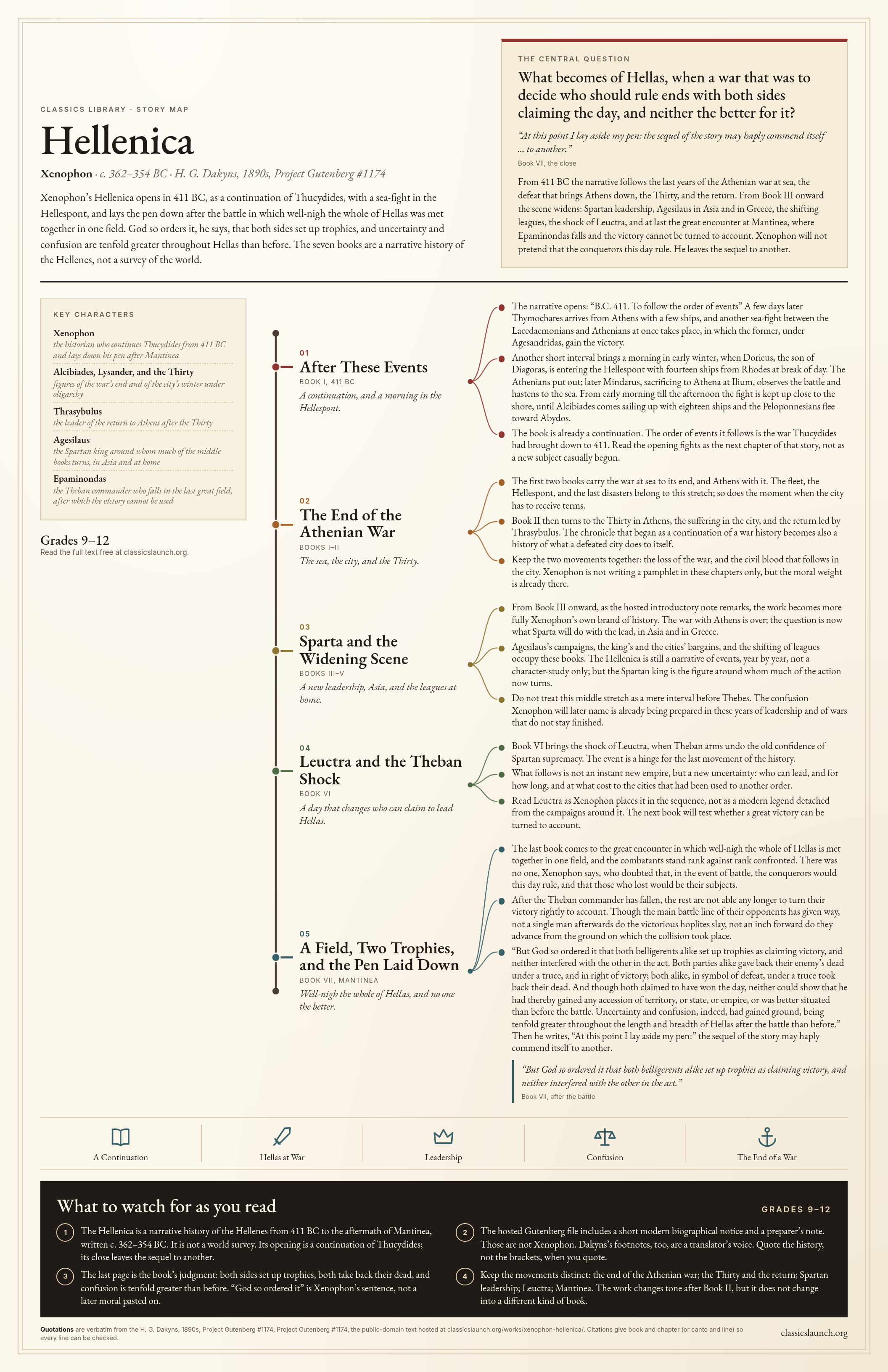
Xenophon’s Hellenica opens in 411 BC, as a continuation of Thucydides, with a sea-fight in the Hellespont, and lays the pen down after the battle in which well-nigh the whole of Hellas was met together in one field. God so orders it, he says, that both sides set up trophies, and uncertainty and confusion are tenfold greater throughout Hellas than before. The seven books are a narrative history of the Hellenes, not a survey of the world.
The central question
What becomes of Hellas, when a war that was to decide who should rule ends with both sides claiming the day, and neither the better for it?
“At this point I lay aside my pen: the sequel of the story may haply commend itself ... to another.”
From 411 BC the narrative follows the last years of the Athenian war at sea, the defeat that brings Athens down, the Thirty, and the return. From Book III onward the scene widens: Spartan leadership, Agesilaus in Asia and in Greece, the shifting leagues, the shock of Leuctra, and at last the great encounter at Mantinea, where Epaminondas falls and the victory cannot be turned to account. Xenophon will not pretend that the conquerors this day rule. He leaves the sequel to another.
- 01
After These Events
Book I, 411 BC
A continuation, and a morning in the Hellespont.
- The narrative opens: “B.C. 411. To follow the order of events” A few days later Thymochares arrives from Athens with a few ships, and another sea-fight between the Lacedaemonians and Athenians at once takes place, in which the former, under Agesandridas, gain the victory.
- Another short interval brings a morning in early winter, when Dorieus, the son of Diagoras, is entering the Hellespont with fourteen ships from Rhodes at break of day. The Athenians put out; later Mindarus, sacrificing to Athena at Ilium, observes the battle and hastens to the sea. From early morning till the afternoon the fight is kept up close to the shore, until Alcibiades comes sailing up with eighteen ships and the Peloponnesians flee toward Abydos.
- The book is already a continuation. The order of events it follows is the war Thucydides had brought down to 411. Read the opening fights as the next chapter of that story, not as a new subject casually begun.
- 02
The End of the Athenian War
Books I–II
The sea, the city, and the Thirty.
- The first two books carry the war at sea to its end, and Athens with it. The fleet, the Hellespont, and the last disasters belong to this stretch; so does the moment when the city has to receive terms.
- Book II then turns to the Thirty in Athens, the suffering in the city, and the return led by Thrasybulus. The chronicle that began as a continuation of a war history becomes also a history of what a defeated city does to itself.
- Keep the two movements together: the loss of the war, and the civil blood that follows in the city. Xenophon is not writing a pamphlet in these chapters only, but the moral weight is already there.
- 03
Sparta and the Widening Scene
Books III–V
A new leadership, Asia, and the leagues at home.
- From Book III onward, as the hosted introductory note remarks, the work becomes more fully Xenophon’s own brand of history. The war with Athens is over; the question is now what Sparta will do with the lead, in Asia and in Greece.
- Agesilaus’s campaigns, the king’s and the cities’ bargains, and the shifting of leagues occupy these books. The Hellenica is still a narrative of events, year by year, not a character-study only; but the Spartan king is the figure around whom much of the action now turns.
- Do not treat this middle stretch as a mere interval before Thebes. The confusion Xenophon will later name is already being prepared in these years of leadership and of wars that do not stay finished.
- 04
Leuctra and the Theban Shock
Book VI
A day that changes who can claim to lead Hellas.
- Book VI brings the shock of Leuctra, when Theban arms undo the old confidence of Spartan supremacy. The event is a hinge for the last movement of the history.
- What follows is not an instant new empire, but a new uncertainty: who can lead, and for how long, and at what cost to the cities that had been used to another order.
- Read Leuctra as Xenophon places it in the sequence, not as a modern legend detached from the campaigns around it. The next book will test whether a great victory can be turned to account.
- 05
A Field, Two Trophies, and the Pen Laid Down
Book VII, Mantinea
Well-nigh the whole of Hellas, and no one the better.
- The last book comes to the great encounter in which well-nigh the whole of Hellas is met together in one field, and the combatants stand rank against rank confronted. There was no one, Xenophon says, who doubted that, in the event of battle, the conquerors would this day rule, and that those who lost would be their subjects.
- After the Theban commander has fallen, the rest are not able any longer to turn their victory rightly to account. Though the main battle line of their opponents has given way, not a single man afterwards do the victorious hoplites slay, not an inch forward do they advance from the ground on which the collision took place.
- “But God so ordered it that both belligerents alike set up trophies as claiming victory, and neither interfered with the other in the act. Both parties alike gave back their enemy’s dead under a truce, and in right of victory; both alike, in symbol of defeat, under a truce took back their dead. And though both claimed to have won the day, neither could show that he had thereby gained any accession of territory, or state, or empire, or was better situated than before the battle. Uncertainty and confusion, indeed, had gained ground, being tenfold greater throughout the length and breadth of Hellas after the battle than before.” Then he writes, “At this point I lay aside my pen:” the sequel of the story may haply commend itself to another.
“But God so ordered it that both belligerents alike set up trophies as claiming victory, and neither interfered with the other in the act.”
- A Continuation
- Hellas at War
- Leadership
- Confusion
- The End of a War
What to watch for as you read
Grades 9–12- The Hellenica is a narrative history of the Hellenes from 411 BC to the aftermath of Mantinea, written c. 362–354 BC. It is not a world survey. Its opening is a continuation of Thucydides; its close leaves the sequel to another.
- The hosted Gutenberg file includes a short modern biographical notice and a preparer’s note. Those are not Xenophon. Dakyns’s footnotes, too, are a translator’s voice. Quote the history, not the brackets, when you quote.
- The last page is the book’s judgment: both sides set up trophies, both take back their dead, and confusion is tenfold greater than before. “God so ordered it” is Xenophon’s sentence, not a later moral pasted on.
- Keep the movements distinct: the end of the Athenian war; the Thirty and the return; Spartan leadership; Leuctra; Mantinea. The work changes tone after Book II, but it does not change into a different kind of book.
Every quotation is word for word from the H. G. Dakyns, 1890s, Project Gutenberg #1174 hosted in this library and is checked against that text each time the site is built. Citations give book and chapter (or canto and line).