Work record
Hellenica
XenophonHellenica by Xenophon (c. 362–354 BC)Hellenica is Xenophon's history of Greek affairs from the last years of the Peloponnesian War down to the battle of Mantinea in 362 BC.c. 362–354 BC · Ancient · History · Ancient Greek
Read this when Thucydides breaks off and the next years of Greece must still be judged.
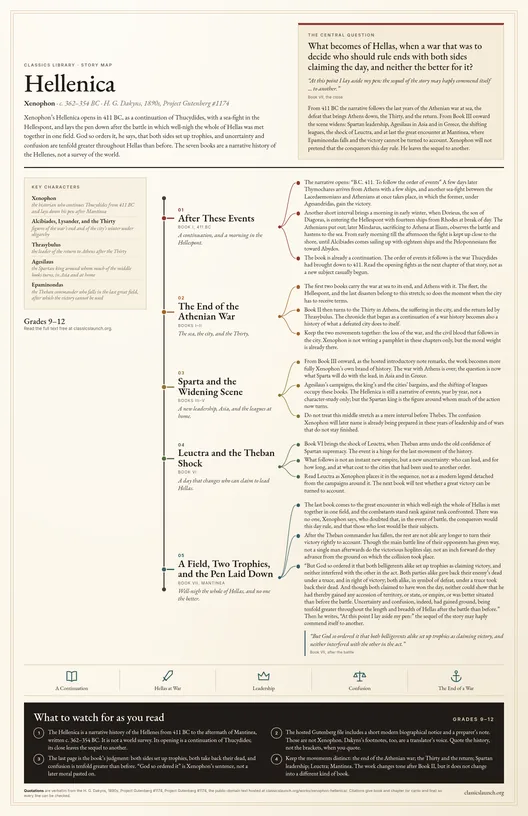 Story mapSee the story mapThe whole book on one page: the story in movements, the characters, and what to watch for. Free to print.
Abstract
Background. Composed after long years away from Athens, this sequel starts at the exact year an earlier unfinished history of the war had stopped, and it follows public affairs among the Greek cities for roughly five more decades.
Scope. Opening books complete the collapse of Athenian sea power, the short reign of the Thirty, and the recovery of the democracy; later books watch Sparta try to hold a victory, then meet a Theban challenge that ends without a durable master in Greece.
Method. The manner is plainer than that of the great predecessor, and the writer often lingers on a commander's habits, a city's vote, or an act of piety, as if the meaning of a campaign were found as much in character as in the movement of fleets and armies.
Significance. For later readers it has been the ordinary bridge across the fourth century BC, and in 1785 it was placed, together with the same author's march inland, on a first list of ancient historians meant for a young American student. A modern student can still use it in that same order: after the unfinished war narrative, and before later writers on the same years.
Key figures
- Agesilaus: Spartan king and Xenophon's principal military portrait
- Lysander: Spartan admiral who finishes the war with Athens
- Epaminondas: Theban commander of the later books

Summary
Hellenica is Xenophon's history of Greek affairs from the last years of the Peloponnesian War down to the battle of Mantinea in 362 BC. It opens in 411 BC, picking up the narrative where Thucydides breaks off, and the first two books carry the war through the Spartan victory at Aegospotami, the surrender of Athens, the rule of the Thirty, and the restoration of the democracy. From the third book onward the work is no longer a continuation of another man's war but Xenophon's own chronicle of the years that followed: the Spartan hegemony in Greece and in Asia, the rise and fall of Thebes, and the shifting leagues among the city-states. Xenophon writes as a man who had served with the Spartans and had lived under their protection, and his portraits of Agesilaus, of the Theban leaders, and of the assemblies that voted for war or peace are those of a participant as well as a narrator. The later books show how quickly victory turns into rivalry. Sparta, having beaten Athens, cannot keep a durable peace; Thebes, having broken Spartan power at Leuctra, cannot unite Greece either. The work closes after Mantinea with an admission that the battle settled nothing: both sides claimed the day, neither gained a sure empire, and confusion in Greece was greater than before. For a student who has read Thucydides, the Hellenica is the next stage of the same story, written in a plainer voice and with a closer interest in character, piety, and the habits of command. It is also the book Thomas Jefferson named, with the Anabasis, when he set out a first course of ancient history for his nephew Peter Carr in 1785. The hosted text is the public-domain translation by H. G. Dakyns, the same translator already used for Xenophon's Anabasis in this library, taken from his collected Works of Xenophon.
Virtues in this work
Plot or Argument
- Books I–II: The end of the Peloponnesian War
The narrative resumes in 411 BC with fighting in the Hellespont and the Aegean. It follows the Spartan admiral Lysander, the defeat of the Athenian fleet, the siege of Athens, the government of the Thirty, and the recovery of the city under Thrasybulus.
- Books III–V: The Spartan hegemony
Sparta sends Agesilaus into Asia and struggles to hold Greece at home. The Corinthian War, the King's Peace, and the growing resistance of Thebes and other cities show how a victor's supremacy begins to crack.
- Books VI–VII: Thebes, Mantinea, and an unfinished ending
Theban power rises under Epaminondas and Pelopidas, Sparta is shaken at Leuctra, and the last book ends at Mantinea in 362 BC with both sides claiming victory and Greece left more unsettled than before.
Characters
- Agesilaus, King of Sparta
Xenophon's admired commander; his campaigns in Asia and Greece occupy much of the middle books.
- Lysander, Spartan admiral
Wins the war at sea and shapes the settlement that follows the fall of Athens.
- Thrasybulus, Athenian leader
Leads the resistance that overthrows the Thirty and restores the democracy.
- Epaminondas, Theban general
Architect of Theban victories, including Leuctra, and a central figure of the later books.
- Pelopidas, Theban leader
Companion of Epaminondas in the rise of Thebes after the Spartan occupation of the Cadmea.
Lessons
A history that will not close
Xenophon ends not with a triumph but with confusion after Mantinea. The book trains a student to see that military success is not the same as a settled order, and that a historian may honestly stop when the event itself has no clear result.
- Why does Xenophon refuse to declare a winner at Mantinea?
- What would a less honest history have done with that ending?
Victory and the habits of power
Sparta's victory over Athens does not produce a just or lasting settlement. The middle books show how a dominant city uses and then loses the loyalty of its allies, and how pride in arms can outrun prudence in peace.
- Where does Spartan policy after the war first begin to fail?
- Which of Agesilaus's qualities help Sparta, and which cost it friends?
Character in public action
Xenophon often pauses for a portrait: Lysander, the Thirty, Agesilaus, the Theban leaders. The history is a school of judgment, asking the reader to weigh courage, piety, cruelty and self-command as they appear in assemblies and in the field.
- Which portrait in the later books most clearly shows a virtue under pressure?
- How does Xenophon's admiration for Sparta affect his fairness to Thebes?
Context
The Hellenica covers Greek history from 411 to 362 BC, a period that begins in the last phase of the war between Athens and Sparta and ends in the unsettled years after Thebes has broken Spartan power. It is the principal surviving continuous narrative for those decades.
Composition
Xenophon likely wrote the work in stages during his long residence at Scillus and later in Corinth, in the first half of the fourth century BC. The first two books are tightly bound to Thucydides; the later books have a freer, more personal manner.
Reception
Ancient readers used the Hellenica as the sequel to Thucydides, though they also noted its Spartan sympathies and its uneven scale. In the eighteenth century it belonged to the ordinary course of Greek history for a student who could read the historians in order. Jefferson named it, with the Anabasis, in his 1785 plan for Peter Carr.
Comparisons
- The History of the Peloponnesian War
The Hellenica begins where Thucydides ends in 411 BC and carries the same war to its close before continuing into the next generation.
- The Persian Expedition
The Anabasis is Xenophon's narrative of the march he helped to lead; the Hellenica is his wider history of Greek public life in the same era.
- The Histories
Herodotus stands at the beginning of the historical course Jefferson named; Xenophon's Hellenica belongs later in that same sequence.
Quotes
“Uncertainty and confusion, indeed, had gained ground, being tenfold greater throughout the length and breadth of Hellas after the battle than before.”
“At this point I lay aside my pen: the sequel of the story may haply commend itself (16) to another.”
For Students
A reading companion for classical Christian high school students. See the student guide.
Reading Guide
Watch for
- How Books I and II attach themselves to the last unfinished year of Thucydides, and what changes when Xenophon is no longer finishing another man's war.
- The rise and conduct of the Thirty in Athens, and the kind of courage Thrasybulus needs to undo that government.
- Agesilaus in Asia and in Greece: watch where military energy serves a just end and where it becomes a habit of domination.
- The close of the last book after Mantinea, including the claim that confusion in Greece was greater than before.
Key terms and names
- Hellenica
- A history of Greek affairs; Xenophon's title for this continuation of the story Thucydides had told down to 411 BC.
- The Thirty
- The oligarchic government imposed on Athens after its surrender, later overthrown in the struggle that restores the democracy.
- King's Peace
- The settlement, backed by the Persian king, that tried to freeze the position of the Greek cities after the Corinthian War.
- Leuctra
- The Theban victory of 371 BC that broke the long military prestige of Sparta and opened the Theban years of the later books.
- Mantinea
- The battle of 362 BC with which Xenophon closes, after which he says that neither side had made Greece more secure.
Seminar Questions
- Comprehension Where does Xenophon's narrative begin, and what earlier history is it meant to continue?
- Comprehension What happens to Athens between the defeat at Aegospotami and the restoration of the democracy?
- Interpretation Why does Xenophon give so much attention to Agesilaus, and how should a reader weigh that attention?
- Interpretation In what way is the ending after Mantinea a judgment on the whole period, not only on one battle?
- Big Question Can a city that wins a long war learn to rule justly, or does victory itself form habits that undo the peace?
- Big Question What does a historian owe the reader when events do not reach a clear conclusion?
Faith Connections
- Proverbs 16:18 (Scripture)
Pride going before a fall is a useful frame for Sparta's years of supremacy and for the sudden reversal after Leuctra, without forcing the history into a simple moral tale.
- Psalm 33:16-17 (Scripture)
The psalm warns that a king is not saved by a great army. Students can set that claim beside the repeated failure of military success, in this book, to produce a lasting order.
Logic and Rhetoric
Central argument: Xenophon continues the history of the Peloponnesian War and then carries the story through Sparta's supremacy and Thebes's challenge, in order to show that victory in the field does not by itself secure justice or peace among the cities. The unfinished ending after Mantinea is part of that argument: Greece is left more confused than before, and the reader is not invited to pretend otherwise.
Rhetorical device: open ending. The last book stops after Mantinea without awarding a durable prize to either side, and the historian lays down his work because the event itself has not settled the story.
Debate: Resolved: A history of war is more honest when it ends in confusion than when it invents a winner.
Writing Prompts
Essay: Trace the change in Xenophon's manner from the first two books to the last. How does his way of judging leaders shift as Sparta's supremacy gives way to Theban power?
Comparison with The History of the Peloponnesian War: Thucydides and Xenophon tell successive parts of the same long crisis in Greece. Compare their ways of explaining why cities go to war and why settlements fail, using one episode from each historian.
Creative Prompts
- Essay
Write a short judgment of Agesilaus as Xenophon presents him, distinguishing what the historian admires from what the events themselves seem to cost Sparta.
- Dialogue
Write a dialogue between a Spartan and a Theban veteran the day after Mantinea, each claiming the field and neither able to say what the victory has won.
- Classroom
Have students map the principal leagues and battles from the surrender of Athens to Mantinea, then mark where Xenophon's sympathy seems strongest.
Further Reading
Verification notes
Primary text checked against the edition identified in fullText. No unverified quotations or page numbers supplied. Recommended grades concern teaching suitability, not a mechanical reading score.
No verification flags recorded.