Work record
The Taming of the Shrew
c. 1590-92 (First Folio 1623) · Renaissance Early Modern · Drama · English
Abstract
Background. Among Shakespeare's earliest comedies, it joins a folk motif of the curst wife to a plot of disguises taken from Gascoigne's Supposes, itself drawn from Ariosto. An anonymous cousin, The Taming of a Shrew, appeared in print in 1594.
Plot. Players perform for a beggar persuaded he is a nobleman. In their comedy a Veronese gentleman marries Baptista's difficult elder girl for her portion, shames her at the altar, and at home starves and wakes her under cover of solicitude until she will say the sun is the moon. Meanwhile disguised wooers compete for her sister, and an impostor father is unmasked. A banquet wager on obedient wives ends with the former shrew lecturing the other brides.
Structure. The Sly frame is never closed in the Folio text, so the audience watching the Paduan story stays aware that it is watching a show. Two plots, one of outright combat and one of secret courtship, run in counterpoint.
Themes. Marriage, money and household order; the power of the tongue; clothing and identity; and play-acting as a way of changing who one is.
Significance. Answered by Fletcher's Tamer Tamed, cut down by Garrick, and reborn as Kiss Me, Kate, it remains among the most performed and debated of the comedies.
Main characters
- Katherina: Baptista's sharp-tongued elder daughter
- Petruchio: Veronese fortune-seeker who outdoes her temper with his own
- Bianca: Seemingly docile younger sister with three wooers
- Baptista Minola: Paduan father who insists the elder marry first
- Lucentio: Pisan student who tutors Bianca in disguise
- Tranio: Servant who plays his master's part
- Hortensio: Rival suitor posing as a lute teacher, later wed to a widow
- Grumio: Petruchio's clowning man
- Christopher Sly: Tinker gulled into thinking himself a lord, the comedy's first audience
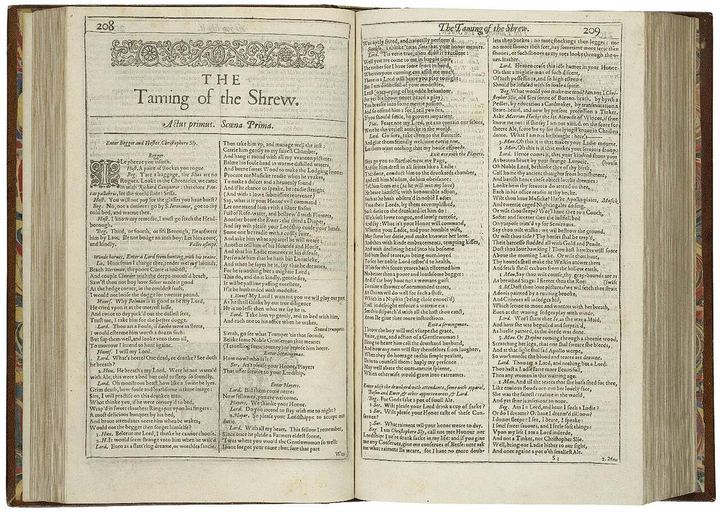

Summary
The Taming of the Shrew is a play within a play. In the Induction, the drunken tinker Christopher Sly is thrown out of an alehouse and falls asleep on the heath. A Lord returning from hunting has him carried to his house, dressed in fine clothes and told that he is a nobleman who has been out of his wits for fifteen years; a page disguised as his wife sits beside him, and travelling players perform a comedy said to be prescribed by his doctors for his melancholy. That comedy is the rest of the play, and Sly is heard from only once more, at the end of the first scene. In Padua, the rich Baptista Minola will not let suitors court his gentle younger daughter, Bianca, until her sharp-tongued elder sister, Katherina, is married. Lucentio, a young student from Pisa, falls in love with Bianca at first sight and changes places with his servant Tranio, disguising himself as Cambio, a schoolmaster, to get into the house; the old suitor Gremio and Petruchio's friend Hortensio, disguised as the music master Licio, compete for her too. Petruchio of Verona arrives, announces that he has come to marry wealthily, and agrees to woo Katherina for her dowry. Their first meeting is a duel of puns; he tells her that he will marry her whatever she says and fixes the wedding for Sunday. He arrives late to the church in ragged clothes on a broken-down horse, behaves outrageously during the service, and carries Kate away before the wedding feast. At his country house he refuses her food on the pretext that the meat is burnt and unwholesome, keeps her awake by complaining of the bed, and sends away the cap and gown made for her, all in the name of loving care. On the road back to Padua he calls the sun the moon, and Kate, giving up the contest, agrees to call it whatever he likes and greets old Vincentio as a budding young maiden at his word. In Padua, Lucentio secretly marries Bianca, Tranio's false Vincentio is exposed when the real father arrives, and all is forgiven. At the wedding feast the three husbands, Petruchio, Lucentio and Hortensio, who has married a wealthy widow, wager on whose wife will come first when called. Bianca and the Widow send excuses; Kate comes at once, fetches the others, and delivers a long speech on a wife's duty to the husband who labours for her, ending with the offer to place her hand beneath his foot. Petruchio kisses her and wins the wager. The play was probably written in the early 1590s and was first printed in the First Folio of 1623.
Virtues in this work
- Temperance: By the road scene of Act 4, Scene 5 Kate has mastered her temper and turns Petruchio's contradictions into a shared joke.
- Humility: Petruchio insists they go to Baptista's in plain clothes in Act 4, Scene 3, holding that honour shows through the meanest habit.
- Justice: Kate's final speech frames marriage as an exchange of duties, the husband's labour and care answered by the wife's love and obedience.
Plot or Argument
- Induction: Christopher Sly
A Lord plays a trick on a drunken tinker, persuading him that he is a nobleman waking from fifteen years of madness. A page plays his wife, and players are brought in to perform a comedy as a cure for his melancholy.
- Act 1: Suitors in Padua
Lucentio arrives to study, falls for Bianca and swaps identities with Tranio. Baptista refuses to marry Bianca before Katherina. Petruchio arrives to marry wealthily, and Hortensio, Gremio and Tranio agree to back his suit of Kate.
- Act 2: The wooing
Kate ties up and strikes Bianca, and breaks a lute over Hortensio's head. Petruchio and Kate trade insults in a rapid duel of wit, and he declares they will be married on Sunday. Tranio, as Lucentio, outbids Gremio for Bianca.
- Act 3: Lessons and a wedding
Lucentio woos Bianca under cover of a Latin lesson and Hortensio under cover of a music lesson. Petruchio arrives late and absurdly dressed, disrupts the ceremony, and carries Kate off before the feast.
- Act 4: The country house and the road
Petruchio denies Kate food and sleep while professing care for her, rejects the tailor's gown, and on the road to Padua insists the sun is the moon until she agrees. Meanwhile Hortensio gives up Bianca for a widow, and Tranio finds a travelling schoolmaster to pose as Vincentio.
- Act 5: Revelations and the wager
The real Vincentio arrives and the disguises collapse; Lucentio and Bianca, secretly married, are forgiven. At the banquet the husbands bet on their wives' obedience, and Kate wins the wager for Petruchio with her speech on a wife's duty.
Characters
- Katherina (Kate), the shrew
Baptista's elder daughter, whose quick, angry tongue has driven off every suitor until Petruchio.
- Petruchio, suitor from Verona
Bold, witty gentleman who sets out to marry for money and to tame Kate by outdoing her temper.
- Bianca, younger daughter
Kate's apparently mild sister, courted by three suitors, who proves less obedient once married.
- Baptista Minola, father
Wealthy gentleman of Padua determined to marry off his elder daughter first.
- Lucentio, Bianca's suitor
Student from Pisa who disguises himself as the schoolmaster Cambio to court Bianca.
- Tranio, Lucentio's servant
Clever servant who impersonates his master and manages the plot to win Bianca.
- Hortensio, Bianca's suitor
Petruchio's friend, disguised as the music teacher Licio, who finally marries a widow.
- Gremio, old suitor
Elderly rich man, called a pantaloon, who bids for Bianca with his wealth.
- Grumio, Petruchio's servant
Comic, put-upon servant who teases the hungry Kate at the country house.
- Vincentio, Lucentio's father
Merchant of Pisa whose arrival in Padua exposes the impostors.
- Christopher Sly, tinker in the Induction
Drunkard tricked into believing he is a lord; the comedy is staged for his benefit.
- The Widow, Hortensio's bride
Wealthy widow who refuses to come when her husband calls in the final scene.
Lessons
The tongue and the heart
Kate's anger is spoken anger: she says her tongue must tell her heart's anger or her heart will break. Petruchio answers words with louder words until she learns to play his game. The play is fascinated by how speech can wound, win and change a person.
- What does Kate mean when she says her heart will break if she keeps her anger in?
- How does the wit-combat of Act 2, Scene 1 show that Kate and Petruchio are well matched?
- Does Kate lose her voice by the end, or find a new use for it?
Inner worth over outward show
Petruchio arrives at his wedding in rags and sends away Kate's fine gown, arguing that the mind makes the body rich and honour shows through mean clothing. The Bianca plot, all disguise and swapped clothes, shows the opposite danger: people taken for what they wear.
- Why does Petruchio insist on going to Baptista's house in plain clothes?
- How many characters in the Bianca plot pretend to be someone else, and what does it cost them?
Marriage as mutual duty
Kate's last speech grounds a wife's obedience in the husband's duty to labour, endure danger and care for her. Whether audiences hear it as sincere, ironic or as a private game between the couple, it sets marriage within an order of reciprocal obligations rather than mere preference.
- What does Kate say a husband owes his wife in her final speech?
- Why do Bianca and the Widow refuse to come when called?
- Is Kate and Petruchio's marriage happier than Lucentio and Bianca's? What is the evidence?
The frame of Christopher Sly
The whole comedy is performed for a drunk who has been persuaded he is a lord. Sly's transformation by clothes and flattery mirrors the play's other changes of identity and reminds the audience that they are watching a story.
- What do Sly and Kate have in common as people whom others set out to change?
- Why might Shakespeare have framed this comedy with a trick played on a beggar?
Context
The play draws on a long European comic tradition of the shrewish wife, found in folk tales and ballads, and on Elizabethan teaching about the household, in which the family was a small commonwealth with the husband at its head and duties binding each member. The homily on matrimony read in English churches and the Book of Common Prayer marriage service both set out the mutual obligations of husband and wife that Kate's final speech echoes.
Composition
The Bianca plot is adapted from George Gascoigne's Supposes (1566), an English version of Ariosto's comedy I Suppositi. A related anonymous play, The Taming of a Shrew, was printed in 1594 and rounds off the Sly frame; scholars still debate whether it was a source, a reported version or a separate adaptation. Shakespeare's play was probably written about 1590-92 and first printed in the First Folio of 1623.
Reception
John Fletcher wrote a sequel, The Woman's Prize, or the Tamer Tamed (c. 1611), in which Petruchio's second wife tames him. David Garrick's short adaptation Catharine and Petruchio (1754) replaced the original on the stage for about a century. Twentieth-century versions include Cole Porter's musical Kiss Me, Kate (1948), Franco Zeffirelli's 1967 film with Elizabeth Taylor and Richard Burton, and the high-school comedy 10 Things I Hate About You (1999).
Comparisons
- much-ado-about-nothing
Beatrice and Benedick's merry war of wit is a later, gentler version of Kate and Petruchio's verbal sparring, ending in marriage without any taming.
- a-midsummer-nights-dream
Both early comedies frame their action with performance: the mechanicals' play before the Athenian court and the players' comedy before Christopher Sly.
- the-merchant-of-venice
Both turn on a father's control of his daughter's marriage, Baptista's rule of the elder first and Portia's father's caskets, and both feature disguise and a wager over wives.
- the-canterbury-tales
Chaucer's Clerk's Tale of patient Griselda, whom Petruchio names in Act 2, and the Wife of Bath's claim to rule in marriage stand on either side of Kate's final speech.
- tales-from-shakespeare
The Lambs' retelling of the play for children omits Christopher Sly and the Induction, presenting the taming plot alone.
Quotes
Frequently cited
“I come to wive it wealthily in Padua; If wealthily, then happily in Padua.”
Frequently cited
“If I be waspish, best beware my sting.”
Frequently cited
“This is a way to kill a wife with kindness”
Frequently cited
“Thy husband is thy lord, thy life, thy keeper, Thy head, thy sovereign; one that cares for thee”
“Seeing too much sadness hath congeal’d your blood, And melancholy is the nurse of frenzy”
“My tongue will tell the anger of my heart, Or else my heart, concealing it, will break”
“For ’tis the mind that makes the body rich; And as the sun breaks through the darkest clouds, So honour peereth in the meanest habit.”
“Then, God be bless’d, it is the blessed sun; But sun it is not when you say it is not, And the moon changes even as your mind.”
For Students
A reading companion for classical Christian high school students. See the student guide.
Reading Guide
Watch for
- The Induction's trick on Christopher Sly in the alehouse and the Lord's bedchamber, and how changing a man's clothes and title is said to change who he is.
- The wooing duel in Act 2, Scene 1, where every insult is caught and returned as a pun.
- Petruchio's soliloquy at the end of Act 4, Scene 1, in which he describes taming Kate in the language of falconry.
- The sun and moon exchange on the road in Act 4, Scene 5, and the change in Kate's tone when she greets Vincentio.
- The wager at the banquet in Act 5, Scene 2, and which wives come when called.
Key terms and names
- Shrew
- A scolding, bad-tempered woman, from the small fierce animal. Katherina is called curst and a shrew by all of Padua before Petruchio arrives.
- Induction
- The two opening scenes in which a Lord tricks the tinker Christopher Sly, turning the rest of the play into a comedy performed for him.
- Supposes
- Gascoigne's 1566 comedy of mistaken identities, the source of the Bianca plot in which Lucentio, Tranio and a false Vincentio pretend to be others.
- Cambio
- The name Lucentio uses while disguised as a schoolmaster; it means change or exchange in Italian, and in Act 5 Lucentio says Cambio is changed into Lucentio.
- Haggard
- A wild-caught adult hawk. In Act 4, Scene 1 Petruchio compares Kate to one that must be starved and kept awake until she comes to her keeper's call.
- Choler
- In humoral medicine, the hot, dry humour of anger. Petruchio throws away the meat claiming that burnt food engenders choler in two people already choleric.
- Grissel
- Patient Griselda of Chaucer's Clerk's Tale, the type of the long-suffering wife. Petruchio promises in Act 2 that Kate will prove a second Grissel.
Seminar Questions
- Comprehension Why will Baptista not allow anyone to court Bianca at the start of Act 1, and how does this rule bring Petruchio into the story?
- Comprehension What does Petruchio do at and after the wedding in Act 3, Scene 2, as Gremio and Tranio report it?
- Comprehension How is the trickery of the Bianca plot exposed in Act 5, Scene 1?
- Interpretation Petruchio says in Act 4, Scene 1 that he will kill a wife with kindness. Is what he does to Kate kindness, cruelty, or something the play cannot easily name?
- Interpretation In Act 4, Scene 5 Kate agrees that the sun is the moon. Is she defeated, or has she discovered that she can enjoy the game she is playing with Petruchio?
- Interpretation Bianca seems the ideal daughter in Act 1 but refuses her husband's call in Act 5. What does the contrast between the sisters suggest about appearance and character?
- Interpretation Why might Shakespeare frame the comedy with Christopher Sly, a beggar persuaded that he is a lord, and then drop him?
- Big Question Kate's last speech grounds obedience in the husband's labour and care. Can authority and love belong to the same marriage, and what does each spouse owe the other?
Faith Connections
- Ephesians 5:21-33 (Scripture)
Paul calls wives to submit to their husbands and husbands to love their wives as Christ loved the church and gave himself for it. Kate's speech in Act 5, Scene 2 echoes the first half; the second half asks what the play shows of Petruchio's love and sacrifice.
- James 3:5-10 (Scripture)
James warns that the tongue is a small member that boasts great things and that no man can tame it. The play's language of taming fixes on Kate's tongue, and her own line in Act 4, Scene 3 claims the right to speak her heart's anger.
- 1 Peter 3:1-7 (Scripture)
Peter prizes the hidden person of the heart over outward adorning and charges husbands to honour their wives as heirs together of the grace of life. Petruchio's rejection of the tailor's gown for the mind that makes the body rich converses with the first part of this passage.
- Chaucer, The Clerk's Tale (Great Conversation)
Chaucer's patient Griselda endures her husband's cruel tests without complaint, and Chaucer's Clerk turns her story into a lesson on patience toward God. Petruchio names her as the model he expects Kate to follow, but Kate's end is lively speech, not silence.
Logic and Rhetoric
Central argument: Kate's anger isolates her and makes her father's household unmanageable. Petruchio meets her temper with a greater show of temper, denying food, sleep and finery while professing care, until she accepts his word even about sun and moon. The surface plot then concludes that a wife flourishes within an order of mutual duty, and Kate's speech wins the wager while the outwardly mild Bianca disobeys. Yet the frame of Sly, the falconry imagery and Kate's evident wit leave the audience to judge whether she has been subdued, has learned self-command, or has joined her husband in a performance.
Rhetorical device: stichomythia. In Act 2, Scene 1 Kate and Petruchio trade single lines at speed, each seizing the other's word and turning it back, as in her line If I be waspish, best beware my sting and his reply that the remedy is to pluck it out.
Debate: Resolved: Kate's final speech in Act 5, Scene 2 is meant sincerely.
Memory Work
For ’tis the mind that makes the body rich; And as the sun breaks through the darkest clouds, So honour peereth in the meanest habit.
My tongue will tell the anger of my heart, Or else my heart, concealing it, will break
Writing Prompts
Essay: Trace Petruchio's methods from the wedding in Act 3, Scene 2 to the road in Act 4, Scene 5, and argue whether the change in Kate is the result of being broken or of learning to match him.
Comparison with Much Ado About Nothing: Kate and Petruchio, like Beatrice and Benedick, begin as sparring wits. Compare how each couple comes to marriage, and argue which play gives the woman's wit the larger part in the outcome.
Medical Lens
The play's medical interest lies in its humoral vocabulary. The Induction offers a small piece of Elizabethan therapeutics: Sly is told he has been lunatic for fifteen years and that his physicians, judging that sadness has congealed his blood and that melancholy nurses frenzy, prescribe a comedy, since mirth was thought to lengthen life. In Act 4 Petruchio withholds roast meat on the ground that burnt meat engenders choler in people who are already choleric, and Grumio teases Kate with dishes he fears are too choleric, a joke that depends on the period's dietary medicine. Petruchio's method of breaking Kate by hunger and wakefulness is borrowed from the falconer's practice of watching a hawk, not from medicine. Sly's drunkenness frames the whole action. Any modern reading of Kate's temper as a disorder would be anachronistic; the play treats it as a humour to be tempered.
- Induction, Scene 2
The Lord's servants persuade Sly that he has been mad for fifteen years, mention his physicians' orders, and announce a comedy as a remedy for melancholy.
- Act 4, Scene 1
Petruchio throws out the supper as burnt meat that engenders choler, then explains in soliloquy his plan to keep Kate hungry and sleepless like an untrained hawk.
- Act 4, Scene 3
Grumio offers the starving Kate one dish after another and withdraws each as too choleric.
Listen to the book
Public-domain audiobook from LibriVox, read by Various volunteers. Recording: Taming of the Shrew (version 2) on LibriVox (Internet Archive).
LibriVox recordings are volunteer readings released into the public domain. The reading may follow a different edition from the text in this library.
Creative Prompts
- Classroom
Stage Kate's final speech in Act 5, Scene 2 three ways, sincere, ironic and as a private joke between Kate and Petruchio, and discuss which the text best supports.
- Essay
Shakespeare never returns to Christopher Sly after Act 1. Argue what is gained or lost by leaving the frame open.
- Dialogue
Write a conversation between Kate and Bianca on the morning after the wager, each judging the other's marriage.
- Fiction
Retell the sun and moon scene of Act 4, Scene 5 from Kate's point of view, showing the moment she decides to play along.
Further Reading
- Much Ado About Nothing, William Shakespeare
- Supposes, George Gascoigne
The 1566 source of the Bianca plot, translated from Ariosto.
- The Woman's Prize, or the Tamer Tamed, John Fletcher
Fletcher's sequel, in which Petruchio is tamed by his second wife.
- Shakespeare's Comedies, Bertrand Evans
Verification notes
Plot, sources (Gascoigne's Supposes; the related 1594 The Taming of a Shrew) and stage history (Fletcher's sequel, Garrick's Catharine and Petruchio, Kiss Me, Kate, the 1967 Zeffirelli film) are standard. Act and scene locators follow the scene headings in the attached Gutenberg text. All eight quotes were found verbatim in content/texts/the-taming-of-the-shrew.txt.
- Date of composition (c. 1590-92 is conventional; some scholars place it as early as 1589 or as late as 1594).
- That Garrick's Catharine and Petruchio held the stage for about a century before the full play returned.