Work record
Peter Pan (Peter and Wendy)
1911 (as Peter and Wendy; play 1904) · Early 20th Century · Novel · English
Abstract
Background. Barrie had already put Peter into an adult novel of 1902 and onto the London stage at Christmas 1904; seven years later he retold the play as prose, adding a running commentary and an epilogue about the heroine's adulthood.
Plot. A boy who will not age loses his shadow in a London nursery, comes back for it, and teaches three siblings to fly to his island. There Wendy keeps house underground for a band of motherless boys, the party survives lagoon, arrows and kidnapping, and a fairy swallows poison meant for Peter. Victory over the pirates on their own deck leads to a flight home, an adoption of six boys, and Peter's solitary return to the island.
Themes. The cost and gift of maturity, the faithfulness of parents, the lure and danger of forgetting, and the line between play and real peril; Hook's anxiety over good form parodies public-school honour.
Form. Seventeen chapters move from nursery comedy through island adventure to a closing chapter that spans generations, all voiced by a teasing adult storyteller who addresses the reader, takes sides, and admits what he does not know about the Darlings and their guests.
Significance. Peter became a byword for refusing adulthood, and Barrie's 1929 gift of the copyright still benefits Great Ormond Street Hospital for Children.
Main characters
- Peter Pan: Flying boy who refuses ever to become a man
- Wendy Darling: London girl who plays mother on the island and later grows up
- John and Michael Darling: Her brothers, who nearly forget their parents
- Tinker Bell: Jealous fairy who gives her life-light for Peter
- Captain Hook: One-handed pirate chief haunted by a clock-swallowing crocodile
- Mr. and Mrs. Darling: Penitent father and patient mother who wait at home
- Nana: Newfoundland dog employed as the children's nurse
- The Lost Boys: Tootles, Nibs, Slightly, Curly and the Twins, Peter's band

Summary
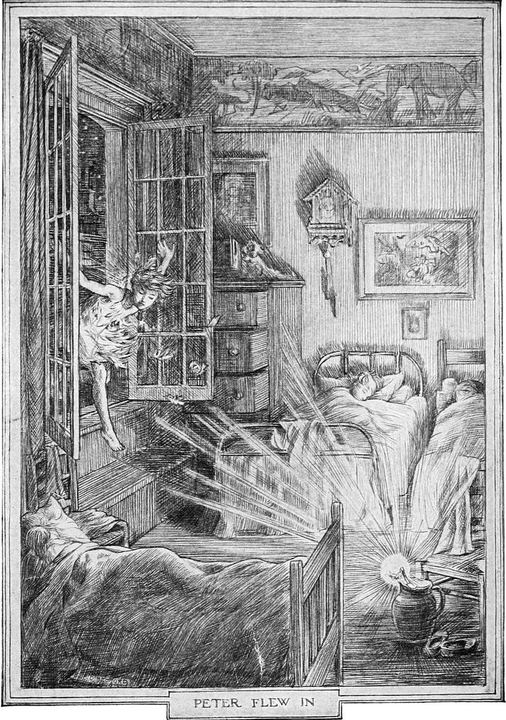
Peter and Wendy, the 1911 novel that grew out of J. M. Barrie's play Peter Pan, opens in the London nursery of the Darling family: Mr. Darling, a clerk anxious about money and dignity; Mrs. Darling, who tidies her children's minds each night; Wendy, John and Michael; and Nana, a Newfoundland dog who serves as their nurse. Mrs. Darling finds the name Peter in her children's thoughts and later sees a strange boy at the nursery window; Nana snaps the window shut on his shadow. One evening Mr. Darling plays a trick with his medicine, pours it into Nana's bowl, and in a temper chains the dog in the yard. With Nana gone, Peter Pan returns for his shadow. Wendy sews it back on, and Peter, who ran away as a baby so that he would never grow up, invites her to the Neverland to be a mother to the Lost Boys and tell them stories. With fairy dust from his jealous fairy, Tinker Bell, the three children fly out of the window: second to the right, and straight on till morning. On the island Tinker Bell tricks the Lost Boy Tootles into shooting Wendy with an arrow; an acorn button Peter gave her as a kiss saves her life, and the boys build a little house around her where she lies. The children settle into the home under the ground, entered through hollow trees. Adventures follow: at the Mermaids' Lagoon Peter saves the princess Tiger Lily from the pirates and is wounded by Captain Hook, whose right hand Peter once cut off and fed to a crocodile that has since swallowed a clock; the Never bird floats her nest to the stranded Peter. Wendy keeps house, doses the boys with medicine and tells them the story of a family whose children flew away, which makes John and Michael realise they are forgetting home. When the children decide to return, the pirates defeat the tribe guarding the house and carry off Wendy and the boys. Hook poisons Peter's medicine, Tinker Bell drinks it to save him, and Peter begs children everywhere to clap if they believe in fairies, which revives her. Peter boards the Jolly Roger, kills pirates one by one in the dark cabin, and duels Hook, who, kicked overboard by Peter at the last, falls into the crocodile's jaws. The children fly home, where Mr. Darling has been living in Nana's kennel in penance, and the Lost Boys are adopted. Peter refuses to stay and grow up. He returns for Wendy's spring cleaning, then forgets; Wendy grows up and marries, and Peter later carries off her daughter Jane, and then Jane's daughter Margaret, so long as children are gay and innocent and heartless. The book was published in 1911 by Hodder and Stoughton in London and Scribner's in New York, with illustrations by F. D. Bedford.
Virtues in this work
- Fortitude: Captured on the Jolly Roger, Wendy refuses Hook's offer and walks toward the plank urging the boys to die like English gentlemen.
- Charity: Tinker Bell, for all her jealousy, drinks the poisoned medicine Hook meant for Peter in order to save his life.
- Humility: Mr. Darling, who had been too proud to take his own medicine, lives in Nana's kennel until the children come home.
- Hope: Mrs. Darling keeps the nursery window open every night her children are gone, trusting they will return.
Plot or Argument
- Chapters I-II: The Darling nursery and the lost shadow
Barrie introduces the Darlings, their dog-nurse Nana, and Mrs. Darling's nightly tidying of her children's minds, where she finds the Neverland and a boy named Peter. Nana catches Peter's shadow in the window. Mr. Darling's medicine trick ends with Nana chained outside on the night the parents dine at Number 27.
- Chapter III: Come away, come away
Peter returns with Tinker Bell to find his shadow, and Wendy sews it on. He tells her how fairies began, explains that he ran away the day he was born, and offers her the post of mother to the Lost Boys. He teaches the children to fly with fairy dust, and they leave through the window.
- Chapters IV-V: The flight and the island come true
The long flight shows Peter's forgetfulness and boastfulness. The narrator surveys the island in motion: the Lost Boys hunting Peter, the pirates under Captain Hook hunting the boys, the tribe of Tiger Lily hunting the pirates, the beasts hunting the tribe, and the ticking crocodile hunting Hook.
- Chapters VI-VII: The little house and the home under the ground
Tinker Bell tells Tootles that Peter wants the Wendy bird shot. The arrow strikes the acorn button Peter gave Wendy, and the boys build a house round her as she lies on the ground. The children are fitted to hollow trees that lead down to a single underground room.
- Chapters VIII-IX: The Mermaids' Lagoon and the Never bird
Peter imitates Hook's voice to free Tiger Lily on Marooners' Rock, fights Hook, and is clawed. Stranded as the tide rises, he feels fear and thinks that to die will be an awfully big adventure; Wendy escapes on Michael's kite and the Never bird gives Peter her nest as a boat.
- Chapters X-XI: The happy home and Wendy's story
The grateful tribe guards the house, and Wendy mothers the boys with mending, meals and medicine. Her bedtime story about the Darling children sends John and Michael's thoughts back home, and Wendy resolves to return, offering to take the Lost Boys. Peter refuses to come.
- Chapters XII-XIII: The children carried off; do you believe in fairies?
The pirates surprise and defeat the guardians, then capture each child as he comes up a tree. Hook creeps down to the sleeping Peter and drops poison into his medicine. Tinker Bell drinks it to save him, and Peter calls on children who believe to clap and keep her alive.
- Chapters XIV-XV: The pirate ship and Hook or me this time
On the Jolly Roger Wendy faces the plank. Peter, ticking like the crocodile, slips aboard, kills pirates in the cabin, frees the boys and fights Hook on deck. Hook, dying with what he thinks is good form, is kicked into the waiting crocodile's mouth.
- Chapters XVI-XVII: The return home and when Wendy grew up
Mr. Darling lives in the kennel until his children return; Peter nearly bars the nursery window but relents at Mrs. Darling's grief. The Lost Boys are adopted, Peter refuses to be caught and made a man, and over the years Wendy grows up while Peter comes for her daughter Jane and later her granddaughter Margaret.
Characters
- Peter Pan, title character
Boy who ran away from his parents as a baby so as never to grow up; brave, forgetful, boastful and charming.
- Wendy Moira Angela Darling, protagonist
Eldest Darling child, who flies to the Neverland to be mother to the Lost Boys and later grows up.
- John and Michael Darling, Wendy's brothers
Her younger brothers; on the island they begin to forget their parents and home.
- Mr. and Mrs. Darling, the parents
A proud, fussy father who later does penance in the dog's kennel, and a loving mother who keeps the window open.
- Nana, the Darlings' nurse
Newfoundland dog who keeps the nursery, catches Peter's shadow, and is chained up the night the children vanish.
- Tinker Bell, Peter's fairy
Small, jealous fairy who plots against Wendy but drinks poison to save Peter.
- Captain James Hook, antagonist
Pirate captain with an iron claw, obsessed with good form and terrified of the ticking crocodile.
- Smee, Hook's boatswain
Oddly lovable pirate who sews at his machine and does not know he is lovable.
- Tootles, Nibs, Slightly, Curly and the Twins, the Lost Boys
Boys who fell out of their prams and came to the Neverland; Tootles shoots Wendy on Tinker Bell's word.
- Tiger Lily, island princess
Proud daughter of the island tribe whom Peter rescues from Marooners' Rock.
- The crocodile, Hook's pursuer
Crocodile that ate Hook's hand, swallowed a clock, and follows him ticking.
- Jane and Margaret, Wendy's descendants
Wendy's daughter and granddaughter, who each fly away with Peter in turn.
Lessons
Growing up is a loss and a gift
Wendy learns at two that she must grow up, and the book ends with her grown, her hair turning white, watching her daughter fly away. Peter never grows up, but he also forgets his friends, his adventures and even Tinker Bell. Barrie lets readers feel the sadness of leaving childhood while showing that only those who grow up can love and remember.
- Peter says he never wants to grow up. What does he miss out on because of that?
- At the end Wendy cannot fly any more. Is she sad, happy, or both?
- What is one good thing about growing up that Peter will never have?
A mother's love keeps the window open
While her children are gone, Mrs. Darling keeps the nursery window open and waits. Wendy's bedtime story about the mother who always left the window open for her children is what calls John and Michael home. The book treats a mother's faithful waiting as stronger than all the magic of the Neverland.
- Why did Mrs. Darling keep the nursery window open every night?
- Peter tells Wendy that his mother barred the window against him. Why do you think the Darling children believed their mother would wait?
- How did Wendy act like a mother to the Lost Boys?
Saying sorry the hard way
Mr. Darling plays a mean trick on Nana and chains her outside, and that night his children fly away. Ashamed, he crawls into Nana's kennel and lives there, even riding to the office in it, until they come home. His penance is comic, but it is real repentance: he takes the blame on himself instead of making excuses.
- What did Mr. Darling do to Nana, and why was it unfair?
- Why did Mr. Darling decide to live in the kennel?
- What is the difference between saying sorry and showing you are sorry?
Courage in danger
On Marooners' Rock Peter is afraid for the first time, yet he stands up straight as the water rises. On the pirate ship Wendy refuses to join the pirates and walks toward the plank telling the boys their mothers hope they will die like English gentlemen. Barrie gives his young heroes real danger and lets them meet it bravely.
- How did Wendy show courage on the Jolly Roger?
- Peter felt afraid on the rock in the lagoon. Does feeling afraid mean someone is not brave?
Context
Peter Pan belongs to the golden age of British children's books that runs from Lewis Carroll's Alice to Kenneth Grahame's The Wind in the Willows. Its London nursery, with a nurse, a father worried about the household accounts, and dinner parties down the street, is an Edwardian middle-class home, and the Neverland gathers up the pirates, island tribes, mermaids and desert islands of the adventure stories Victorian boys read.
Composition
Barrie first wrote of Peter as a baby who lives among the birds and fairies of Kensington Gardens in chapters of his adult novel The Little White Bird (1902), later reissued with Arthur Rackham's pictures as Peter Pan in Kensington Gardens (1906). The play Peter Pan, or the Boy Who Would Not Grow Up opened at the Duke of York's Theatre, London, on 27 December 1904. Barrie turned the story into the novel Peter and Wendy, published in 1911 with illustrations by F. D. Bedford; it adds the narrator's commentary and the final chapter, When Wendy Grew Up, developed from a scene added to the play in 1908. The play script itself was not published until 1928.
Reception
The play was a great success and was revived in London nearly every Christmas for decades, with Peter traditionally played by a woman. The novel, later issued simply as Peter Pan, became one of the best-known children's books in English and the source of many stage, film and animated adaptations. In 1929 Barrie gave the copyright in Peter Pan to Great Ormond Street Hospital for Children, and the hospital has drawn income from it ever since.
Comparisons
- alices-adventures-in-wonderland
Both send a Victorian or Edwardian child out of the ordinary world into a dream country, but Alice is always eager to get back to sense and size, while the Neverland tempts the Darlings to forget home altogether.
- the-wind-in-the-willows
Published three years apart, both are Edwardian books that mix comic adventure with a strong pull toward home; Mole's longing for his burrow in Dulce Domum answers John and Michael's fading memory of the nursery.
- treasure-island
Hook's Jolly Roger borrows openly from Stevenson's pirates, and Barrie's narrator even says Hook was the only man Barbecue (Long John Silver) feared; Jim Hawkins, unlike Peter, comes home older and wiser.
- the-lion-the-witch-and-the-wardrobe
Both take children from a London home into a magic land where they fight a villain and are crowned or praised, but Lewis's children are meant to grow and return, while Peter's island is a place to stop growing.
- winnie-the-pooh
Christopher Robin, like Wendy, must leave an enchanted place of childhood behind; both books end with a gentle farewell that keeps the magic alive for the next child.
Quotes
Frequently cited
“All children, except one, grow up.”
Frequently cited
““Second to the right,” said Peter, “and then straight on till morning.””
Frequently cited
“It was saying, “To die will be an awfully big adventure.””
““You see, Wendy, when the first baby laughed for the first time, its laugh broke into a thousand pieces, and they all went skipping about, and that was the beginning of fairies.””
““If you believe,” he shouted to them, “clap your hands; don’t let Tink die.””
““Proud and insolent youth,” said Hook, “prepare to meet thy doom.””
““I’m youth, I’m joy,” Peter answered at a venture, “I’m a little bird that has broken out of the egg.””
“It is only the gay and innocent and heartless who can fly.”
For Students
A reading companion for classical Christian high school students. See the student guide.
Reading Guide
Watch for
- The nursery window: notice who opens it, who shuts it, and why Peter almost bars it in Chapter XVI.
- Everything Peter forgets, from the children on the flight in Chapter IV to Hook and Tinker Bell in Chapter XVII.
- Medicine bottles and cups. Follow them from Mr. Darling's trick in Chapter II to Hook's poison in Chapter XIII.
- The ticking crocodile. Each time Hook hears it, watch what happens to him.
Key terms and names
- Neverland
- The island Peter lives on. The narrator says every child has a Neverland in his or her mind, and each one is a little different.
- Lost Boys
- Boys who fell out of their prams when their nurses were looking the other way and were sent to the Neverland. Peter is their captain.
- Fairy dust
- The dust from a fairy that lets the Darling children fly, once Peter blows some on them and they think lovely thoughts.
- Jolly Roger
- Captain Hook's pirate ship, anchored in Kidd's Creek, where the final battle takes place.
- Good form
- Behaving the way a well-bred gentleman should. Hook worries about it more than anything, even as he is about to die.
- Marooners' Rock
- A rock in the Mermaids' Lagoon where pirates leave prisoners to drown when the tide comes in. Tiger Lily is tied there.
- Kennel
- Nana's dog-house. Mr. Darling lives in it while the children are gone to show he is sorry.
Seminar Questions
- Comprehension How did Nana catch Peter's shadow, and how did Wendy fix it?
- Comprehension Why did Tootles shoot an arrow at Wendy, and what saved her?
- Comprehension What did Tinker Bell do when she found out the medicine was poisoned?
- Interpretation Peter wants Wendy to be a mother to the Lost Boys, but he does not want a mother himself. Why might that be?
- Interpretation Why do John and Michael start to forget their home on the island, and why does Wendy's story help them remember?
- Interpretation Captain Hook cares so much about good form. Did he behave like a gentleman? Did Peter?
- Big Question If you could stay a child forever like Peter, would you? What would you have to give up?
Faith Connections
- 1 Corinthians 13:11 (Scripture)
Paul writes that when he became a man he put away childish things. Wendy does this in Chapter XVII, while Peter, who never puts them away, also never learns to love or remember well.
- Matthew 18:3 (Scripture)
Jesus says we must become as little children to enter the kingdom. Barrie's book helps show the difference between childlike trust and humility, which Jesus praises, and Peter's childish forgetting and boasting.
- Luke 15:20 (Scripture)
The father in the parable sees his son a great way off and runs to him. Mrs. Darling keeps the window open the same way, and the children's return in Chapter XVI is a homecoming of welcome rather than scolding.
- C. S. Lewis, On Three Ways of Writing for Children (Great Conversation)
Lewis argued that a good children's story is one also enjoyed by adults and that growing up should mean adding new tastes, not losing old ones. Peter and Wendy, with its grown-up narrator, makes a good test case for his claim.
Logic and Rhetoric
Central argument: Everyone except Peter grows up. Growing up means losing the power to fly and the carefree heartlessness of childhood, but it also brings memory, love and the ability to care for others. Peter keeps his childhood only by forgetting everyone he loves. So the book argues that growing up, though sad, is better than staying forever a child.
Rhetorical device: intrusive narrator. Barrie's narrator talks directly to the reader, judging Mrs. Darling, Mr. Darling and Hook and even admitting that Wendy's daughter Jane is now a common grown-up, as in Chapter XVII, where the closing lines about children who are gay and innocent and heartless come in his voice.
Debate: Resolved: Wendy was right to leave the Neverland and go home.
Memory Work
All children, except one, grow up.
“Second to the right,” said Peter, “and then straight on till morning.”
Writing Prompts
Essay: Write about Mr. Darling living in Nana's kennel. Why did he do it, and was it a good way to say he was sorry?
Comparison with Alice's Adventures in Wonderland: Alice falls down a rabbit-hole and Wendy flies out of a window. Compare what each girl finds in her strange land and how each one gets home.
Medical Lens
Medicine runs through the book as a domestic comedy of the Edwardian nursery, where children were dosed from bottles and the father boasts of having taken his own medicine without a murmur. Nana the dog is the nursery nurse, and Wendy's mothering of the Lost Boys includes giving them medicine, which the narrator says she gave too often. Hook's plot turns the household dose into poison: he drops a lethal drug into the cup Wendy left for Peter, and Tinker Bell's drinking it and reviving through the children's belief is the book's death-and-recovery scene. When Wendy is shot, Slightly is sent to fetch a doctor and plays one, a child's imitation of the family doctor's visit. Outside the text, Barrie's 1929 gift of the Peter Pan copyright to Great Ormond Street Hospital for Children is a notable episode in the history of hospital philanthropy.
- Chapter I
The narrator compares a child's mind to the maps doctors draw of other parts of the body, introducing the Neverland as a map of the mind.
- Chapter II
Mr. Darling's medicine trick: he dodges his own dose by pouring it into Nana's bowl, and the quarrel ends with Nana chained outside.
- Chapter VI
After Wendy is shot, Slightly is sent for a doctor and returns in John's hat pretending to be one, taking her temperature with a glass thing.
- Chapter XIII
Hook poisons the medicine cup by Peter's bed; Tinker Bell drinks it, her light fades, and the children's clapping restores her.
Listen to the book
Public-domain audiobook from LibriVox, read by Phil Chenevert. Recording: Peter Pan (Version 5) on LibriVox (Internet Archive).
LibriVox recordings are volunteer readings released into the public domain. The reading may follow a different edition from the text in this library.
Creative Prompts
- Classroom
Draw your own map of the Neverland, the way the narrator describes children's minds in Chapter I, with the lagoon, the home under the ground, Marooners' Rock and the pirate ship marked.
- Fiction
Write the night Mrs. Darling spent waiting by the open window, from Nana's point of view, ending when she hears the children come back.
- Dialogue
Act out the scene in Chapter XI where Wendy tells the Lost Boys her story about the family whose children flew away, and the boys interrupt her with questions.
- Essay
Was Peter happy? Use what he forgets in Chapters IV and XVII and what he refuses in Chapter XVI to decide.
Further Reading
- Peter Pan in Kensington Gardens, J. M. Barrie
The earlier story of the baby Peter in Kensington Gardens, issued in 1906 with Arthur Rackham's illustrations.
- Peter Pan, or the Boy Who Would Not Grow Up, J. M. Barrie
The play, first staged in 1904 and published in 1928.
- J. M. Barrie and the Lost Boys, Andrew Birkin
- The Wind in the Willows, Kenneth Grahame
Verification notes
All quotations were found by grep in content/texts/peter-pan.txt (Project Gutenberg #16, the 1911 Peter and Wendy text); chapter locators follow the chapter headings in that file. Plot details follow the text. Publication facts (The Little White Bird 1902; play opened 27 December 1904 at the Duke of York's Theatre; Peter Pan in Kensington Gardens 1906; Peter and Wendy 1911 with F. D. Bedford's illustrations; play published 1928; Great Ormond Street gift 1929) are standard and well documented.
- That the When Wendy Grew Up scene was first staged in 1908 (as a single performance) before Barrie developed it into the novel's final chapter.
- The publisher names and month of the 1911 first editions (Hodder and Stoughton, London; Charles Scribner's Sons, New York).