Work record
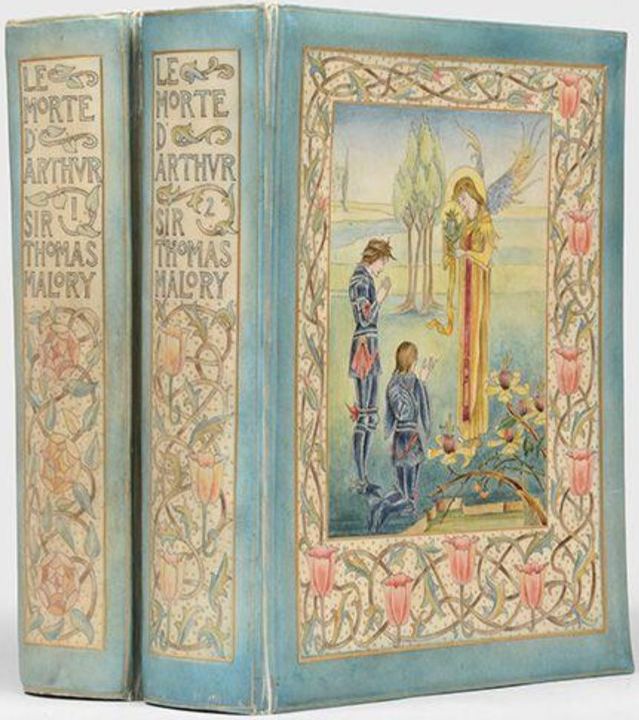
Le Morte d'Arthur
1485 (Caxton; completed c. 1469-70) · Medieval · Epic · English (Middle English, Caxton's 1485 text in modernized spelling)
Abstract
Background. A knight writing amid the Wars of the Roses, Malory condensed thirteenth-century French romances and English Arthurian poems into one English book. Caxton, England's first printer, issued it at Westminster fifteen years later.
Narrative. The cycle runs from Uther's night with Igraine through the founding of Camelot, the conquest of Rome, and long sequences devoted to Gareth, Tristram and Launcelot. At its centre stands the Grail quest, which only Galahad, Percivale and Bors complete. Thereafter the queen's love affair is exposed, two of Gawaine's brothers fall in her rescue, and the realm splits; Mordred's rebellion ends in mutual slaughter, the king's departure for Avilion, and the penitent deaths of the lovers.
Structure. Episodes interlace, with Malory repeatedly leaving one knight to turn to another, citing his French book as authority, and pausing for personal comment on love, fickle subjects and his own captivity.
Themes. Chivalric honour and its oath, divided love and loyalty, sin and grace, and the transience of earthly glory. Healing, whether by leechcraft, enchantment or prayer, recurs throughout the cycle.
Significance. For five centuries English readers have known Arthur chiefly through this book. Tennyson, the Pre-Raphaelites, Twain, Pyle and T. H. White all built on it, and the 1934 Winchester manuscript discovery opened fresh study of Malory's craft.
Main characters
- Arthur: Boy who draws the sword and becomes king of the Round Table
- Launcelot: Peerless knight torn between his king and his queen
- Guenever: Arthur's queen and Launcelot's beloved, finally a nun
- Galahad: Launcelot's son, chaste achiever of the Sangreal
- Gawaine: Arthur's nephew, avenger of his slain brothers
- Mordred: Incestuously begotten son who usurps the throne
- Tristram and Isoud: Cornish knight and the Irish queen he loves
- Merlin: Seer who arranges Arthur's birth and is entombed by Nimue

Summary
Le Morte d'Arthur is Thomas Malory's English prose gathering of the Arthurian legend, from the hero's conception to the death of the last knights of the Round Table. Uther Pendragon, with Merlin's help, begets Arthur on Igraine, and the child is raised secretly by Sir Ector. After Uther's death a sword appears in a stone in a London churchyard, and only the boy Arthur can draw it. He wins his throne against rebel kings, receives Excalibur from the Lady of the Lake, unknowingly begets Mordred on his half-sister, and marries Guenever, who brings the Round Table as her dowry. The knights swear each Pentecost to show mercy, flee treason and succour ladies. Early books follow Balin's tragic Dolorous Stroke, Merlin's entrapment by Nimue, Morgan le Fay's plot to kill Arthur with his own sword, and Arthur's war against the Roman emperor Lucius, which ends with his crowning in Rome. Then come the adventures of Sir Launcelot du Lake, greatest of the knights, and of the kitchen knight Gareth, called Beaumains, who earns his knighthood in silence while a scornful damsel mocks him. The long central section tells of Sir Tristram, his love for La Beale Isoud and his enmity with her husband King Mark of Cornwall. Launcelot is tricked into begetting Galahad on Elaine, the daughter of King Pelles, and runs mad for years after Guenever's anger, until the Holy Grail heals him. The Grail appears at Camelot at Pentecost, covered in white samite, and the knights vow to seek it. Most fail; Launcelot sees it only in part because of his sin, while Galahad, Percivale and Bors achieve the quest, and Galahad dies in ecstasy at Sarras. Back at court, Launcelot's love for the queen grows open. He defends her when she is accused of poisoning a knight, is loved unto death by Elaine of Astolat, rescues Guenever from Meliagaunt, and heals the wounded Sir Urre by prayer. Agravaine and Mordred expose the lovers; in rescuing the queen from the fire Launcelot unknowingly kills Gareth and Gaheris, and Gawaine's grief turns Arthur against his greatest friend. While Arthur besieges Launcelot in France, Mordred seizes the kingdom. At the last battle on Salisbury Plain Arthur kills Mordred and is mortally wounded; Bedivere throws Excalibur into the water, and ladies bear the king away by barge to Avilion. Guenever becomes a nun, Launcelot a priest, and both die in penitence. Malory finished the work in 1469-70; William Caxton printed it at Westminster on 31 July 1485, dividing it into twenty-one books.
Virtues in this work
- Humility: Gareth serves a year in Arthur's kitchen as Beaumains and bears the damsel Linet's insults without complaint before revealing his birth.
- Piety: Galahad asks God to let him die once he has seen the mysteries of the Grail at Sarras.
- Friendship: Arthur grieves more for the broken fellowship of his knights than for the loss of his queen in Book XX.
- Charity: Launcelot prays over the wounded Sir Urre, asking that the healing be God's work and not his own.
- Honor: The knights renew each Pentecost their oath to give mercy, flee treason and never fight in a wrongful quarrel.
Plot or Argument
- Books I-II: The making of a king
Arthur's begetting, the sword in the stone, his wars against the rebel kings, Excalibur and the begetting of Mordred; then the tale of Balin, the knight with two swords, whose Dolorous Stroke wounds King Pellam and who, failing to recognize his brother Balan, fights him until both are slain.
- Books III-V: The Round Table and the Roman war
Arthur marries Guenever and founds the fellowship with its Pentecostal oath. Merlin is sealed under a stone by Nimue, Morgan le Fay plots against Arthur through Accolon, and Arthur defeats the Emperor Lucius and is crowned in Rome.
- Books VI-VII: Launcelot and Gareth
Launcelot rides out on adventures and proves the best knight in the world. Gareth serves a year in Arthur's kitchen as Beaumains, endures the scorn of the damsel Linet, and rescues her sister Lyonesse.
- Books VIII-X: Sir Tristram
Tristram kills Marhaus, is healed of a poisoned wound by La Beale Isoud, loves her though she marries King Mark, and becomes a knight of the Round Table, at odds with Mark's treachery throughout.
- Books XI-XII: Elaine, Galahad and Launcelot's madness
Enchantment brings Launcelot to Elaine of Corbin and Galahad is born. Driven out by Guenever's jealousy, Launcelot runs mad in the forest until he is healed by the Sangreal at Pelles's castle.
- Books XIII-XVII: The quest of the Holy Grail
Galahad sits in the Siege Perilous and the Grail visits Camelot. The knights depart; Gawaine and many others fail, Launcelot is shown his sin, and Galahad, Percivale and Bors reach Sarras, where Galahad sees the mysteries and dies.
- Books XVIII-XIX: The queen's knight
Launcelot defends Guenever against a charge of poisoning, Elaine of Astolat dies of love for him and her body comes by barge to Westminster, Meliagaunt abducts the queen, and Launcelot heals Sir Urre.
- Book XX: The breaking of the fellowship
Agravaine and Mordred trap the lovers. Launcelot rescues the queen from burning and kills Gareth and Gaheris unawares; Gawaine demands vengeance, and Arthur besieges Launcelot first at Joyous Gard and then in France.
- Book XXI: The death of Arthur
Mordred usurps the throne. Gawaine dies of his wound after writing to Launcelot, Arthur and Mordred kill each other at the last battle, Excalibur returns to the water, and Arthur goes to Avilion. Guenever and Launcelot end their lives in religion, and Ector laments over Launcelot's body.
Characters
- King Arthur, King of Britain
The boy who draws the sword from the stone and becomes head of the noblest fellowship in Christendom, undone at last by treason within his own house.
- Sir Launcelot du Lake, greatest of the knights
Matchless in arms and courtesy, Arthur's dearest knight and Guenever's lover, whose divided loyalty brings down the Round Table.
- Queen Guenever, Arthur's queen
A proud, passionate queen who loves Launcelot and ends her days as a nun at Almesbury.
- Sir Gawaine, Arthur's nephew
A fierce, loyal knight whose grief for his brothers turns into implacable vengeance against Launcelot.
- Sir Mordred, Arthur's son by his half-sister
The traitor who exposes the queen, seizes the kingdom and gives Arthur his death wound.
- Sir Galahad, Launcelot's son, the Grail knight
The pure knight who sits in the Siege Perilous and achieves the Holy Grail.
- Sir Tristram, knight of Cornwall
A great hunter, harper and warrior who loves La Beale Isoud, wife of his uncle King Mark.
- Merlin, prophet and enchanter
Arthur's counsellor, who arranges his birth and foretells his doom before Nimue imprisons him.
- Morgan le Fay, Arthur's half-sister
An enchantress who plots against Arthur yet is among the queens who bear him to Avilion.
- Sir Gareth (Beaumains), Gawaine's youngest brother
A humble, patient knight who serves in the kitchen before proving himself, and dies by Launcelot's hand unawares.
- Sir Bedivere, Arthur's last knight
The knight who returns Excalibur to the water and sees the king carried away.
- Sir Ector de Maris, Launcelot's brother
The knight who speaks the great lament over Launcelot's body.
Lessons
An oath that measures every knight
In Book III Arthur makes his knights swear never to commit murder or treason, to give mercy to those who ask it, to succour women, and never to fight in a wrongful quarrel for gain. The rest of the book tests every knight against that oath, and the Round Table falls when private loyalties outweigh it.
- Which parts of the Pentecostal oath are hardest for the knights to keep?
- Who keeps the oath best in the book, and who breaks it most gravely?
- Why does Arthur renew the oath every year at Pentecost?
The best knight of the world and the holiest
Launcelot is the finest knight in courtesy and arms, but on the Grail quest he learns that worldly prowess cannot reach the holy vessel while he clings to his sin. Galahad, his son, achieves what his father cannot. Malory honors both kinds of knighthood while ranking holiness above glory.
- Why is Launcelot allowed only a partial vision of the Grail?
- What makes Galahad worthy to achieve the quest?
- Is Launcelot's healing of Sir Urre in Book XIX a sign of grace or of his reputation?
Divided loyalties
Launcelot loves Arthur and loves the queen; Gawaine loves Arthur and loves his brothers; Arthur loves his queen and his fellowship. In Book XX each is forced to choose, and Arthur's lament that queens could be replaced but such a fellowship never could shows what is being lost.
- Whose choice does the most to destroy the Round Table: Launcelot's, Gawaine's, Agravaine's or Arthur's?
- Why does Arthur grieve more for his knights than for his queen?
- Could the fellowship have been saved after Gareth's death?
Penitence at the end
After the last battle Guenever becomes a nun and Launcelot a priest, and both die doing penance. Malory gives the great lovers not a tragic triumph but a turning to God, and the book ends with the author himself asking his readers' prayers.
- Why does Guenever refuse to kiss Launcelot one last time at Almesbury?
- What does Ector's lament praise in Launcelot, and what does it leave out?
- How does Malory's own closing prayer change the way the book ends?
Context
Malory wrote during the Wars of the Roses, when English knights and nobles were fighting one another for the crown, and his complaint in Book XXI about the fickleness of Englishmen, who deserted Arthur for Mordred, reads naturally against that background. Chivalry and the Round Table were already old ideals; Edward IV and other princes still staged tournaments and founded orders of knighthood in their image. Malory drew mainly on the French prose romances of the thirteenth century, the Vulgate and the prose Tristan, and on English poems, especially the alliterative and stanzaic Morte Arthure poems, compressing and reshaping them into a single English book.
Composition
Malory's closing words say that the book was ended in the ninth year of Edward IV (1469-70). Caxton printed it at Westminster, finishing on 31 July 1485, and explains in his preface that gentlemen of England urged him to print the history of Arthur; he divided the text into twenty-one books and wrote the chapter headings. In 1934 a manuscript was found at Winchester College that preserves Malory's work in a somewhat different form, without Caxton's divisions and with a fuller version of the Roman war. The library text is A. W. Pollard's edition of Caxton's text in modernized spelling (Macmillan, 1900), joined from Project Gutenberg's two volumes.
Reception
Caxton's edition was reprinted by Wynkyn de Worde and others into the seventeenth century, and the book became the standard English source for the Arthurian legend. After a period of neglect it was revived by editions of 1816-17 and inspired Tennyson's Idylls of the King, the Pre-Raphaelite painters, Mark Twain's satire A Connecticut Yankee in King Arthur's Court, Howard Pyle's retellings for young readers, and T. H. White's The Once and Future King. Eugène Vinaver's edition of the Winchester text (1947) renewed scholarly interest in Malory's own shaping of his sources.
Comparisons
- the-story-of-king-arthur-and-his-knights
Pyle's illustrated retelling for young readers draws on Malory for the sword in the stone, Excalibur and the early adventures, but softens the adultery and the tragic ending that dominate Malory's last books.
- sir-gawain-and-the-green-knight
The fourteenth-century poem shows Gawaine as a courteous, chaste knight tested by temptation, very different from Malory's vengeful Gawaine of Book XX.
- the-sword-in-the-stone
T. H. White reimagines Arthur's boyhood under Merlin, which Malory passes over in a sentence, and leads up to the drawing of the sword in Book I.
- the-faerie-queene
Spenser's Redcrosse Knight in Book I is an allegory of holiness built on the Arthurian romance tradition; his quest and his falls invite comparison with Galahad's purity and Launcelot's failure.
- ivanhoe
Scott's romance looks back at the code Malory's knights swear at Pentecost, setting a wounded knight's praise of chivalry against Rebecca's doubts about martial glory.
- don-quixote
Cervantes's hero is driven mad by reading romances of chivalry like those Malory used; reading the two together shows both the grandeur of the knightly ideal and its comedy.
Quotes
Frequently cited
“Do after the good and leave the evil, and it shall bring you to good fame and renown.”
Frequently cited
“Whoso pulleth out this sword of this stone and anvil, is rightwise king born of all England.”
Frequently cited
“never to do outrageousity nor murder, and always to flee treason; also, by no means to be cruel, but to give mercy unto him that asketh mercy”
Frequently cited
“Then there entered into the hall the Holy Grail covered with white samite, but there was none might see it, nor who bare it.”
Frequently cited
“for queens I might have enow, but such a fellowship of good knights shall never be together in no company.”
Frequently cited
“Hic jacet Arthurus, Rex quondam, Rexque futurus.”
Frequently cited
“thou were the courteoust knight that ever bare shield. And thou were the truest friend to thy lover that ever bestrad horse.”
“Now, blessed Lord, would I not longer live, if it might please thee, Lord.”
For Students
A reading companion for classical Christian high school students. See the student guide.
Reading Guide
Watch for
- The Pentecostal oath at the end of Book III, and which knights later keep or break each part of it.
- Launcelot's double role as the best knight of the world and as the queen's lover, especially in Books XIII-XVII and XX.
- Gareth's year in the kitchen in Book VII and how his humility contrasts with other knights' pride.
- Malory's own interruptions, such as his reflection on love in May in Book XVIII and his complaint against fickle Englishmen in Book XXI.
- The return of Excalibur to the water and the barge to Avilion in Book XXI.
Key terms and names
- Round Table
- The table Guenever brings as her dowry and the fellowship of knights who sit at it, bound by the oath sworn each Pentecost.
- Sangreal
- Malory's name for the Holy Grail, the vessel of the Last Supper, whose quest occupies Books XIII-XVII.
- Siege Perilous
- The seat at the Round Table that destroys any unworthy knight who sits in it, until Galahad takes it.
- Worship
- In Malory's English, honour and good name won by deeds; knights fear above all to lose their worship.
- Excalibur
- Arthur's sword from the Lady of the Lake, whose scabbard protects its bearer from bleeding; Bedivere returns it to the water.
- Avilion
- The island to which the wounded Arthur is carried by queens in a barge, to be healed of his grievous wound.
- Leech
- A physician or surgeon; Malory's knights have leeches search their wounds after every combat.
- Dolorous Stroke
- Balin's blow against King Pellam with a sacred spear in Book II, which lays waste the surrounding lands.
Seminar Questions
- Comprehension How does Arthur prove that he is the rightful king, and why do some lords refuse to accept him?
- Comprehension What is the Pentecostal oath, and when do the knights renew it?
- Comprehension How do Gareth and Gaheris die, and why does their death turn Gawaine against Launcelot?
- Interpretation Why does Launcelot, the best knight of the world, fail to achieve the Grail when his son succeeds?
- Interpretation Why does Malory say that Arthur grieves more for his lost knights than for his queen?
- Interpretation Why does Malory refuse to say for certain whether Arthur died or will come again?
- Big Question Can a fellowship founded on high ideals survive the private loves and loyalties of its members?
- Big Question Is earthly glory a help or a hindrance on the way to holiness?
Faith Connections
- Matthew 5:8 (Scripture)
Blessed are the pure in heart, for they shall see God. Galahad, the pure knight, sees the mysteries of the Grail openly at Sarras, while Launcelot sees only in part.
- 2 Samuel 1:19-27 (Scripture)
David's lament for Saul and Jonathan, how are the mighty fallen, is the biblical model for Ector's great lament over Launcelot in Book XXI.
- Micah 6:8 (Scripture)
To do justly, love mercy and walk humbly with God sums up the Pentecostal oath of Book III, with its charge to give mercy to all who ask.
- Augustine, City of God XIV.28 (Church Fathers)
Augustine says two loves made two cities, love of self and love of God. Malory's Round Table is torn between earthly love and glory on one side and the call of the Grail on the other.
Logic and Rhetoric
Central argument: A fellowship of knights bound by an oath of mercy and loyalty can make a realm noble; but its strength depends on the faithfulness of its members, and private loves, vengeance and treason will break it. Therefore earthly chivalry, however glorious, must finally give way to penitence and the love of God, as Launcelot and Guenever learn at the end.
Rhetorical device: anaphora. Ector's lament over Launcelot in Book XXI, Ch. XIII repeats the opening And thou were in line after line, praising his courtesy, faithfulness and meekness.
Debate: Resolved: that Launcelot, not Mordred, bears the greater blame for the fall of the Round Table.
Memory Work
never to do outrageousity nor murder, and always to flee treason; also, by no means to be cruel, but to give mercy unto him that asketh mercy
thou were the courteoust knight that ever bare shield. And thou were the truest friend to thy lover that ever bestrad horse.
Writing Prompts
Essay: Trace the Pentecostal oath of Book III through the fall of the Round Table in Books XX-XXI. Argue which broken promise does the most damage and why.
Comparison with Sir Gawain and the Green Knight: Compare the Gawaine of Sir Gawain and the Green Knight with Malory's Gawaine in Book XX. What virtue does each version emphasize or lack, and why might the two authors have portrayed him so differently?
Medical Lens
Wounds and their treatment fill the book. Leeches and surgeons search wounds after every battle; a fragment of Tristram's sword lodged in Marhaus's head cannot be removed by any surgeon and kills him, while Tristram's own wound from an envenomed spear defies every leech until La Beale Isoud, described as a noble surgeon, finds the poison and heals him. A queen is accused of poisoning a knight with an apple in Book XVIII. The book also contains two long episodes of madness: Tristram's in Book IX and Launcelot's in Books XI-XII, where, after Guenever's anger, he runs wild in the woods for years and is restored by the Sangreal. Malory's aside on Tristram's sickness in prison, the greatest pain a prisoner may have, has often been read as drawn from his own captivity. Healing by holiness is a recurring motif, from the Grail's cures to Launcelot's prayer over Sir Urre, whose wounds were cursed never to close until searched by the best knight of the world. These episodes reflect late medieval wound surgery and belief in miraculous healing; modern readings of Launcelot's madness as a depressive or psychotic episode should be offered only as interpretations.
- Book VIII, Chs. VIII-IX
Marhaus dies of a sword fragment no surgeon can remove; Tristram's poisoned spear wound is healed by Isoud, a noble surgeon, in Ireland.
- Book IX, Ch. XXXVI
Malory's reflection on sickness as the greatest pain a prisoner may have, as Tristram nearly kills himself in despair.
- Book XI, Ch. X - Book XII, Ch. IV
Launcelot, out of his mind, wanders the forest and is finally recognized by Elaine and healed by the Sangreal.
- Book XIX, Chs. X-XII
Sir Urre's enchanted wounds are searched by a hundred and ten knights in vain and healed when Launcelot prays over them, after which Launcelot weeps like a beaten child.
- Book XXI, Ch. V
The mortally wounded Arthur is borne away by barge, saying he goes to Avilion to heal him of his grievous wound.
Creative Prompts
- Classroom
Hold a council of the Round Table after Gareth's death, with students arguing as Arthur, Gawaine, Launcelot and Bors about what should be done.
- Essay
Who is the true hero of Le Morte d'Arthur: Arthur, Launcelot or Galahad? Argue from at least three books.
- Poetry
Write an elegy for a fallen friend modeled on Ector's lament for Launcelot, with each line beginning in the same way.
- Fiction
Retell the return of Excalibur from Bedivere's point of view, including the two times he hides the sword.
Further Reading
- Idylls of the King, Alfred, Lord Tennyson
Victorian verse retelling drawn largely from Malory.
- The Once and Future King, T. H. White
- A Connecticut Yankee in King Arthur's Court, Mark Twain
- The Discarded Image, C. S. Lewis
Lewis's introduction to the medieval picture of the world.
- The Works of Sir Thomas Malory, Eugène Vinaver (ed.)
Edition based on the Winchester manuscript.
Verification notes
Book and chapter locators follow Caxton's divisions as printed in the attached text (A. W. Pollard's edition, joined from Gutenberg #1251 and #1252); the Pollard edition's 1900 Macmillan date was confirmed through library catalogue records. Episode details for the healing of Tristram, Marhaus's death, Launcelot's madness, the Grail's appearance, Sir Urre and the last battle were checked in the text. The Winchester manuscript discovery (1934) and Vinaver's edition (1947) are standard facts of Malory scholarship. Quotes were checked against the attached text; the Latin tomb inscription is printed in italics in the source.
- The identification of the author with Sir Thomas Malory of Newbold Revel is the scholarly consensus but not certain.