Work record
Tear Down This Wall (Brandenburg Gate Address)
1987 · Postwar Contemporary · Oratory · English
Abstract
Background. Twenty-six years after East Germany sealed the sector border, the American president came to the divided city during its 750th anniversary. Gorbachev's openness campaign had raised Western hopes, and senior advisers wanted no direct demand made of him.
Content. Speaking with the barrier at his back, Reagan reaches across it to East Germans who could hear him only by radio or television. He traces West Berlin's recovery from 1945 through American aid and German enterprise, and contrasts its abundance with the shortages of the Soviet bloc. Testing whether Moscow's new policy is genuine, he calls on its leader to prove it at this very gate. He then backs NATO's missile stance, outlines arms talks, and offers ideas for linking the two halves of the city through flights, conferences, exchanges, and sport.
Themes. Liberty as the source of wealth and peace, sincerity proved by deeds, strength as the path to negotiation, and the endurance of love and religious faith under an atheist regime.
Significance. Little remarked at the time, the challenge seemed prophetic when crossings opened in November 1989. Six months after the address, Washington and Moscow signed a treaty abolishing intermediate-range missiles. It remains the defining phrase of Reagan's presidency and an emblem of the Cold War's peaceful end in Europe.
Key figures
- Ronald Reagan: 40th President of the United States, the speaker
- Mikhail Gorbachev: General Secretary of the Soviet Communist Party, challenged to open the gate
- Helmut Kohl and Eberhard Diepgen: West German Chancellor and Governing Mayor of West Berlin, greeted on the platform
- The people of Berlin, East and West: The crowd before the gate and the listeners beyond the wall
- John F. Kennedy and George Marshall: Earlier American statesmen whose words about Berlin and Europe Reagan recalls

Summary
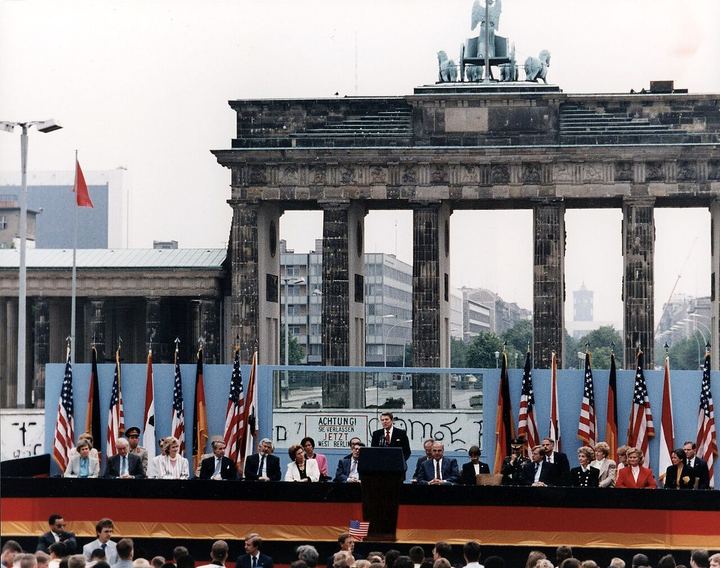
On 12 June 1987 President Ronald Reagan spoke in front of the Brandenburg Gate in West Berlin, with the Berlin Wall and the closed gate directly behind his platform. The city was marking its 750th anniversary, and Reagan, on his second visit, addressed Chancellor Helmut Kohl, Governing Mayor Eberhard Diepgen, and a large crowd, while also speaking by broadcast to listeners in East Berlin and Eastern Europe. The speech, drafted by the White House speechwriter Peter Robinson, runs to about 2,700 words. It opens with Kennedy's 1963 visit and a line from a Berlin song, declares in German that there is only one Berlin, and describes the wall as a gash of barbed wire and concrete and a scar across the city. Reagan then recounts the Marshall Plan and West Germany's economic miracle, setting West Berlin's rebuilt prosperity against Khrushchev's boast that communism would bury the West, and concludes that freedom is the victor. Turning to Mikhail Gorbachev's new talk of reform and openness, he asks whether it marks real change or token gestures, and proposes one unmistakable sign: Mr. Gorbachev, open this gate, tear down this wall. The second half defends the Western alliance's firmness on missiles, which had brought the Soviets back to arms talks, and offers practical proposals for Berlin: air links, international conferences, youth exchanges, and Olympic Games held in both halves of the city. The close turns inward. Reagan says that what keeps Berliners in their besieged city is love, describes the sunlight forming a cross on the East Berlin television tower, and reads graffiti on the wall predicting its fall. State Department and National Security Council officials had urged that the challenge to Gorbachev be softened or cut; Reagan kept it. The speech drew modest notice at first, but after the wall was opened on 9 November 1989 its central line became one of the most quoted sentences of the Cold War.
Virtues in this work
- Fortitude: Reagan delivered the direct challenge to Gorbachev at the wall itself, against the advice of officials who wanted it removed.
- Prudence: He tests Soviet reform by a concrete deed instead of words, and pairs the challenge with practical proposals for arms reduction and for opening the city.
- Hope: The speech reads the graffiti on the wall as a promise and declares that across Europe this wall will fall.
- Charity: Reagan names love as what keeps Berliners in their encircled city and speaks warmly to those behind the wall whom he cannot reach.
Plot or Argument
- Greeting and the one Berlin
Reagan greets Kohl, Diepgen, and the crowd, recalls Kennedy's visit twenty-four years earlier, quotes a Berlin song about a suitcase left in the city, and addresses listeners in the East directly, joining them in the belief that there is only one Berlin.
- The wall as a scar
He describes the barriers dividing Europe from the Baltic southward, calls the wall an instrument of a totalitarian state, and answers President von Weizsäcker's saying about the closed gate by widening it into the question of freedom for all mankind.
- Rebuilding in freedom
He recalls the ruins of 1945, the Marshall Plan, and the Wirtschaftswunder, describes West Berlin's industry, universities, and shops, sets them beside Khrushchev's boast and the failures of the Communist world, and concludes that freedom leads to prosperity and peace.
- The challenge to Gorbachev
Weighing the Soviet talk of reform and openness, he asks whether it is profound change or token gesture and names the one unmistakable sign: Gorbachev should come to the gate, open it, and tear down the wall.
- Strength, arms, and proposals for Berlin
He defends the alliance's missile counterdeployment, which brought the Soviets back to negotiate, describes proposals to eliminate a whole class of nuclear weapons, and offers concrete steps for the city: air access, international meetings, youth exchanges, and shared Olympic Games.
- Love, the cross, and the wall's fall
He says Berliners stay out of love, contrasts the totalitarian suppression of creation and worship with the cross of sunlight on the East Berlin television tower, reads graffiti foretelling the wall's fall, and ends with a word to the demonstrators and a blessing.
Key claims
The main steps of the argument, in order, and how they fit together.
- There is only one Berlin, and the wall is a scar imposed on the city by a totalitarian state.How it is supported: Appeal to Kennedy's visit, a Berlin song, and the image of barbed wire and concrete across the city.
- Postwar history shows that freedom produces prosperity and peace while the Communist world produces backwardness.How it is supported: The Marshall Plan and West Germany's economic miracle contrasted with Soviet bloc shortages and Khrushchev's boast.
- Soviet talk of reform and openness must be tested by deeds rather than accepted on words alone.How it is supported: Reasoning that token gestures cannot be mistaken for profound change.
- Opening the Brandenburg Gate and tearing down the wall would be the one unmistakable sign of real Soviet change.How it is supported: Direct appeal to Mikhail Gorbachev to come to the gate.
- Western strength, not weakness, is what brought the Soviets back to the negotiating table on arms.How it is supported: The alliance's missile counterdeployment and proposals to eliminate a whole class of nuclear weapons.
- The West should offer practical steps to open Berlin and join its two halves.How it is supported: Proposals for air links, international conferences, youth exchanges and shared Olympic Games.
- The love and faith of free people will outlast the wall, which cannot withstand truth.How it is supported: The cross of sunlight on the East Berlin television tower and graffiti foretelling the wall's fall.
Argument map
Supported by
- 2Postwar history shows that freedom produces prosperity and peace while the Communist world produces backwardness.
which rests on
- 1There is only one Berlin, and the wall is a scar imposed on the city by a totalitarian state.
- 4Opening the Brandenburg Gate and tearing down the wall would be the one unmistakable sign of real Soviet change.
which rests on
- 3Soviet talk of reform and openness must be tested by deeds rather than accepted on words alone.
- 5Western strength, not weakness, is what brought the Soviets back to the negotiating table on arms.
which rests on
- 6The West should offer practical steps to open Berlin and join its two halves.
- 7The love and faith of free people will outlast the wall, which cannot withstand truth.
Therefore
Plain-language summaries of the author's argument, not quotations.
Lessons
Naming the test of sincerity
Reagan does not dismiss Gorbachev's reforms or simply praise them. He lists what has changed, asks whether the changes are real or cosmetic, and then names a single public act that would settle the question. The method teaches that claims of reform are best judged by a concrete deed that cannot be faked.
- What evidence of Soviet change does Reagan list before he issues his challenge?
- Why is opening the gate a better test than any statement Gorbachev could make?
- When someone says they have changed, what kind of deed would show that they mean it?
A wall as an argument
The speech uses the wall standing behind the speaker as its chief piece of evidence. A government that must fence its own citizens in has already answered the question of which system people prefer, and Reagan lets the concrete, the guard towers, and the closed gate make that case before he draws the conclusion that freedom is the victor.
- Why does Reagan call the wall a scar rather than simply a border?
- What does it mean that the wall was built to keep people in rather than to keep enemies out?
- How does the physical setting of a speech strengthen or weaken what is said?
What keeps a people going
Near the end Reagan asks why West Berliners stay in a city surrounded by a hostile state and answers that it is not stubbornness or sentiment but love. He then links that love to worship, pointing to the cross the sun makes on the atheist state's television tower. The speech locates the strength of a free people in their affections and their faith, not only in their economy or their arms.
- What reasons for staying in Berlin does Reagan consider and set aside before he names love?
- Why does he move from love to worship in the next paragraph?
- Can love for a place be a political virtue, and what would it require of citizens?
Context
After 1945 Berlin was divided into four sectors under American, British, French, and Soviet control, deep inside the Soviet zone that became the German Democratic Republic. West Berlin survived the Soviet blockade of 1948-49 through the Allied airlift. To halt the flight of East Germans to the West, the East German government sealed the sector boundary on 13 August 1961 and built the Berlin Wall, which by the 1980s was a fortified system of concrete walls, a death strip, watchtowers, and guard dogs. Kennedy spoke in West Berlin in June 1963. By 1987 Mikhail Gorbachev, Soviet leader since 1985, was promoting glasnost (openness) and perestroika (restructuring), and the United States and the Soviet Union were negotiating over intermediate-range nuclear missiles in Europe.
Composition
Peter Robinson of the White House speechwriting staff drafted the speech after visiting Berlin in the spring of 1987, where West Berliners told him that if Gorbachev were serious about reform he could get rid of the wall. Officials at the State Department and the National Security Council objected repeatedly to the demand that Gorbachev tear down the wall as provocative and unrealistic and proposed softer wording. Reagan read the drafts, told his staff he wanted the line kept, and delivered it. The speech was given on 12 June 1987 from a platform at the gate, and the stored text is the version printed in the Public Papers of the Presidents, which includes Reagan's closing remark about demonstrators.
Reception
The speech was well received by the crowd but drew only moderate attention in the press at the time, and Soviet sources dismissed it. In December 1987 Reagan and Gorbachev signed the Intermediate-Range Nuclear Forces Treaty, eliminating the class of weapons mentioned in the speech. When East Germany opened the border crossings on 9 November 1989 and Berliners began breaking pieces off the wall, the Brandenburg Gate address was recalled as a prophecy, and the phrase tear down this wall became the best-known line of Reagan's presidency.
Comparisons
- kennedy-inaugural-address
Reagan opens by recalling Kennedy's 1963 visit to Berlin; Kennedy's inaugural had pledged to pay any price for the survival of liberty, and Reagan's address, a generation later, presses that same Cold War commitment at the wall itself.
- house-divided-speech
Lincoln argued that a nation could not endure half slave and half free; Reagan stands at the line dividing a city and a continent and argues that freedom and its denial cannot share Europe forever.
- challenger-disaster-address
Both are Reagan speeches remembered for a single phrase, but the Challenger address consoles a grieving nation from the Oval Office while the Berlin address challenges a rival power in the open air.
- alone-in-berlin
Fallada's novel shows ordinary Berliners quietly resisting the Nazi state with handwritten cards; Reagan, in the same city under a later dictatorship next door, reads aloud a young Berliner's spray-painted words that the wall will fall.
Quotes
Frequently cited
“General Secretary Gorbachev, if you seek peace, if you seek prosperity for the Soviet Union and Eastern Europe, if you seek liberalization: Come here to this gate! Mr. Gorbachev, open this gate! Mr. Gorbachev, tear down this wall!”
Frequently cited
“Yes, across Europe, this wall will fall. For it cannot withstand faith; it cannot withstand truth. The wall cannot withstand freedom.”
“For I join you, as I join your fellow countrymen in the West, in this firm, this unalterable belief: Es gibt nur ein Berlin.”
“Standing before the Brandenburg Gate, every man is a German, separated from his fellow men. Every man is a Berliner, forced to look upon a scar.”
“Freedom leads to prosperity. Freedom replaces the ancient hatreds among the nations with comity and peace. Freedom is the victor.”
“East and West do not mistrust each other because we are armed; we are armed because we mistrust each other.”
“In a word, I would submit that what keeps you in Berlin is love--love both profound and abiding.”
“Yet even today when the Sun strikes that sphere--that sphere that towers over all Berlin--the light makes the sign of the cross.”
For Students
A reading companion for classical Christian high school students. See the student guide.
Reading Guide
Watch for
- The direct address to listeners in East Berlin in paragraph 3, which makes the people behind the wall part of the audience.
- The image of the wall as a gash and a scar, and the echo of Kennedy in every man is a Berliner.
- The before-and-after structure of the Marshall Plan paragraphs: where there was rubble, where there was want.
- The questions about Soviet reform that set up the climax, then the three rising commands: come here, open this gate, tear down this wall; and the chiasmus about mistrust and arms in paragraph 15.
- The turn from economics to love and worship near the end, with the cross on the television tower and the graffiti on the wall.
Key terms and names
- Brandenburg Gate
- An eighteenth-century triumphal gate in the centre of Berlin that stood just inside East Berlin behind the wall, closed to traffic and a symbol of the divided city.
- Berlin Wall
- The fortified barrier built by East Germany from August 1961 to stop its citizens escaping to West Berlin; it was opened on 9 November 1989.
- Marshall Plan
- The American program of economic aid for rebuilding Western Europe after the Second World War, announced by Secretary of State George Marshall in June 1947.
- Wirtschaftswunder
- German for economic miracle: the rapid recovery of West Germany's economy in the 1950s.
- glasnost and perestroika
- Gorbachev's policies of openness and restructuring, which Reagan calls a new policy of reform and openness.
- totalitarian
- Describing a state that seeks to control every part of its citizens' lives, including speech, work, travel, and worship.
- counterdeployment
- NATO's placement of its own intermediate-range missiles in Western Europe in answer to the Soviet SS-20s, which Reagan credits with bringing the Soviets back to negotiate.
Seminar Questions
- Comprehension Whom does Reagan address in the speech, and why does he single out listeners in East Berlin?
- Comprehension What evidence does Reagan give that freedom leads to prosperity?
- Interpretation Why does Reagan ask whether the Soviet reforms are profound changes or token gestures before he challenges Gorbachev?
- Interpretation What does Reagan mean when he says the two sides are armed because they mistrust each other, and how does that shape his view of peace?
- Interpretation Why does the speech end with love, the cross on the tower, and graffiti, rather than with arms or economics?
- Big Question Is a wall that keeps people in different in kind from a wall that keeps people out, and what does each say about the government that builds it?
Faith Connections
- Ephesians 2:14 (Scripture)
Paul says Christ is our peace, who hath made both one and hath broken down the middle wall of partition between us. Reagan longs for an earthly version of that reconciliation, East and West made one city again.
- Hebrews 11:30 (Scripture)
By faith the walls of Jericho fell down. Reagan declares that the Berlin Wall cannot withstand faith, and points to the cross that the sun makes on the tower of an atheist state.
- John 8:32 (Scripture)
Ye shall know the truth, and the truth shall make you free. The speech joins truth and freedom as the forces the wall cannot withstand, and sets the free press of the West against a state that jammed broadcasts.
Logic and Rhetoric
Central argument: Four decades of history show that freedom produces prosperity and peace, while the totalitarian system produces backwardness and must wall its people in. If the Soviet reforms are real, Gorbachev can prove it by one unmistakable act, opening the gate and tearing down the wall. Meanwhile the West must stay strong, since strength brought the Soviets to negotiate, and must offer practical ways to open Berlin. The love and faith of free people will outlast the wall.
Rhetorical device: anaphora. Paragraph 12 repeats if you seek three times, peace, prosperity, liberalization, and then builds through three commands to the climax, Mr. Gorbachev, tear down this wall!
Debate: Resolved: that a leader should publicly challenge a rival head of state even when his own advisers judge it provocative.
Memory Work
General Secretary Gorbachev, if you seek peace, if you seek prosperity for the Soviet Union and Eastern Europe, if you seek liberalization: Come here to this gate! Mr. Gorbachev, open this gate! Mr. Gorbachev, tear down this wall!
Yes, across Europe, this wall will fall. For it cannot withstand faith; it cannot withstand truth. The wall cannot withstand freedom.
Writing Prompts
Essay: Reagan's address moves from the wall to economics, to the challenge to Gorbachev, to arms control, to proposals for Berlin, and finally to love and faith. Analyze this sequence and argue whether the famous challenge is the true climax of the speech or whether the ending carries its deepest point.
Comparison with House Divided Speech: Compare Lincoln's House Divided speech with Reagan's Brandenburg Gate address. Each speaks about a division that cannot last; how does each describe the division, what does each say will end it, and how much does each rely on the audience's moral convictions?
Creative Prompts
- Classroom
Show a photograph of the platform with the Brandenburg Gate and the wall behind it, then read paragraph 12 aloud. Ask students to explain how the setting makes the challenge to Gorbachev stronger than the same words spoken in Washington would have been.
- Essay
Officials argued that the line tear down this wall was provocative and should be cut. Write the memo one of them might have sent, then write Reagan's reply explaining why he kept it.
- Fiction
Write a scene in an East Berlin apartment on 12 June 1987 in which a family listens to the speech on a Western radio station with the volume turned low.
Further Reading
- Tear Down This Wall: A City, a President, and the Speech that Ended the Cold War, Romesh Ratnesar
- How Ronald Reagan Changed My Life, Peter Robinson
- An American Life, Ronald Reagan
- The Berlin Wall: A World Divided, 1961-1989, Frederick Taylor
Verification notes
The stored text is the Reagan Library transcription of the Public Papers of the Presidents version, including the page markers (Pg. 635-637), the bracketed translations of the German phrases, double hyphens for dashes, and the spelling Weizsacker without the umlaut; quotes reproduce it as stored. Paragraph numbers count from 'Thank you very much' as paragraph 1. The closing paragraph about demonstrators is printed in the Public Papers but is absent from the final draft in the Reagan Library speechwriting files, so it was added in delivery. The speech credits the song 'Ich hab noch einen Koffer in Berlin' to Paul Lincke; it is usually attributed to Ralph Maria Siegel (1951). Accounts of the drafting and the internal objections come from Peter Robinson and other participants. All quotes are found verbatim in the stored text.
No verification flags recorded.